
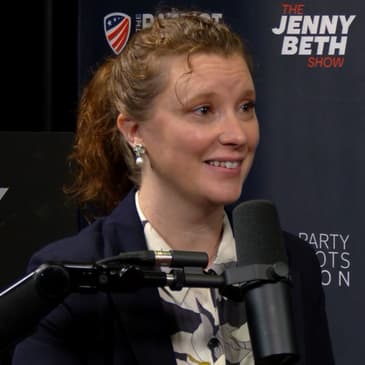
At the Restoring National Confidence Summit in Las Vegas, Jenny Beth sat down with Hannah Joy who is fighting for freedom in deep blue Washington state.
Twitter/X: @RealHannahJoy | @jennybethm
[00:00:00] It clicked for me that nobody's going to come save us.
[00:00:06] No, you have to look in the mirror for the person who is going to save you.
[00:00:10] Right. And it made me very quickly realize our business was lost because of our lack of activism.
[00:00:17] Keeping our republic is on the line and it requires patriots with great passion, dedication and eternal vigilance to preserve our freedoms.
[00:00:26] Jenny Beth Martin is the co-founder of Tea Party Patriots.
[00:00:30] She's an author, a filmmaker and one of Time magazine's most influential people in the world.
[00:00:36] But the title she is most proud of is Mom to her Boy Girl Twins.
[00:00:40] She has been at the forefront fighting to protect America's core principles for more than a decade.
[00:00:47] Welcome to The Jenny Beth Show.
[00:00:49] This episode of The Jenny Beth Show was recorded on Radio Row at Turning Point Action's Restoring National Confidence Summit in Las Vegas.
[00:00:57] I hope you'll be inspired by my next guest.
[00:01:00] Hannah Joy is the executive board representative for Congressional District 3 and the Washington State Republican Party
[00:01:07] and the chairwoman of the Washington State Republican Liberty Caucus.
[00:01:11] She and her family have experienced some awful things at the hands of an extremely overbearing government in a deep blue state.
[00:01:18] But she is not letting that discourage her.
[00:01:21] Listen now, as she explains how she is fighting for freedom in a state where it often seems all hope is lost.
[00:01:28] Hannah, thank you so much for being with us today.
[00:01:31] Thank you for having me.
[00:01:32] And you live in Washington State in the blueest blue.
[00:01:38] How did you wind up in Washington?
[00:01:40] So it's actually kind of a fun story.
[00:01:42] I'm a strong Christian.
[00:01:44] My husband and I feel very strongly that we were led to Washington.
[00:01:48] So I actually was raised and I was born and raised in Savannah, Georgia.
[00:01:51] Yay, my home state.
[00:01:53] And my husband was military.
[00:01:56] He retired out of the military.
[00:01:58] We had had six children at the time.
[00:02:00] He said, I want to raise my kids back in the Great Northwest.
[00:02:02] I want them to go fishing for salmon and hunting for elk.
[00:02:06] And he said, let's go back.
[00:02:08] And I said, okay, let's do this.
[00:02:10] So we were like, oh, my God.
[00:02:12] We're going to go back to the Great Northwest and we're going to go back.
[00:02:15] And then we went down this quite little hardware store at the base of Mount St.
[00:02:21] Helens and we were like, this is going to be our dream life.
[00:02:24] And we're going to go and have a little hardware store and a little white dog
[00:02:28] and some goats and raise our kids.
[00:02:30] And did it turn out like the dream that you envisioned?
[00:02:33] Or was it a nightmare?
[00:02:35] It wasn't a nightmare, but I think it definitely revealed why we were led to go.
[00:02:38] And we very quickly realized that Washington was a very anti-small business.
[00:02:42] We had historically been raised in entrepreneurial homes.
[00:02:46] We both had small businesses in Georgia.
[00:02:49] We understood what business was like.
[00:02:52] But when we landed in Washington and purchased that small business,
[00:02:55] we realized really quickly we weren't going to be able to make a living.
[00:02:58] How did you figure that out?
[00:03:02] I can imagine some ways, but what did you experience?
[00:03:05] It's mostly the over taxation, the over regulation.
[00:03:09] It was this kind of snooty attitude towards small mom and pops.
[00:03:17] Washington pretends to be geared towards big bucks.
[00:03:21] We saw big bucks favor greatly during COVID shutdowns.
[00:03:25] And that was kind of the key.
[00:03:28] So funny is when we first purchased our hardware store,
[00:03:31] the next day after we signed our contract, the mountain caught fire is the Eagle Creek fire.
[00:03:36] And I thought this is not a good sign.
[00:03:40] And then COVID came and that was another realization that this state does not protect individual people,
[00:03:46] does not protect individual rights nor small businesses.
[00:03:49] When did you move to Washington?
[00:03:51] About 2018.
[00:03:53] So 2018, we're now in 2024.
[00:03:57] You've been through a lot of really tough times in Washington.
[00:04:00] And what's happened with your hardware store?
[00:04:04] So we had the hardware store.
[00:04:06] We wanted to run it with our children.
[00:04:08] We want our children to learn mathematics on the register and great interpersonal skills with customers.
[00:04:13] And knowing that it wasn't going to be enough to support our large family,
[00:04:17] we also opened a gun store inside of it.
[00:04:20] Very rural county, a lot of hunting, a lot of fishing,
[00:04:23] a lot of need for just kind of guns that were more for that, geared towards that, right?
[00:04:32] For hunting and sporting and also hunting for food that you're going to be eating
[00:04:38] because you're in a rural community.
[00:04:40] Yes, yes.
[00:04:41] And that's another thing.
[00:04:42] Prices are very, very high in Washington.
[00:04:45] And a lot of people in my district or my county rather, harvest their own food.
[00:04:50] It's almost a necessity and a way of life up there.
[00:04:54] Explain that.
[00:04:56] If you're in the suburb of Atlanta, that is not going to make a lot of sense.
[00:05:01] So most people in that area rely on whatever they can hunt.
[00:05:06] So elk or bear or they raise hog or raise cattle for their main meat source.
[00:05:13] You don't see a lot of grocery stores.
[00:05:16] Actually, we only have two grocery stores in our entire county.
[00:05:20] Wow.
[00:05:21] And they are very small and very expensive.
[00:05:24] So unless you're willing to drive 45 minutes an hour to a large grocery store,
[00:05:28] you have to rely on what you grow or what you harvest.
[00:05:31] And okay, so that's the kind of community that it is.
[00:05:35] Yes.
[00:05:36] And you've got the hardware store, you opened a gun store.
[00:05:39] Did that help you be able to make ends meet?
[00:05:41] It did.
[00:05:42] It was actually really great.
[00:05:44] And actually more than make ends meet,
[00:05:46] it made us have this relationship with the community we never had before.
[00:05:50] We felt very much like I outsider as my first came in.
[00:05:53] And it was kind of the pivotal moment where they were accepting us and like,
[00:05:58] oh, you're one of us.
[00:05:59] Oh, that's great.
[00:06:00] You know, and my husband became commander of the Legion there and was helping veterans.
[00:06:06] We had a large, large group of veterans in this county.
[00:06:09] We didn't even realize we're there.
[00:06:11] And they were in desperate need.
[00:06:13] They were hungry, they were cold, they weren't getting services they need.
[00:06:17] There was no veterans court.
[00:06:19] They were getting unfairly treated.
[00:06:21] And so another aspect of the gun store for him was kind of creating veteran services
[00:06:26] that we would do outside of, I mean, well inside the gun store
[00:06:29] that brought us really close to the community.
[00:06:32] I really love for the community.
[00:06:34] And then what happened?
[00:06:38] How did you realize, you mentioned before that it was not as welcoming to entrepreneurs
[00:06:44] and small business owners.
[00:06:46] So what kind of difficulties did you face?
[00:06:49] Well, mostly it would mean COVID.
[00:06:52] 2020 happened and we were kind of told we were non-essential.
[00:06:56] Hardware store was non-essential.
[00:06:58] A gun store is not non-essential.
[00:07:00] They're two and the same.
[00:07:01] What Seattle doesn't seem to understand is that not everybody lives rule.
[00:07:07] And actually Washington state is mostly rule.
[00:07:11] I'm so sorry, suburban.
[00:07:13] And so when you say a hardware store is non-essential
[00:07:15] where we're almost the only provider for gas,
[00:07:18] we're the only provider for pellets,
[00:07:20] for your pellet stove to keep you alive throughout the winter.
[00:07:23] We provide essential services.
[00:07:25] So that was our first real big hit was like, oh man, right?
[00:07:30] Then they passed a capital gains tax,
[00:07:33] which is just incomes tax and disguise.
[00:07:35] Then they created laws that prevented our police officers from doing their jobs,
[00:07:40] which created this really big issue of smashing grabs
[00:07:44] and small mom and pops that were completely unenforceable.
[00:07:49] On top of that, you couldn't claim insurance on it
[00:07:52] because it would make your insurance rise.
[00:07:54] And it was COVID was a horrible, horrible time
[00:07:58] and we kind of realized that moment that we're not sure if we're going to make it.
[00:08:04] And so we signed a lawsuit with Freedom Foundation.
[00:08:08] They do amazing work.
[00:08:11] They were so great.
[00:08:13] They came out to the store and they said, here's what we're doing.
[00:08:15] We want to say it's your first amendment right to allow somebody in your store
[00:08:19] if you want to sell to them without a mask.
[00:08:22] I said, absolutely, we're not going to discriminate against anybody.
[00:08:25] In fact, by allowing them to come into our store,
[00:08:29] what we saw was essentially saving lives.
[00:08:32] Some of these people didn't have any other means.
[00:08:35] It went nowhere.
[00:08:38] It went nowhere.
[00:08:40] We were, Ellen and I were sent out to our store.
[00:08:42] We had an amazing share of labor and industry.
[00:08:46] So we had a group in our county that would repeatedly call this snitch hotline.
[00:08:51] And it was an anonymous snitch hotline saying...
[00:08:54] I like the Soviet Union.
[00:08:56] Very.
[00:08:57] And they said, we see people going in there without masks.
[00:08:59] They're letting them in.
[00:09:00] They're actually selling them things.
[00:09:02] And so...
[00:09:03] How dare you?
[00:09:05] Week after week.
[00:09:06] And so finally Ellen and I came out and they're like,
[00:09:08] hey, we've gotten like 35 calls that you're violating the law.
[00:09:12] We called the sheriff's office and we're like, we need backup.
[00:09:16] Sheriff's amazing came out.
[00:09:18] It was like, you want them out of your store?
[00:09:19] We'll get them out of your store.
[00:09:21] You know, we don't play with this.
[00:09:23] And we obviously didn't.
[00:09:25] We worked with them, but they didn't shut us down.
[00:09:28] But we definitely got some slaps on the wrist.
[00:09:32] It's eye-opening to live in America, small mom and pop shop.
[00:09:38] Your kids are the workers.
[00:09:40] And to have somebody from the state come out and say you're violating a law
[00:09:44] by allowing somebody to come into your store to buy pellets to stay alive through the winter.
[00:09:48] It's just unreal.
[00:09:50] How did it make you feel?
[00:09:52] Angry.
[00:09:54] Very angry.
[00:09:56] This community we had grown to love, they had grown to love us.
[00:10:00] We wanted to protect them and help them.
[00:10:02] And yet we were told no.
[00:10:04] And oftentimes we're told that the progresses over the ones of the love, right?
[00:10:08] They're the ones who want to see the small man make it so far from the truth.
[00:10:14] It made me angry.
[00:10:15] It's like I got involved in politics.
[00:10:18] Okay.
[00:10:19] Now, I want to talk about politics, but before we go completely into that,
[00:10:24] the fate of your hardware store was not a good fate, was it?
[00:10:31] It wasn't.
[00:10:32] We ended up selling it for...
[00:10:35] I don't want to reveal too much, but we ended up selling it for definitely less than it was worth
[00:10:39] just for the fact that we needed to liquidate.
[00:10:42] We had... Our gun store was attacked in the sense that after signing the Freedom Foundation lawsuit
[00:10:49] a couple years later, we got hit with this very mysterious audit from the state of Bob Ferguson.
[00:10:55] It's just very random.
[00:10:57] And we had an amazing accountant out of Oregon who kept our books to a T, just wonderful.
[00:11:02] Can't say enough about it.
[00:11:03] And at one point she said you have to stop talking to them.
[00:11:06] Don't talk to them anymore because they are looking for things to get you on.
[00:11:10] I can't even tell you the amount of what are you talking about?
[00:11:14] Well, this, this and this and this and this.
[00:11:17] But your lawsuit was about First Amendment rights.
[00:11:20] Absolutely.
[00:11:21] And then your accountant was telling you not to speak, not to exercise your First Amendment rights
[00:11:25] because if you did, then it would harm your business.
[00:11:29] So it compounded the First Amendment problems.
[00:11:32] Yes.
[00:11:33] Yes, it did.
[00:11:34] And we ended up actually just...
[00:11:38] We compromised in order just to say what little we had left of savings in order to just close the business,
[00:11:46] surrender our FFL and say kind of you won in a sense.
[00:11:51] And it was heartbreaking because we weren't the only one.
[00:11:54] Most every small mom-and-pop gun store in Washington is now closed to stores.
[00:11:59] I'm not... I could be any name off of my two hands, any that are left in the state.
[00:12:04] How did you feel the day that that happened when you closed everything and you sold it?
[00:12:11] What was going through your mind and your emotions and the conversations with your husband?
[00:12:15] Run, leave, save your kids.
[00:12:21] That's what we were feeling.
[00:12:24] Just the constant attack of just trying to be left alone and just be alone.
[00:12:32] Raise my kids, help my community, love my neighbor.
[00:12:35] It's all we wanted.
[00:12:36] That's all we were out for.
[00:12:38] And I kind of say they created a beast because after we liquidated everything and we got our store shut down
[00:12:45] and we had to sell this and that, I said, that's it.
[00:12:48] We're going to go full-time politics.
[00:12:51] Okay.
[00:12:52] And so you became active?
[00:12:54] And had you ever been active before?
[00:12:56] Never.
[00:12:57] Okay.
[00:12:58] Never.
[00:12:59] I mean your husband was in the military.
[00:13:00] You were already giving your-
[00:13:01] Now you make me feel bad.
[00:13:02] Yeah, my husband was in the military but I was never active.
[00:13:04] But you were serving the country by being a military family and that's incredibly important.
[00:13:09] And so now all of a sudden you're thrust into activism.
[00:13:12] Not by choice either.
[00:13:15] Not by choice at all.
[00:13:16] Actually it's kind of funny.
[00:13:18] I got invited to the Republican Party in my county and I'm like, that's it.
[00:13:22] I'm going to go tell them what for.
[00:13:24] I'm going to go tell them that they aren't protecting me,
[00:13:27] that they're not doing what they should be doing,
[00:13:29] that my rights are being trampled.
[00:13:31] And I went to this meeting and I said my piece and then everyone just kind of looked at me like I was lost it.
[00:13:39] Looking back on it now, yeah, I had lost it for a second.
[00:13:43] And they said, huh, you should become a PCO and solve all the world's problems.
[00:13:48] I will.
[00:13:49] And a PCO for those who don't know what is a PCO?
[00:13:53] It's a precinct committee officer.
[00:13:55] Okay.
[00:13:56] I ended up not becoming a precinct committee officer.
[00:13:58] I ended up becoming a state committee woman,
[00:14:00] which represents our county at the state committee.
[00:14:04] And I did it with every ounce of my being.
[00:14:10] I tried to be the best state committee woman I could be because I was trying to prevent what happened to us to anybody else.
[00:14:17] And that is when I began talking to legislators and senators and diving deep into RCW,
[00:14:23] Revised Code of Washington and learning about policy and legislation.
[00:14:27] And it clicked for me that nobody's going to come save us.
[00:14:33] No, you have to look in the mirror for the person who's going to save you.
[00:14:37] Right.
[00:14:38] And it made me very quickly realize our business was lost because of our lack of activism.
[00:14:44] Well, in your defense, we all have to be active.
[00:14:50] All of us have to be active.
[00:14:52] When you have that much pressure bearing down on you from the government,
[00:14:55] it's very difficult individually to be able to stop the full weight and force of state government or the federal government.
[00:15:03] Yeah.
[00:15:04] So don't beat yourself up too much about that because what you went through were extraordinary circumstances
[00:15:13] and insinuating circumstances in some ways.
[00:15:16] Yeah.
[00:15:17] Yeah, predictable.
[00:15:18] When I want to come back to your activism, but I just wanted to, we just met today.
[00:15:23] So you don't know a lot about me.
[00:15:25] And I want to let you know that when COVID first happened, my now ex-husband and I, he went through a business failure
[00:15:34] and we lost everything.
[00:15:36] We've been through bankruptcy.
[00:15:38] We lost our cars.
[00:15:39] We just everything.
[00:15:41] A garage sale where you're selling every single thing that is worth anything so that you've got money just to pay utilities
[00:15:47] and make sure you've got food for your kids.
[00:15:49] Right.
[00:15:50] I've been through that.
[00:15:51] I know how hard that is.
[00:15:52] And when I hear stories about people whose business failed, I'm always very, very sensitive to it.
[00:15:58] But ours were a result of business problems that we cannot blame on the government.
[00:16:08] He did expand into California and that created some of the problems, which are what you have dealt with.
[00:16:15] So there was some of those issues, but still at the end of the day, it isn't anything like what you've experienced
[00:16:20] or the people who had government weaponized against them who were losing everything just trying to stay out of prison.
[00:16:27] But when the government shut down in 2020, I was on Steve Bannon's podcast, the day he launched war room pandemic
[00:16:36] or the day after, like right around the time he was launching it.
[00:16:40] And he's like, you need to check out what is going on with this.
[00:16:45] So this virus that's moving around the world.
[00:16:47] So I was paying attention to that back in January and we didn't shut down till mid-March.
[00:16:53] And so throughout all of January and all of February, I was learning every single thing I could,
[00:16:58] paying attention to what was happening to China.
[00:17:02] My kids wanted a mission trip out of the country.
[00:17:04] So I was tracking the virus around the world to make sure they weren't going to get stuck out of the country.
[00:17:09] Because we were in high school at the time, going with a church group and no one else was paying attention to it.
[00:17:13] But I travel all the time through that's something that I at least knew enough to kind of pay attention to.
[00:17:18] Okay. So all this is going on as we lead into March.
[00:17:21] And I was telling everyone two weeks before we shut down, we are about to shut down the country.
[00:17:27] The entire supply chain is going to be messed up.
[00:17:30] Oh, yes.
[00:17:31] I cannot explain to you how badly it's going to be messed up because if China shut down in January,
[00:17:37] it's going to take six to eight to 12 weeks for the product that would have been coming here to America not to be here.
[00:17:44] And I knew that from work that I did in logistics when I programmed computers.
[00:17:49] And people just looked at me like it was crazy and I said, we're about to have economic problems.
[00:17:54] This is going to be bad.
[00:17:55] Well, then we shut down and I'm like, okay, see, I told you.
[00:17:59] But for the first two weeks, we're very calm.
[00:18:01] Like, okay, we'll support this.
[00:18:03] We're not going to be out attacking it after 14 days or 15 days to slow the spread.
[00:18:08] My organization Tea Party Patriots Action and I were privately speaking to people in the White House and you have to reopen the country.
[00:18:17] What in the world are you doing?
[00:18:19] The country must be reopened because if you don't, you are going to crush small businesses.
[00:18:23] Oh, yeah.
[00:18:24] They're going to go bankrupt.
[00:18:25] They're going to lose their companies.
[00:18:26] Yes.
[00:18:27] And I don't know what this is like.
[00:18:28] I don't want that for anyone.
[00:18:30] Yeah.
[00:18:31] And then we came out more publicly and more forcefully about it.
[00:18:36] But my point is the world went through so many problems and some of them were so predictable.
[00:18:42] But then in Georgia, Governor Kemp was like the first one to reopen.
[00:18:48] Yes.
[00:18:49] And DeSantis and Christina Ommel say they didn't shut down, but Kemp, his shutdown was so limited.
[00:18:54] And then when he opened, it was so...
[00:18:56] He got rid of the limitation.
[00:18:58] So the seat was really the free estate in the country.
[00:19:02] I really think maybe North Dakota or South Dakota was the same.
[00:19:07] But it was really...
[00:19:09] He did a great job with that and he was careful for small business owners.
[00:19:13] And he was attacked for it.
[00:19:15] And I was like, I am defending this man.
[00:19:17] Yeah.
[00:19:18] He said in an interview, I don't want people to go broke.
[00:19:20] Right.
[00:19:21] I mean, he got it.
[00:19:22] And so what he did versus what Washington state did are so completely different.
[00:19:29] What he did versus Chicago and New York and Illinois and in California, completely night and day.
[00:19:37] And yet the COVID outcomes are pretty much equal.
[00:19:40] It didn't matter.
[00:19:41] But the business and economic outcomes between the states are not equal.
[00:19:46] And what you went through in the tyranny you experienced is infuriating.
[00:19:51] And there was even kind of a tear to the stack.
[00:19:54] Not only was the shutdown detrimental small businesses by making us discriminate on what business we were allowed to take in,
[00:20:01] but also telling us we had to shut our doors.
[00:20:04] And then this offering of governmental assistant money with supposedly no strings attached,
[00:20:10] which now in 2024 many of those small businesses took the PPP loan or took those loans
[00:20:16] are now having to find them being paid back immediately,
[00:20:19] which is shutting their business down.
[00:20:21] This was such a domino effect against small businesses in the state of Washington.
[00:20:26] I just can't even explain to you how awful it was.
[00:20:30] So when we met just a little while ago, one of the first things I said to you is how's your house?
[00:20:34] How is your personal guarantees?
[00:20:37] Because and I was warning business owners who I taught you in 2020.
[00:20:41] I'm like, if you're signing a loan, you make sure it's a business signing the loan
[00:20:46] that you personally signing it.
[00:20:48] Because if you don't, if you're not careful for that in five or 10 years from now,
[00:20:52] your own home may be at risk and you're not thinking of it in the crisis
[00:20:57] because you're so desperate to save the company.
[00:21:00] But you have to pay attention to your home first.
[00:21:05] And I'm glad that I hate what you went through,
[00:21:08] but I'm also glad that you still have a home right now.
[00:21:11] So one benefit of homeschooling is you get to pick your curriculum.
[00:21:15] And one of the years for one of my high school students was learning people like Frederick Bastiat
[00:21:21] and learning all about these ideas of socialism and how they affect people.
[00:21:27] And when 2020 hit, I saw it a mile away.
[00:21:30] Yeah.
[00:21:31] I was like, whoa, we just went through this study.
[00:21:33] And so we took our savings and we did.
[00:21:35] We purchased our house and we thought, okay, if it all goes really bad,
[00:21:40] at least we'll have land to grow food on.
[00:21:42] At least we'll have land to grow cattle on.
[00:21:44] I mean, we were really preparing.
[00:21:46] We were talking to our friends like who's going to take care of this resource and this resource.
[00:21:52] When you live in a rural county that is completely dependent on each other,
[00:21:57] you really have to go that far because we were talking about,
[00:22:00] are they going to shut down the highways or are we going to be able to get in the city?
[00:22:03] What is it?
[00:22:05] Well, we had no idea.
[00:22:06] It wasn't out of the...
[00:22:07] It was smart to be thinking that way.
[00:22:09] Yeah.
[00:22:10] Our governor at one point said,
[00:22:11] make sure you look into the windows of your neighbors.
[00:22:13] And if you see they have friends over for Thanksgiving, call the Snitch Hotline.
[00:22:16] Yes, Soviet Union in Washington state.
[00:22:20] Okay, so now you're active.
[00:22:21] Yes.
[00:22:22] You're in the state committee.
[00:22:23] Yes.
[00:22:24] You are not just in the state committee, but you have a bigger position
[00:22:30] than just state committee woman from your county now, right?
[00:22:32] Yes, definitely not a bigger position.
[00:22:34] I say the largest position in the state party is a precinct committee officer.
[00:22:38] Okay.
[00:22:39] They are the greatest because they have the most influence, the most close connection to
[00:22:44] the actual voters.
[00:22:45] And then I actually don't have a position on the state committee.
[00:22:49] I have a position on the executive board.
[00:22:52] Okay.
[00:22:53] And I see myself as the person to disseminate information and resources that I gather from
[00:22:58] everywhere to bring downward to them so that they can do the great work of contacting
[00:23:04] those voters and getting them out and giving them the resources they need.
[00:23:09] So I am excited about this, being an executive board member, but I'm even more excited about
[00:23:15] running for RNC member as national committee woman because one of the greatest things
[00:23:20] we see is a lack of good communication, a lack of transparency.
[00:23:24] And there's very much like the supply chain.
[00:23:26] There's a broken chain of information from the top to the bottom.
[00:23:31] And it's got to stop because the bottom is where it's at, right?
[00:23:34] Right.
[00:23:35] As we were preparing to be here at this conference, we're trying to train local leaders and county
[00:23:43] leaders so that they can be ready to secure and win in the fall.
[00:23:47] But for a party chairman or a leader locally in a county to be ready for poll watchers
[00:23:57] and poll workers and the other work that must happen in the fall and the voter ID and getting
[00:24:01] out the vote, there's a lot of groundwork that has to happen in January, February and March
[00:24:05] to be ready for the influx of volunteers later in the year.
[00:24:09] And I reached out to a county party chairman in Georgia and I said, hey, do you have a
[00:24:15] workbook or anything?
[00:24:16] Is there any kind of manual to help you prepare so you know what you're doing?
[00:24:20] Because I was going back through looking at all the materials that I've had and accumulated
[00:24:24] over the years.
[00:24:25] And she said, no, we don't have anything like that.
[00:24:28] We have a precinct committee manual but that is it.
[00:24:33] Right.
[00:24:34] And I said, okay, so I have to figure that out before Monday and this is on Friday just
[00:24:39] a few days ago.
[00:24:40] But the lack of communication, the lack of tools that a brand new volunteer person who
[00:24:48] is stepping up to be a chairman of a party or stepping up to be a vice chairman or even
[00:24:53] starting a local group, whether it's a pro-life group or a conservative group or a
[00:24:59] liberty group or whatever.
[00:25:00] It might be any of those, there are things you have to do to be prepared if you're trying
[00:25:04] to get out the vote in an election year.
[00:25:07] And what you're talking about that broken chain, we have to figure out a way to put
[00:25:11] it back together.
[00:25:12] Yeah.
[00:25:13] And I'm actually really proud of Washington.
[00:25:15] So we have a new chair now.
[00:25:16] He's actually sitting in the legislature so he flipped his district from blue to
[00:25:20] red.
[00:25:21] And he came in and he was ready to go, bowl in a China shop.
[00:25:25] And previous to him, a lot of us had been coming together doing things like ballot
[00:25:30] harvesting and yes, legal and state Washington.
[00:25:32] Right.
[00:25:33] There we go.
[00:25:34] And you have all mail-in ballots in Washington.
[00:25:36] A hundred percent mail-in ballots.
[00:25:37] There's nowhere to vote in person.
[00:25:41] With exception, maybe you can go to your auditor's office, fill out your mail-in
[00:25:44] ballot and that's it.
[00:25:45] But we came up with ideas that were out of the box thinking.
[00:25:50] We decided that the RNC was not going to provide us what we needed.
[00:25:54] And the infighting was not going to help us at all, that we had to go past and
[00:25:58] beyond that.
[00:25:59] Right.
[00:26:00] And we had to create our own systems of information or our own systems and our
[00:26:03] own ways of reaching the voters.
[00:26:06] So a lot of voters in the state of Washington have gone independent.
[00:26:09] They see, well, along with extreme voter apathy, I mean less than 40% voter
[00:26:16] turnout.
[00:26:17] The majority of voters don't vote in a state of apathy, especially for
[00:26:19] Republicans who've just been hounded and told over and over again that their
[00:26:23] vote doesn't matter.
[00:26:25] They're not even told they're a minority.
[00:26:28] They're told that they are the problem.
[00:26:30] And it's heartbreaking because actually I got a good story on this one.
[00:26:34] I started a newspaper to combat this biasness.
[00:26:39] I published it.
[00:26:40] My own money.
[00:26:41] I took my savings.
[00:26:42] I published this and started this newspaper.
[00:26:44] This letter from this mom of two, and she goes, I thought I was the only one.
[00:26:50] She said, I never knew there were other people in this county who thought like me, and I
[00:26:54] was too scared to talk about it.
[00:26:57] And that newspaper for that woman was just what she needed to keep going.
[00:27:02] And I often think how many voters in the state of Washington feel like they are absolutely
[00:27:07] the only one.
[00:27:08] And I guarantee you there's enough of them to flip districts if we reached out
[00:27:12] to them.
[00:27:13] And I'm sure you're right about that in Washington.
[00:27:15] And I also think across the entire country, there are a lot of voters who would love to
[00:27:19] step up and volunteer in some way.
[00:27:21] They just don't know how and they've never been asked and they've not connected.
[00:27:26] And they're scared.
[00:27:27] I mean, the reality is they're scared.
[00:27:29] We don't see any less of a tax, right, for our conservatism.
[00:27:33] Some of my friends are facing indictment in Georgia.
[00:27:36] Yes.
[00:27:37] Yeah.
[00:27:38] And a lot of us are facing our business being shut down.
[00:27:40] Right.
[00:27:41] And we're targeted by the IRS.
[00:27:43] And donors to the Tea Party were individually targeted by the IRS.
[00:27:46] So yes, all of that, it has a chilling effect.
[00:27:51] It does.
[00:27:52] One of the things that made us kind of really upset during COVID was there was a competing
[00:27:55] hardware store in the next town over and they were very much discriminating.
[00:27:59] Like you couldn't even be on the property without a mask on.
[00:28:03] You had to social distance.
[00:28:05] They went moneyless, contactless.
[00:28:08] And a lot of our people were angry and they came over to our store and they're like, I can't
[00:28:11] believe they would do that to me.
[00:28:12] I've been with them for 25 years and I gave them my business.
[00:28:17] And then the moment the mask made it through lifted, the loyalty was gone.
[00:28:22] And it just made me think we often see progressives.
[00:28:28] They will promote a business and say, go save them.
[00:28:32] Go give them their business.
[00:28:34] Boycott them, boycott them.
[00:28:36] Don't boycott them.
[00:28:37] Listen, when it comes to the conservatives, we don't have the same mentality.
[00:28:41] I'm not necessarily getting angry about it.
[00:28:44] I'm confused and would like to know more about that phenomenon and why conservatives don't
[00:28:49] do that same thing.
[00:28:50] It would have saved tens of thousands of small businesses.
[00:28:55] I think it was close to 21,000 small businesses died within the time COVID hit to today.
[00:29:02] 25,000 families left the school district in 2020 to 2021 because the vaccinations and masking
[00:29:11] and well now we have DEI and all of the awful things have come down.
[00:29:16] Families are just hopeless and I'm no longer going to be hopeless and I'm no longer going
[00:29:21] to live in fear.
[00:29:23] So my campaign and everything that I'm talking to voters about is we're no longer functioning
[00:29:28] off of fear.
[00:29:29] You're no longer to function off the fear of kids being taken and your business
[00:29:32] being taken.
[00:29:33] We're going to function off of hope, hope that we did it once when we created this great
[00:29:38] nation.
[00:29:39] We can absolutely do it again.
[00:29:42] It just takes remembering.
[00:29:44] That's exactly right.
[00:29:46] If someone's listening to this and it's the first time that they've heard about
[00:29:51] the thing, I mean it's the first time they've heard of you but it's the first
[00:29:54] time that they've thought about how else they can be active.
[00:29:58] What are things that you would recommend to them to do generally speaking and then in
[00:30:02] Washington state specifically?
[00:30:04] Talk to your neighbor.
[00:30:05] I guarantee you guys have something in common.
[00:30:08] You like to bake, bake something, bring it to them.
[00:30:11] I found so many times when I would canvas in these large neighborhoods nobody even
[00:30:16] knew who their neighbor were.
[00:30:18] They didn't know if they had children, they didn't know their name, they knew
[00:30:21] what they drove but that was about it.
[00:30:23] And the isolation was so palpable.
[00:30:26] It was dystopian.
[00:30:30] And so if I could say if you want to get active but you're worried the first thing
[00:30:33] you should do is reach out to your neighbor.
[00:30:35] That's the first step.
[00:30:37] Just go knock on their door and say hi.
[00:30:38] It doesn't have to be political but just by passing that one barrier is the
[00:30:43] beginning of us healing our nation and healing the divide and the
[00:30:46] misunderstandings of each other and that would go a long way.
[00:30:50] I think that that is so important.
[00:30:52] It's building those relationships and it's remembering that United we stand in
[00:30:57] this country.
[00:30:58] If we don't find a way to unite with our fellow Americans, our country is in
[00:31:03] really deep, deeper trouble than we can even imagine.
[00:31:06] Absolutely.
[00:31:07] A lot of Washington state's problems are not partisan.
[00:31:11] And once we stop thinking in a partisan way and just reach out in love
[00:31:15] and say how are you struggling?
[00:31:17] What is this law affecting you?
[00:31:19] It doesn't have to be a partisan issue, right?
[00:31:21] How are you dealing with the fact that you have no child care?
[00:31:24] How are you dealing with the fact that gas is $6 a gallon?
[00:31:27] How are you dealing with a mileage tax on top of that and increase in property tax?
[00:31:31] How are you dealing with paying into a Washington Cares fund for your entire
[00:31:35] life without being able to get anything back for 10 years and then you only get
[00:31:40] two and a half months of care?
[00:31:42] How are you dealing with the fact that you are struggling?
[00:31:46] And then let's fix that, right?
[00:31:52] And you mentioned the new state party chairman flipped a legislative district.
[00:32:00] So he was the one who flipped it.
[00:32:01] He's the legislator that flipped it.
[00:32:03] Right.
[00:32:03] And I hope that you are working with others who are running for office
[00:32:07] across the state of Washington who are working to do that this year.
[00:32:11] They need to hear from you.
[00:32:13] You need to go campaign around the state so that other people can hear from
[00:32:17] you so that they'll vote to help flip Washington.
[00:32:20] If not from blue to red, at least from blue to purple.
[00:32:23] Right.
[00:32:24] We do.
[00:32:25] Deep blue to turquoise or something.
[00:32:28] We're working it.
[00:32:29] So this year I represent CD3, which is Joe Kent's district.
[00:32:33] He's running for Congress.
[00:32:34] He's probably made the news several times.
[00:32:37] And we have a plan this year to do active canvassing like we've never seen before.
[00:32:44] I personally have knocked on thousands of thousands of doors for candidates across our state.
[00:32:48] I'll drive three or four hours to knock on doors for candidates that I truly believe in
[00:32:53] because I know that's what it takes.
[00:32:55] It takes feet on the ground.
[00:32:57] And sometimes I'll bring my kids because nothing like good civic lesson.
[00:33:01] Yeah.
[00:33:02] But by doing is inspiring.
[00:33:05] By telling is not inspiring.
[00:33:07] Right.
[00:33:07] And so as long as I am still being active in these campaigns by volunteering my time
[00:33:12] to phone call and canvas and stuff, envelopes and put stickers on.
[00:33:18] That is the hope that I can inspire others to the same.
[00:33:20] And it is catching on.
[00:33:22] We are finally seeing CD3 major unity.
[00:33:25] We're seeing people coming together and doing these things they would have never done before
[00:33:29] because they're too scared because they see others doing it.
[00:33:32] So I am very excited this year for 2024.
[00:33:35] I have full faith that we'll be flipping seats.
[00:33:39] We actually just flipped a seat in Yakima.
[00:33:41] Matt Brown, who's running with me as National Committee man, did a ballot
[00:33:45] harvesting program this off season and ended up flipping 15 out of 22 races
[00:33:51] in his district, one that had never in the history of Washington been read before.
[00:33:55] And so we know it's doable.
[00:33:57] It's amazing work.
[00:33:58] Yes. Yes.
[00:33:58] And with very little money, that's another thing people think you need
[00:34:01] massive and massive amounts of money to flip these races.
[00:34:05] You really don't.
[00:34:05] You need really good planning, really good strategy and you need some flat
[00:34:10] foot. So you need people out there just doing what they're doing.
[00:34:12] Right. Right.
[00:34:13] Well, that is great.
[00:34:14] I'm so excited about the work that you're doing in Washington.
[00:34:17] And I hope that as people have listened to this and watched this,
[00:34:21] that they have a little bit of hope about Washington state.
[00:34:23] It's people like you who are on the last line in Washington state
[00:34:27] and you're holding that line.
[00:34:29] And I appreciate that very much about you.
[00:34:31] Well, thank you.
[00:34:32] I appreciate it.
[00:34:33] There's too many out there who don't have a voice yet, and I will be
[00:34:36] it for them until they find it.
[00:34:39] I am Jenny Beth Martin with the Jenny Beth Show, and we are at Turning Point
[00:34:42] Actions Restoring National Confidence Summit.
[00:34:45] And it were on media rows.
[00:34:46] So you might have heard a little bit in the background.
[00:34:48] Mike Lindell is somewhere over there.
[00:34:50] So you might even hear his voice a little bit.
[00:34:52] But it's really great.
[00:34:53] Thanks for joining us today.
[00:34:55] The Jenny Beth Show is hosted by Jenny Beth Martin, produced by Kevin
[00:35:00] Mooneyhand and directed by Luke Livingston.
[00:35:04] The Jenny Beth Show is a production of Tea Party Patriots Action.
[00:35:08] For more information, visit teapartipatriots.org.
[00:35:15] If you liked this episode, let me know by hitting the like button
[00:35:18] or leaving a comment or a five star review.
[00:35:21] And if you want to be the first to know every time we drop a new
[00:35:24] episode, be sure to subscribe and turn on notifications for whichever
[00:35:28] platform you're listening on.
[00:35:30] If you do these simple things, it will help the podcast grow.
[00:35:33] And I'd really appreciate it.
[00:35:35] Thank you so much.