
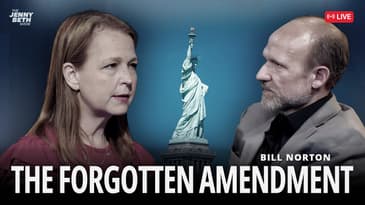
There is an amendment in the Bill of Rights that the Supreme Court has cited on only a few occasions in two hundred years. Scholars have taken to calling it the forgotten amendment, or the lost one. Constitutional scholar Bill Norton says the reason it went unused is not neglect. It is a misreading that started at the very beginning and never got corrected, and it costs you rights every time Washington claims a power it was never handed.
Here is the argument. The Ninth Amendment says the enumeration of rights in the Constitution shall not be construed to deny or disparage the rest. Almost everyone reads that as a note about the Bill of Rights. It cannot be. The Bill of Rights did not exist yet when the Ninth was written and sent to the states for ratification. So when it says enumerated in the Constitution, it means the whole document. James Madison worked this out in letters with George Washington and put it plainly: protecting rights is the same thing as limiting powers, two sides of one coin. Every limit on power in the Constitution is a right being protected. Which means every time a power gets stretched, invented, or read away, a right goes with it.
That is the spine of the hour. Around it, Bill Norton and Jenny Beth Martin close out the four-lesson founding principles series: the natural law principle behind the Second Amendment, which he says is simply the right of self preservation; why the founders threw out the word tolerance in favor of freedom of conscience; John Adams on how mixing religion and government corrupts both; the trial of William Penn, the jury held without food or sleep, and the not guilty verdict no judge could overturn; the consent principle buried in the least exciting amendment in the Bill of Rights, and how Arizona's own pandemic statutes got ignored; and the James Madison letter that Article Five opponents have been quoting out of context for years.
Guest: Bill Norton, constitutional scholar and author of Behind the Bill of Rights, co-authored with Jeremy Nelson of the National Center for Constitutional Studies.
Jenny Beth Martin also takes a moment in this episode to press the Senate on the SAVE America Act, the Safeguard American Voter Eligibility Act, the bill requiring proof of citizenship to register to vote. The Capitol switchboard is 202-224-3121.
Get the full four-lesson founding principles training at teapartypatriots.org/1776. More at jennybethshow.com and teapartypatriots.org.
00:00 — Cold Open: The Last Lesson in the Founding Principles Series
01:12 — Behind the Bill of Rights, and the Three Books
03:28 — What Surprised Him About the Founders
05:57 — The Second Amendment and the Right of Self Preservation
10:51 — Freedom of Religion, or Freedom of Conscience
15:08 — Thomas Paine and George Washington on Tolerance
19:56 — John Adams: Religion and Government Corrupt Each Other
21:51 — The Paradox of Tolerance and Cancel Culture
29:20 — Jury Nullification and the Trial of William Penn
41:24 — The Third Amendment and the Principle of Pre-Consent
44:24 — Arizona's Governor and the Wrong Emergency Sections
47:55 — Jenny Beth Martin on the Fight to Reopen the Schools
50:52 — The Foreign Intelligence Surveillance Act and On-Call Judges
53:09 — The Ninth Amendment We Have Been Reading Wrong
58:52 — Enumerated in the Constitution, Not the Bill of Rights
1:02:47 — The Amendment the Supreme Court Barely Cites
1:03:55 — Madison, Patrick Henry, and the Virginia Ratification Fight
1:06:58 — An Aside on the SAVE America Act and Proof of Citizenship to Vote
1:08:14 — What Madison's Letter About a New Convention Really Says
1:13:15 — Two Hundred Fifty Years, and a Government You Can Change
#JennyBethShow #NinthAmendment #BillNorton #BillOfRights #JamesMadison #JuryNullification #FoundingPrinciples #FreedomOfConscience #ThirdAmendment #TeaPartyPatriotsAction