
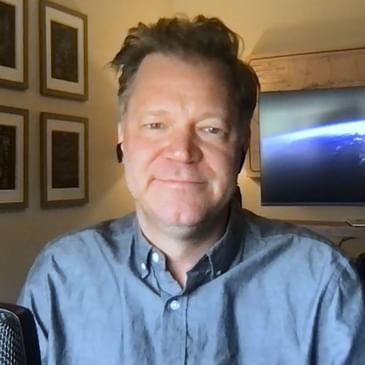
In this episode of The Jenny Beth Show, Jenny Beth Martin speaks with Justin Folk, director of the thought-provoking film Am I Racist?, available on Daily Wire Plus. Justin shares his journey from Hollywood filmmaking to directing documentaries that challenge divisive narratives around race in America. Through humor and satire, Am I Racist? critiques the DEI industry and exposes the contradictions and hypocrisies in today's anti-racism culture. Justin explains why comedy is a powerful tool for tackling sensitive topics, making the film a unique blend of insight and entertainment. Listen in as they discuss the impact of DEI policies, the importance of unity, and how everyday Americans are responding to these critical issues.
Twitter/X: @JustinFolk | @jennybethm
Website: get.dailywire.com
[00:00:00] Growing up in the 90s, I never thought much about race.
[00:00:03] What's happening in this country, it's Nazism.
[00:00:05] Republicans are Nazis.
[00:00:06] I'm gonna sort this out.
[00:00:07] I need to go deeper undercover.
[00:00:09] They gon' say I'm racist.
[00:00:10] Joining us now is Matt, certified DEI expert.
[00:00:13] Here's my certification.
[00:00:15] What's up with white people?
[00:00:16] What are you doing to decenter your whiteness?
[00:00:19] Who's making it to the center? Why are they doing that?
[00:00:21] And what you're doing is you're stretching out of your whiteness.
[00:00:24] This is more for you and less for you.
[00:00:25] Am I Racist?
[00:00:27] Now streaming only on Daily Wire Plus.
[00:00:30] Keeping our Republic is on the line.
[00:00:32] And it requires patriots with great passion, dedication, and eternal vigilance to preserve our freedoms.
[00:00:39] Jenny Beth Martin is the co-founder of Tea Party Patriots.
[00:00:43] She's an author, a filmmaker, and one of Time Magazine's most influential people in the world.
[00:00:48] But the title she is most proud of is Mom to her Boy Girl Twins.
[00:00:53] She has been at the forefront, fighting to protect America's core principles for more than a decade.
[00:00:59] Welcome to the Jenny Beth Show.
[00:01:02] In today's episode, I'm joined by Justin Folk, the director of Matt Walsh's thought-provoking and hilarious film, Am I Racist?
[00:01:10] We dive into everything you want to know about this powerful documentary and what Justin would like to see the film accomplish.
[00:01:17] You won't want to miss this insightful conversation with Justin Folk.
[00:01:21] Justin, thank you so much for joining me today.
[00:01:24] Thanks for having me.
[00:01:25] Appreciate it.
[00:01:26] So you have been in the entertainment industry for a long time, and you have shifted from film making with fictional films to documentaries.
[00:01:38] Why did you make that shift?
[00:01:42] Yeah, I was part of the mainstream sort of Hollywood industry for a number of years.
[00:01:47] And those were good years.
[00:01:49] I learned a lot.
[00:01:50] But I really, after some time, I realized that sort of what I was involved with, what I was making, didn't reflect my worldview.
[00:01:58] It didn't really reflect the values that I was trying to promote in life.
[00:02:02] And so I made a shift.
[00:02:04] And I made a shift into being my own content maker, being my own content creator, directing my own films, and really trying to have an impact on the war of ideas.
[00:02:15] You know, I love this country, and I wanted to make movies that were much more pro-American, I guess, since Hollywood wasn't doing that.
[00:02:23] And thankfully, there's been a lot of opportunity there because the audience is still there.
[00:02:28] The audience still wants this stuff.
[00:02:31] And Hollywood has sort of, you know, advocated its responsibility to make films that actually talk about America in a true way and an inspiring way.
[00:02:41] And so there's been some real opportunity there to make movies that do so.
[00:02:46] So it's been exciting to make my own films.
[00:02:49] What I find interesting about that is that you shifted from mainstream Hollywood to working on documentaries so that you could do films that are more about your worldview.
[00:03:01] And in doing those films, you aren't just educating people about their worldview and your worldview, but you're motivating them and inspiring them to take action and then make a positive change and have a real impact on the country that you love.
[00:03:18] Now, with the latest film, Am I Racist? What do you think about it? And what was surprising to you as you made the film? And what do you think might happen as a result of creating this documentary?
[00:03:32] It is a difficult issue for people to talk about in the case of race and racism in our country.
[00:03:38] And so I'm hoping the film gives people courage to speak out and really say what they truly believe.
[00:03:44] And in this case, we've had a society that's been plagued by these what they call anti-racist experts or grifters is what I like to call them that have been pushing this divisive ideology on all of us.
[00:03:58] And listen, we have a very polite society. Nobody wants to be called a bigot or hateful or any other thing.
[00:04:04] So in a lot of ways, people have gone along with it for a long time.
[00:04:09] And and so what surprised me in terms of making the film is that there are so many more people with common sense than this that don't really believe in this thing and don't don't think that we need to obsessively focus on race and make race and skin color the number one thing in our society.
[00:04:28] You know, Martin Luther King taught us that we need to be moving away from that.
[00:04:31] And that was quite some time ago. And somehow, you know, a number of years ago, the you know, the idea came to to start to focus more on race and start to divide us more as a society.
[00:04:43] And it's it's had a bad repercussions. And so the thing that surprised me is just how many more regular common sense people there are in the United States that are ready to push back on this.
[00:04:52] And and actually next week is the is a huge opportunity for that because the election is coming.
[00:04:57] And really, I believe this is the DEI election.
[00:05:01] You have a DEI camp candidate in the form of Kamala Harris, who self-admittedly, I mean, Biden admitted why he picked her.
[00:05:12] And it had only to do with her immutable characteristics, you know, her sex and her race is the fact that she's in there.
[00:05:18] And and she's, in my view, been exposed as somebody with very little ideas.
[00:05:23] And and so we really America has a choice here.
[00:05:26] Do we keep going down this direction where we go away from merit and ideas or do we focus obsessively on race and skin color?
[00:05:35] One of the things that I find interesting looking at the polling right now and of course, we don't know what it will ultimately be with the election.
[00:05:45] But the polling right now indicates that 60 percent or plus more than 60 percent of men are supporting Donald Trump.
[00:05:55] And it isn't that 60 percent of black men or 60 percent of Hispanic men necessarily are are supporting him.
[00:06:04] But the when you look at the race, when you you look at the race in these polling in the polls, even the men, regardless of skin color, are leaning in towards Donald Trump.
[00:06:16] And as a mom of now a 21 year old son and also a 21 year old daughter, I have twins.
[00:06:23] I I I I always have just thought what I'm seeing coming out of the public school system is alarming to me because it is so derogatory towards towards what my son would ultimately become, which is which is a man.
[00:06:39] And I just find it really interesting that this election is going to be sort of a D.E.I.
[00:06:46] election. And I think that a lot of people are going, you know, you can only bash groups of people for so long just because of the way they look and how they were born without them going.
[00:06:56] I'm pushing back against this and I'm seeing enough is enough.
[00:06:59] I am who I am, not just because of how I was born, but of what I can accomplish.
[00:07:03] And I think that's part of the value of the film films that you and Matt have produced.
[00:07:09] You're reminding people it's OK to push back against some of the craziness that's going on in our society and in our school systems right now.
[00:07:18] That's right. We hope that people speak up and stand up for what they know to be true.
[00:07:24] And as we've seen, the media and even in the case of D.E.I. corporations and and everyone in between,
[00:07:31] all these major institutions have been pushing a lie on us for a really, really long time.
[00:07:36] And a lot of us have got along with it.
[00:07:38] And and for a good reason, a lot of people.
[00:07:41] I mean, there is a real tangible threat of losing your job in some cases or being cut out of things that it can be very, very harmful for some people,
[00:07:51] depending on what they do for a living. And so people are afraid to speak up.
[00:07:56] But the good thing that happens when somebody does speak up is more people speak up.
[00:08:00] And and that's why we make these movies is we realize that by going out and just simply saying what's on people's minds,
[00:08:08] what they what they know to be true, what is true, what is good and right about our country,
[00:08:13] that people will will take that and they'll they'll go the next round with us.
[00:08:22] And and that's what this is all about. Listen, a movie can only do so much.
[00:08:26] A movie can inspire. It can make you laugh. It can make you cry.
[00:08:30] But ultimately, after that, when that film finishes in those final credits roll,
[00:08:35] it's up to the people that have the audience, the people that have seen the movie, the people that have been impacted to go out in their own world and and make a difference.
[00:08:45] And so, yeah, that's what we hope for this film.
[00:08:48] Am I racist? And we really hope to turn the corner here on this issue of race and remind people of what's in the Declaration of Independence.
[00:08:58] Remind people what this country was built on, what the founders meant it to be.
[00:09:01] And and frankly, it's a meritocracy. It's a meritocracy where anybody anywhere can succeed.
[00:09:09] You know, we don't have a society of haves and have nots.
[00:09:13] What we have is a society of haves and haven't yet.
[00:09:16] And so we need to get back to that and remind people of that.
[00:09:20] And so, you know, this election will make a big difference in terms of the way people look at this this country of ours.
[00:09:27] Do are we a meritocracy still or do we want to people and put people in boxes and ask for things?
[00:09:34] So, Justin, as you were filming, did you encounter any challenges?
[00:09:39] I think that there were some because I've seen the film just with recognition of Matt Walsh.
[00:09:46] And what how did you what were some of the challenges that you faced and how did you overcome those in the documentary?
[00:09:55] Making a film like Am I Racist is not an easy challenge.
[00:10:00] You know, you're going out there, you're basically and I give a lot of credit to not just my team, but to Matt Walsh and his unbelievable talent, really, to sort of, you know, in the story itself, Matt becomes essentially one of them.
[00:10:13] He becomes a expert on Am I Racism?
[00:10:16] He becomes a DEI expert.
[00:10:18] And so he had to sort of live that character.
[00:10:21] And and in the situations that we put him in in the movie where he is sitting across from these people, it's a real challenge because he obviously has to engage with them and get out of them what he wants to get out.
[00:10:36] But he has to know his stuff.
[00:10:37] He has to speak their language.
[00:10:38] And and for the rest of us, it's really a challenge to to make a film like this, to have a crew that's just professional and put together and not give an indication that, you know, not not not sort of give away the tell, so to speak.
[00:10:56] And so, you know, but we're really proud of what we did.
[00:11:00] We're really proud of what we accomplished.
[00:11:02] And but it took a lot of thought, a lot of effort.
[00:11:04] It wasn't easy to do.
[00:11:06] And but the results speak for themselves.
[00:11:09] And we're really proud of it.
[00:11:10] Why did you guys decide to make it comedic instead of a more have a more serious tone?
[00:11:16] Well, we think comedy is powerful.
[00:11:18] And in the case of race, it's such a it's an issue that's just loaded with so so much heaviness.
[00:11:26] You know, obviously, we have racial wounds in our country, but we really wanted to give people the opportunity to laugh.
[00:11:34] And when you laugh, it opens you up to other ideas.
[00:11:37] And so we just felt like comedy is the thing that can kind of pick the lock and open something someone's mind up to to ideas and to points of view that maybe they wouldn't otherwise consider.
[00:11:48] And so we also felt like ridicule is a very powerful tool.
[00:11:54] And the left has used this use the tool of ridicule very, very well for many, many years.
[00:11:59] You think of Jon Stewart, you think of Stephen Colbert, you think of all these people on the left that have ridiculed conservatives for years.
[00:12:06] And it has a powerful effect.
[00:12:08] And we just felt like anybody out there that needs to be ridiculed, it's these people that are pushing this division on us.
[00:12:15] These DEI so-called experts that are getting paid a lot of money, a ton of money.
[00:12:22] And we show it in the movie.
[00:12:23] We show how much we had to pay them to get them on screen.
[00:12:28] But it was important to use ridicule to expose them, to expose their ideas and to show them for who they really are.
[00:12:37] So has there been any pushback since the film came out and some of the people who were in the film realized that they were actually going to, that they wound up in the film, am I racist?
[00:12:48] What has been their response?
[00:12:51] Well, they weren't thrilled, to put it mildly.
[00:12:54] I think they realized deep down that they did exactly what we asked them to do.
[00:13:00] We presented ourselves as making a movie on anti-racism.
[00:13:03] We said, hey, you're an expert, you know, and would you please be in our movie and enlighten us to your ideas?
[00:13:08] And that's exactly what they did.
[00:13:10] We gave them the chance to speak.
[00:13:12] We kind of gave them the perfect platform to showcase their ideas to the world.
[00:13:17] And that's what they did.
[00:13:19] And that was our job.
[00:13:20] That was our goal the whole time is not to manipulate their words, but to show them in their true sense.
[00:13:28] And so even though they weren't happy about being in a movie with Matt Walsh, I think deep down they know that we did exactly what we said we were going to do, which was to show them and their ideas to the world.
[00:13:42] And what I found interesting when I watched it is that there was a bit of hypocrisy that they have that you exposed.
[00:13:51] And perhaps part of that is through the ridicule.
[00:13:54] But they say that they want certain things to happen, reparations, for instance, but then they don't actually want to be the ones paying that.
[00:14:03] And I think that it's interesting how you were able to highlight some of the hypocrisy or the contradictions in their thinking.
[00:14:15] Well, I think that's exactly right.
[00:14:16] I think that's a great point.
[00:14:17] There's a tremendous amount of hypocrisy in this sort of DEI industry.
[00:14:23] And it was our job to expose that.
[00:14:25] And we think it's pretty apparent there on screen.
[00:14:28] But I think the whole industry is full of hypocrisy.
[00:14:32] And it's a big, giant power and money grab.
[00:14:36] And that's what we really wanted to show.
[00:14:38] You know, DEI is a – I think it's a $15 billion a year industry.
[00:14:43] And up until recently, every single Fortune 500 company was doing it.
[00:14:47] And I think everyone knew it was a fraud.
[00:14:51] But yet it was something that they had to do.
[00:14:54] And so we wanted to expose that sort of hypocrisy of like, okay, well, if I just do this, if I just post the black square or if I just do this or do that, then I have virtue.
[00:15:08] I'm a good person and I'm fine.
[00:15:10] And we just wanted to expose all that.
[00:15:13] And so, yeah, there's a ton of hypocrisy.
[00:15:15] And we think we make it pretty clear with people like Robin DiAngelo who have made – I don't even know how much money she's made doing what she's doing.
[00:15:27] But she's done it at the expense of America.
[00:15:30] She's done it at the expense of regular, everyday Americans by dividing our country and getting us all to look at each other based on skin color and race, which is exactly the thing that we should be getting away from.
[00:15:45] You're exactly right.
[00:15:46] Right. And it's so odd to me the way that instead – the way that they want to solve a problem that they say exists is to highlight the problem, exacerbate the problem, and make the problem even bigger than it was before they started.
[00:16:02] That doesn't actually solve problems.
[00:16:04] It creates more problems.
[00:16:05] Yeah, that's right.
[00:16:06] And I think that's the biggest hypocrisy of it all, right, is, okay, how do we want to do away with this problem of racism?
[00:16:13] Well, we're going to use racism.
[00:16:15] And if you don't see hypocrisy in that, then I can't help you.
[00:16:19] But yeah, we start our movie with a quote by Ibram X. Kendi, who was one of the sort of leading anti-racist sort of thinkers.
[00:16:30] He has a book called How to Be an Anti-Racist.
[00:16:32] It was a best-selling book, especially after George Floyd.
[00:16:36] And we have a quote from his that we start our movie.
[00:16:39] And the quote – and I'm going to paraphrase it, but it basically says in order to make up for past discrimination, we need to use present discrimination.
[00:16:50] And if that isn't hypocrisy, then I don't know what is.
[00:16:54] That is exactly right.
[00:16:55] And it's very frustrating that that is the approach that they're taking, but it's also good to see that you're highlighting these problems, but you're doing so in a way that doesn't make people leave the theater completely angry and ready to go pick a fight.
[00:17:12] They laugh.
[00:17:14] They see some of the problems in it.
[00:17:17] And I think that they leave thinking more about the issue than when they walked into the theater.
[00:17:23] That's right.
[00:17:24] I think there's actually a very, very hopeful message to our movie that I think comes across very strong.
[00:17:28] And that message is brought to us by the common everyday people that we have in the movie.
[00:17:34] You know, we do interview the race experts and the grifters, and we show America what they believe and what they're pushing.
[00:17:41] But we also have an opportunity in the film to go talk to some regular everyday common people.
[00:17:45] And that includes some white bikers in a biker bar, and that includes some blacks from the south.
[00:17:54] And both of them basically told us the same thing.
[00:17:57] Their take on race was actually exactly the same, that we basically bleed the same color and that we need to get over this thing.
[00:18:04] And so there's a real inspirational message from those people, the common everyday people in our film that are both white and black, and they have the same message for Americans.
[00:18:14] And so we're really proud of that message.
[00:18:16] And so in the end, we hope the film is actually a hopeful and inspiring one for Americans.
[00:18:22] I hope so as well.
[00:18:24] If there's one message and the key takeaway that you want people to have when they leave viewing the film, what is that key takeaway?
[00:18:34] Well, I think it goes back to the message that those people I just talked about.
[00:18:38] I think the message is simple.
[00:18:41] Milton, who's one of the characters that one of the people, one of the common everyday people that Matt talks to, he's a auto mechanic in New Orleans.
[00:18:49] And his message was, I would just adopt his message, which was, we need to love each other.
[00:18:54] We need to not look at skin color.
[00:18:56] We need to just love each other.
[00:18:58] Now, Milton's a Christian man.
[00:19:00] He tells us in the film that he reads the Bible every day.
[00:19:02] And that's where he draws his wisdom from, and it comes out on screen.
[00:19:07] But that's his message.
[00:19:09] It's very simple.
[00:19:10] We need to love each other.
[00:19:11] We need to look past race.
[00:19:12] We need to not focus on racism.
[00:19:14] And we need to look past these, really, these characteristics like skin color that really should be as important as our shoe size, which is not at all.
[00:19:23] And that's the message.
[00:19:25] That's the message.
[00:19:26] So what's next for you on the horizon?
[00:19:29] Are you working on other documentaries with Matt Walsh or other documentaries in general?
[00:19:35] Yeah, we're working on some ideas.
[00:19:37] And we'll see what happens.
[00:19:38] As I mentioned earlier, it's not easy making these films.
[00:19:41] It's a challenge.
[00:19:42] So we have to figure out how to one-up ourselves.
[00:19:46] We were happy with Am I Racist?
[00:19:49] After What Is a Woman was a success, we had to really look at each other and say, okay, what are we going to do here that can top that?
[00:19:55] And fortunately, based on the feedback that we've gotten, we were able to do that.
[00:20:00] And so to do that again is going to be another challenge.
[00:20:03] And so we're thinking long and hard about that.
[00:20:05] I have a great team, really, really a great, funny, and smart group of people.
[00:20:11] And we'll come up with something, and we'll see what that is.
[00:20:16] Going back to the very first question I asked about how you came out of mainstream Hollywood, are the other people on your team, are they out of mainstream Hollywood as well?
[00:20:29] Or are they new recruits who are new to the film industry?
[00:20:34] I would say a good many of them are from Hollywood.
[00:20:37] In fact, some of them still work in Hollywood, believe it or not.
[00:20:40] Some of my crew, some of my team, my cinematographer, Anton Syme, my other shooter, Andy Patch, and Chris Claypool, our sound guy.
[00:20:51] I don't know if I should even really be saying their names right now because these guys are going to go out and work on regular commercials and movies that are in the mainstream.
[00:21:00] My producers, Kirby Williamson and Rebecca, are veterans of Hollywood.
[00:21:08] And Brian Hoffman as well, my producer, him along with Sean Hampton, my other producer, have worked in Hollywood for years.
[00:21:17] Benyam is a newcomer.
[00:21:18] Ben, the producer in the film that Robin DiAngelo pays the reparations, he kind of comes to us from another journey, which is through politics.
[00:21:26] And communication and politics.
[00:21:29] And so he's more of a political strategist.
[00:21:32] And that's his background.
[00:21:33] However, he really proved himself to be a quite capable producer on this movie, did an excellent job.
[00:21:39] And, you know, really sort of that diversity of our team from all these various backgrounds really helped us.
[00:21:46] And it was just fun to make.
[00:21:48] That's the biggest thing about this.
[00:21:49] We had a lot of fun making this movie.
[00:21:50] It wasn't easy, but really, really proud of our team.
[00:21:54] That's very good.
[00:21:55] I have been involved in producing a few documentaries, nothing as comedic as you have.
[00:22:03] But it's tough to do.
[00:22:05] You take a very serious topic.
[00:22:08] You want to educate people, inspire them, get them to take action.
[00:22:13] And it isn't as easy as it might look to be able to do.
[00:22:19] And you guys are some of the best in the conservative side at doing this.
[00:22:24] Well, thank you.
[00:22:25] I appreciate that compliment.
[00:22:26] We work hard, you know, and we have a lot of experience.
[00:22:29] And so at the end of the day, you never know if it's going to translate.
[00:22:34] You never know if that hard work is going to result in something that people really, you know, really receive in a good way.
[00:22:42] And we kind of go into a dark room and we come up with these ideas and we bang these ideas together and we argue.
[00:22:49] And we and we but the other side comes, you know, a piece of art.
[00:22:55] And, you know, we hope that that art is well received.
[00:22:59] We hope it translates.
[00:23:00] We hope that the art impacts people's lives.
[00:23:03] And we're really very, very pleased that in this case it has and very proud of that.
[00:23:09] Well, it's a great film and people who have not seen it really do need to go and see it.
[00:23:14] I enjoyed watching it.
[00:23:15] I went with my son and I know that several people who I work with have gone to see it and everyone has had great things to say about it.
[00:23:23] So I encourage people to see it now if they want to.
[00:23:26] Where can they go to to watch the film?
[00:23:28] The place to watch the film right now is Daily Wire Plus.
[00:23:31] It's on the Daily Wire platform.
[00:23:33] It's a subscription platform.
[00:23:34] So, you know, you need to go to dailywire.com to get a subscription to watch the film.
[00:23:39] But I highly recommend it.
[00:23:41] There's a ton of other good content on there as well.
[00:23:42] But that's where you can watch Am I Racist?
[00:23:44] And the aforementioned What is a Woman are both on Daily Wire Plus right now.
[00:23:49] Very good.
[00:23:50] Well, thank you so much for joining me today, Justin.
[00:23:52] I really appreciate the conversation.
[00:23:54] I think you do great work.
[00:23:55] I'm glad I got to meet you.
[00:23:56] And I want everyone to go to dailywire.com and watch the film.
[00:24:00] Pay the subscription for Daily Wire Plus.
[00:24:03] They have great programming.
[00:24:04] It is worth your money to do this.
[00:24:07] And you're going to learn a lot from Matt and Justin and all the other people over at Daily Wire.
[00:24:14] Thanks for joining me.
[00:24:15] Thank you.
[00:24:15] And the last thing I'll say just really quick is your subscription is what enables us to do what we do.
[00:24:20] So it is important.
[00:24:21] You know, everybody has a million subscriptions.
[00:24:24] But if you like movies like this, if you like to see movies like this being made, it is important to support it financially.
[00:24:30] So we really appreciate that.
[00:24:32] Well, thank you so much, Justin.
[00:24:34] I really appreciate it.
[00:24:35] Thanks.
[00:24:36] Thanks for having me.
[00:24:37] The Jenny Beth Show is hosted by Jenny Beth Martin, produced by Kevin Mooneyham, and directed by Luke Livingston.
[00:24:46] The Jenny Beth Show is a production of Tea Party Patriots Action.
[00:24:51] For more information, visit teapartypatriots.org.
[00:24:57] If you liked this episode, let me know by hitting the like button or leaving a comment or a five-star review.
[00:25:03] And if you want to be the first to know every time we drop a new episode, be sure to subscribe and turn on notifications for whichever platform you're listening on.
[00:25:12] If you do these simple things, it will help the podcast grow, and I'd really appreciate it.
[00:25:18] Thank you so much.