
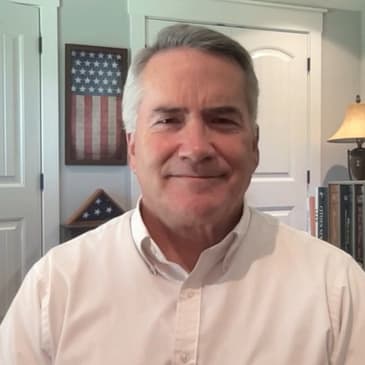
In this episode of The Jenny Beth Show, former Congressman Jody Hice, President at FRC Action, discusses the critical importance of election integrity in the United States. With insights from his time in Congress and current efforts at FRC, Jody Hice explains the urgent need for safeguarding our elections, addressing illegal voting, and the reforms necessary to restore voter confidence. Learn about key issues like voter ID laws, election security, and how noncitizens affect the integrity of U.S. elections.
Twitter/X: @JodyHiceFRCA | @jennybethm
Website: www.frcaction.org
Book: https://a.co/d/b8BiS1C
[00:00:00] Elections are about whether or not the will of the people was accurately heard and accurately accounted for on election day. Was this an accurate accounting of the will of the people? And when that is threatened, then we are in serious, serious trouble.
[00:00:18] Keeping our Republic is on the line, and it requires patriots with great passion, dedication, and eternal vigilance to preserve our freedoms. Jenny Beth Martin is the co-founder of Tea Party Patriots. She is an author, a filmmaker, and one of Time Magazine's most influential people in the world.
[00:00:37] But the title she is most proud of is mom to her boy-girl twins. She has been at the forefront, fighting to protect America's core principles for more than a decade. Welcome to The Jenny Beth Show.
[00:00:51] Today, I'm joined by former Congressman Jody Hice, Senior Advisor to the President at Family Research Council. We discuss his work on election integrity, his experience in Congress, and what's at stake for America in the upcoming elections.
[00:01:04] Stay tuned for this insightful conversation with a true patriot and advocate for our Republic.
[00:01:11] Jody Hice, thank you so much for being with me today. I'm really excited about this. You have been active on the election integrity front, you've been a member of Congress, and now you are working with Family Research Council. What job do you enjoy the most?
[00:01:26] Oh, wow. Well, you know, there's certainly parts of Congress that I miss. I miss being in the Freedom Caucus, being in the trenches with so many warriors. Really, I miss that part of it.
[00:01:38] But I'm thrilled to death to be a part of the Family Research Council. I'm the Senior Vice President there and the President of FRC Action, which, of course, is the political arm of FRC. So we've got a lot going on during this election cycle.
[00:01:52] And it's just a great honor to be a part of such a wonderful team. So it's good to still be in the trenches, but it's also good not to be personally shot at every week, as was the case in Congress.
[00:02:06] Well, that is good. You probably still take some heat from time to time, even with what you're doing right now. It seems that when we speak for what we stand for, that often happens.
[00:02:19] Absolutely. There's no question. And unfortunately, we're living in an environment where that's become norm. You know, and when I said being shot at, of course, I'm speaking figuratively.
[00:02:29] But yeah, we're living in a political environment that is just extremely toxic. And if you stand up for anything these days, it seems that opposes the radical left agenda, you are going to become a target of tremendous ridicule and of who knows what.
[00:02:49] And so, yeah, it continues, certainly on a different level as it was as a member of Congress.
[00:02:54] But as you well know yourself, if you're if you're on the front line pushing back against this radical agenda, you're going to become a target.
[00:03:05] That is very true. And at some point, thankfully, my parents taught me that sticks and stones will break my bones, but words will never hurt me.
[00:03:14] And I just have to remember that and and and ignore the people who hate because they're going to hate people no matter what.
[00:03:22] Judy, what is it that you're doing exactly with FRC right now?
[00:03:28] Well, as far as on the action side of things, we of course, we have a number of races that we are following and engaging as much as we can.
[00:03:37] We've got if I can summarize it without going into specific details because it's still kind of up and down.
[00:03:42] There's probably a dozen or so House races that we are following very closely, probably about 10 Senate races.
[00:03:50] There are also some gubernatorial races that we're closely monitoring.
[00:03:56] So we are we are looking at engaging those.
[00:03:59] But also, you know, there's a we have the seven swing states that we are actively involved in.
[00:04:05] And then also with action, we are engaged right now in an effort.
[00:04:10] We're calling it a PSA project, a public service announcement.
[00:04:14] But we are getting out the word that it is illegal to vote in a federal election if you're not a legal citizen of the United States.
[00:04:22] And so we are trying to get that message out as well.
[00:04:25] The and you well know as much as I do, the importance of election integrity and the various ways in which that is under assault these days.
[00:04:34] And it appears as though one of the big attempts this go around is to get illegals to vote.
[00:04:40] And so we are trying to push back against that and let people know that if you are not a legal citizen by law, you're not allowed to vote in a federal election.
[00:04:50] I think that what we're seeing with some people who are registered when they shouldn't be because they are a noncitizen, whether they're here legally or not.
[00:05:01] I think some of it is just that they go either to the Department of Motor Vehicles or they go to at this point with what President Biden has done, issuing an executive order that tells every federal office in the country that if you come in contact with a person, you have to work to register them to vote.
[00:05:23] I think that you wind up with people who are just they get a stack of paperwork, whether it's because they're trying to get Obamacare or a driver's license or whatever else it may be.
[00:05:33] And they fill it all out without even reading it.
[00:05:36] You're just filling in the blanks and sign it and go to the next page.
[00:05:40] And I think that might be how some people are getting registered.
[00:05:43] It's not that they actually intend to do anything illegal.
[00:05:47] They just inadvertently become registered without realizing the paperwork that they're filling out,
[00:05:52] especially if they don't have full command of the English language.
[00:05:56] Yeah, I think you're exactly right.
[00:05:57] So I certainly don't put all the blame on those who are here illegally.
[00:06:02] This is a disaster that's been created.
[00:06:05] And it's hard to think that it has not been purposefully created the way it is unfolding.
[00:06:11] And so that's another reason why we're trying to get the word out.
[00:06:15] Another complication to all of this, Jenny Beth, is the fact that in many places, particularly some blue states,
[00:06:21] certainly, but there are different places where it is legal for an illegal individual to vote in local and state elections.
[00:06:31] And so the reality is when you combine that with a federal election, we don't have two different ballots.
[00:06:38] And so you have local, state and federal all on the same ballot.
[00:06:43] So these individuals come into a scenario like that, receiving a ballot, and they're thinking they can vote for everything on the ballot.
[00:06:52] That's what they're doing.
[00:06:53] And so it really complicates things.
[00:06:55] And so we are certainly not trying to be a part or privy of voter suppression by preventing these people who perhaps can legally vote in a local election.
[00:07:05] But when it comes to the federal part, there is a federal law that prohibits them from voting.
[00:07:13] So it's an extremely complicated issue that we are trying the best we can to enter into that space and give clarity as to what the law is.
[00:07:23] Well, I really appreciate that.
[00:07:25] It should not be so complicated, but local governments certainly have made it complicated.
[00:07:29] And I think that they've done so, as you said, deliberately so that it creates these kind of issues and they wind up voting.
[00:07:38] And I think that Democrats very cynically think that non-citizens are just going to vote for Democrats so it's worth it no matter what.
[00:07:47] And I would imagine if they're actually coming to America for a better life, they would not want to have to have – they would not want to continue a socialist government.
[00:08:00] And I would hope that when they do become citizens, they're voting for the kind of America that has created the opportunity for them to come here in the first place.
[00:08:10] Well, absolutely.
[00:08:11] And, you know, just for an example, Washington, D.C. is one of those areas, by the way, the district where illegals can vote in the local elections.
[00:08:20] But you're exactly right.
[00:08:21] You would think that these individuals who are fleeing their countries, running away from their country in order to get into the United States where they have freedom and liberty and all these –
[00:08:34] you would think that they would readily vote against the very policies that they are running from and support policies in America that are going to continue to represent what America has always been,
[00:08:49] a land of freedom and individual rights, limited government, maximum individual freedoms.
[00:08:55] But, you know, when you talk about, as you did, many of these people don't even speak English.
[00:09:00] And they're coming here.
[00:09:01] There's a linguistic barrier.
[00:09:03] There's who knows what they are being told when they are registered to vote, how to vote or whatever.
[00:09:09] Who knows what they are being told.
[00:09:11] And many of them probably come in here and if they do vote, they vote the way they're told to vote or whatever the situation may be.
[00:09:20] So, you know, we have got to get out there with all that we can and let these individuals know that the things they are running from are not the things they need to vote for.
[00:09:34] That's exactly right.
[00:09:36] Jody, one of the things that I get asked often from people around the country when I give speeches, they'll be almost every single time.
[00:09:45] There is someone who comes up to me who says they're very active in their church and they want to know what they can do to reach out to people in their church to talk about either elections or voter guides or how to register people to vote.
[00:09:59] And that I often will point them to Family Research Council and over to Chad Connolly's organization, Faith Wins.
[00:10:06] Could you address what what they can do if they in their own church?
[00:10:11] Are you able to address that?
[00:10:12] Yeah, absolutely. And another great place to go is iVoterGuide.com.
[00:10:17] They've got a whole section on their website that specifically addresses what churches can do.
[00:10:23] And there's an enormous amount of freedom and liberty there.
[00:10:26] Voter guides, for the most part, I know the ones that we do at FRC and I think Faith Wins as well and iVoterGuide, they're C3 compliant.
[00:10:35] So they are totally in line with church structures.
[00:10:40] Most churches are C3 organizations.
[00:10:43] And so there is no violation by distributing the vast majority, at least all of them that I'm aware of, the voter guides, even registering voters in the church.
[00:10:54] You have the capacity. What you cannot do is tell folks to vote for a specific party or a specific candidate and that type of thing.
[00:11:02] But you can absolutely compare party platforms, different candidates, and put in the hands of the people those type of things without any issue whatsoever.
[00:11:15] And, you know, we could go beyond, and I know you know this, Jenny Beth, but as a former pastor myself, the thing that drove me to Congress, one of the primary things was even challenging the law that the IRS code, not a law,
[00:11:30] the code that says that a C3, a church, cannot endorse a candidate.
[00:11:37] Listen, I strongly disagree with that, and I challenge that IRS code, along with about 33 other pastors from across the country.
[00:11:46] It's known as the Johnson Amendment.
[00:11:48] But you do not waive, you do not surrender your First Amendment right when you go to church.
[00:11:53] In fact, the very hub, the centerpiece of religious liberties is freedom to speak from the pulpit, and the pulpit itself is the centerpiece, if you will, the epicenter of religious free speech.
[00:12:08] And so I think there's an enormous challenge that is coming, even on the Johnson Amendment as a whole.
[00:12:16] But specific to your question, voter guides are no problem.
[00:12:19] They're C3 compliant, and there's absolutely no problem in the world having candidate platform comparisons and the like.
[00:12:31] Okay, that's very helpful.
[00:12:32] And then for the people in the audience, when he is referring to a C3, he means an IRS-designated 501C3 organization.
[00:12:41] It is a church, a synagogue, the Red Cross.
[00:12:45] It's the places where you're able to donate money and get a tax deduction for it.
[00:12:51] Generally, those are 501C3 organizations, and most churches fall under that designation.
[00:12:58] And that's what he meant, just in case you did not know.
[00:13:02] And then when he said that he is the chairman or the president of Family Research Center Action, that's a 501C4 organization.
[00:13:12] And that kind of organization can tell you to pick up the phone and call your member of Congress or stand for or against different kinds of legislation.
[00:13:22] And that's what Tea Pretty Patriots Action is as well.
[00:13:26] And so at any rate, I just wanted to explain the differences and what he meant when he was saying that, in case you are not familiar with it.
[00:13:34] But if you are interested and you're active in your church, check out iVoterGuide.
[00:13:39] Check out what Family Research Council has put together and the voter guides that they have, because it's a great way for you to be active in that community, in your local community, and with your own network through your church.
[00:13:54] And it's a question I get constantly, so I wanted to make sure I addressed it.
[00:13:59] Jody, recently you released a book.
[00:14:02] So in addition to being a pastor and a radio host and running a nonprofit now and a former member of Congress, you are an author.
[00:14:12] Tell me about that book.
[00:14:13] Yeah, it's called Sacred Trust, Election Integrity and the Will of the People.
[00:14:18] And really, Jenny Beth, this came out of my time in Congress, specifically as a senior member of the Oversight Committee, Oversight and Accountability.
[00:14:29] And during COVID, we had, in fact, the very first case that we had in the United States, we had one case.
[00:14:40] And the very next week, Democrats in the Oversight Committee started holding hearings of the necessity for us to change our election laws and to start sending ballots to everyone because a pandemic may be coming.
[00:14:54] This, that, and the other.
[00:14:54] We only had one case.
[00:14:57] And they started pushing for massive federal takeover of the election processes.
[00:15:03] And that started a series of one hearing after another, after another, after another.
[00:15:08] While the rest of the country was concerned, what does this potential pandemic mean?
[00:15:12] Where is this thing going?
[00:15:14] The Democrats were pushing majorly for election reform.
[00:15:17] So that got, that raised my awareness as to what is going on.
[00:15:23] Why are they talking about election reform like this when we're just at the beginning stages where everyone else is wondering, are we even going to have a pandemic?
[00:15:33] What does this first case mean?
[00:15:34] And they continued pushing that and pushing in.
[00:15:37] And then they took it a step further and said voter suppression is another reason why we need election reform.
[00:15:44] And they really highlighted Georgia as exhibit A, if you will, in their argument.
[00:15:50] Well, being from Georgia, I knew that what they were saying was wrong.
[00:15:54] And so personally, I started pushing back on all of this stuff.
[00:15:58] And from those two issues, I started becoming very much involved in this whole election integrity issue and became a major individual on Capitol Hill pushing back against what the Democrats were doing.
[00:16:11] I certainly was not the only one, but I became probably the leading voice among the Georgia delegation for sure.
[00:16:17] But out of that experience came this whole issue of election integrity.
[00:16:23] And so the book really deals not only with my personal experiences in Congress, how I got to Congress and some experiences there.
[00:16:30] But in particular, it zeroes in on this issue of election integrity, how this has become a major point of discussion for the Democrats.
[00:16:42] And not just a point of discussion, but a point of desired influence.
[00:16:47] They want to alter the way we hold elections in this country.
[00:16:53] And we saw that as COVID became the excuse, literally, for election laws to change all over this country, mostly without the consent of the various state legislatures,
[00:17:05] but through secretaries of state or governors or whomever, just unilaterally making decisions under emergency provisions and election laws just like that were changed all across our country, including my home state, our home state of Georgia.
[00:17:21] But we saw this type of thing all over the country.
[00:17:24] And now we are behind the eight ball, having had horrible implement implementations of election reforms.
[00:17:33] And now we are we find ourselves pushing back against that.
[00:17:37] And we've got a lot of ground cover.
[00:17:38] Fortunately, there's been a lot of ground covered in numerous states.
[00:17:42] But unfortunately, a lot of states have just adopted those those regulations that were forced upon them during COVID.
[00:17:52] What do you think some of the changes are that are positive that have helped us catch up with the reforms?
[00:18:00] And what are some of the the most glaring problems you think still need to be addressed?
[00:18:06] A lot of them are the same thing.
[00:18:09] For instance, we've had mostly in red states have done a relatively good job in trying to protect and defend against some of the horrible things that took place during COVID, such as photo ID.
[00:18:21] We're seeing many states require ID to prove that you are who you say you are before you get a ballot.
[00:18:31] The drop off boxes, for example, in Georgia, there's been some major reforms on that type of thing.
[00:18:37] Voter verification, signature verifications for mail in ballots.
[00:18:44] But on the negative side, some of the horrible things that we still need to fix is the fact that we have so many mail in ballots and the the continued early voting, the late voting.
[00:18:56] All of these things are major concerns that need to continue to be addressed.
[00:19:02] Look, at the end of the day, Jenny Beth, elections are not about who wins or who loses.
[00:19:09] Elections are about whether or not the will of the people was accurately heard and accurately accounted for on Election Day.
[00:19:18] Was this an accurate accounting of the will of the people?
[00:19:22] And when when that is threatened, then we are in serious, serious trouble.
[00:19:28] My candidate may lose in an election.
[00:19:30] I may be horribly disappointed.
[00:19:31] But if it was a fair election, then I can always go back two years from now or whatever and we can fight to try to change the minds of the people.
[00:19:39] But if the will of the people, the legal registered voters of a district or state or whatever it may be, if the voice of the people is not accurately heard and accounted, then how do we fix it?
[00:19:55] And so this whole issue of election integrity, I believe, is one of the most essential issues facing our country today and one that we cannot sweep under the rug.
[00:20:08] This is an issue that we must remain diligent on to make sure that we're going to have free and fair elections.
[00:20:15] I think what you said is so important that elections are at the end of the day.
[00:20:21] It is about making sure that you have an accurate counting and accounting of the will of the people.
[00:20:27] I see I've said it a little bit differently, but I like the way that that you phrased it just then.
[00:20:33] And it's true.
[00:20:34] Of course, I have people who I want to win elections, but I have always been able to say, even when I've lost and been terribly, terribly disappointed.
[00:20:45] OK, well, I can go back and try again the next time.
[00:20:48] But if I don't feel like this, if I feel like if I do feel like the system is completely rigged and there's no way to to express myself through my vote,
[00:20:58] I think it becomes a very dangerous situation in America.
[00:21:01] It certainly undermines democracy.
[00:21:04] It undermines representative democracy or undermines our entire republic.
[00:21:09] And we have to restore this faith in the outcome of our elections.
[00:21:14] And the only way to do that is to make sure that that we have honest, secure and transparent elections.
[00:21:22] Well, there's no question about that.
[00:21:24] That is, as I said, I believe one of, if not the most premier issue facing our country.
[00:21:32] If we lose fair elections, we can't fix anything.
[00:21:39] I mean, it is it is taken away from us.
[00:21:42] If the voice of the people at the ballot box is somehow rigged or tainted in whatever way.
[00:21:48] And that's what concerns me when we're dealing with a host of, be it illegal people who have come across our borders illegally,
[00:21:57] who are now planning on voting or being told they can vote, or whether it's dead people on our voter files.
[00:22:04] And that goes back to another one of the major issues that must be reformed and corrected if we're going to have fair elections.
[00:22:11] You cannot have fair elections if you don't have accurate, as much as possible, voter files.
[00:22:18] And, you know, I congratulate Texas just this past week.
[00:22:22] Governor Abbott and company are removing almost a million people off of the voter files in that state who do not belong.
[00:22:32] And a host of them, they were illegal.
[00:22:33] They had moved out of the state.
[00:22:35] They were dead people.
[00:22:36] I mean, there are a whole host of individuals, but accounting to nearly a million people.
[00:22:41] We need more of that.
[00:22:43] Governor Youngkin in Virginia has taken some similar leadership.
[00:22:47] You cannot have fair elections if you do not have accurate voter files.
[00:22:51] That is something that must be taken seriously.
[00:22:55] You know, you're exactly right.
[00:22:58] And the fighting and the pushback on making sure that the voter rolls is clean, it just shows, I think it just shows we're over the target when we're trying to get that corrected.
[00:23:06] You've got to know that the people who are able to request ballots actually legitimately are supposed to be requesting those ballots.
[00:23:16] And I think one thing that is very broken in our entire system nationwide that probably could be addressed even outside of Congress through interstate compacts possibly is the fact that when you go get a driver's license,
[00:23:33] you wind up being registered to vote thanks to the National Voter Registration Act or the motor voter law.
[00:23:38] So you go to get your driver's license and you either are given the opportunity to register to vote or you're automatically registered, like in the state of Georgia,
[00:23:47] unless you decline and say that you don't want to be registered.
[00:23:52] Well, if you're moving from one state to another and you get a driver's license in the new state, your old state's license is canceled.
[00:24:01] And the new state lets the old state know that you now have a new driver's license and it cancels out the old state's license.
[00:24:08] Why don't they just go ahead and do the exact same thing with your voter registration?
[00:24:13] It seems like such a common sense thing to do.
[00:24:16] And I think most people around the country think that's already happening and it simply is not.
[00:24:22] And then when you go to try to get yourself cleaned off the rolls, you have to provide, you have to fill out paperwork,
[00:24:28] you have to give an ID, you have to just go through all of these hoops and you have to find the paperwork to fill out in the first place.
[00:24:35] It is not seamless. It is not easy.
[00:24:38] And it's one of the things that I think creates a lot of the problems with the voter rolls.
[00:24:43] And those inaccurate voter rolls give the opportunity for nefarious people to go in and request ballots that they shouldn't be requesting ballots for
[00:24:54] because the people never should be on the rolls in the first place.
[00:24:57] Yeah, absolutely.
[00:24:57] And that is one of those extremely common sense solutions that needs to be implemented.
[00:25:04] And it is not a big cost to do that sort of thing.
[00:25:09] It's all digital.
[00:25:10] When a person moves, changes their driver's license, the driver's license from the previous state.
[00:25:17] I mean, that is just total common sense.
[00:25:20] And the same applies with moving.
[00:25:23] The post office knows when you change address, you go from one address to another.
[00:25:28] For crying out loud, Amazon knows when you move.
[00:25:31] I mean, we have, you know, there are so many ways to keep track of this from utility companies to visa card companies to school districts to driver's license to post office.
[00:25:44] All of these are simple.
[00:25:47] The same could be said with the coroner's office.
[00:25:49] When you die, they know when you die.
[00:25:51] And the benefits and insurance payments for life insurance, all these things cannot happen without first there being a death certificate.
[00:26:00] And when that happens, a whole series of activities take place to verify the death of an individual.
[00:26:05] Among other things, it ought to be they're no longer on the voter rolls.
[00:26:08] So there's so many commonsensical issues that ought to be implemented.
[00:26:15] And the very fact that we have primarily a major political party in this country that does not want those things to happen indicates to me and highlights to me that they do not want secure elections.
[00:26:31] They think that they can gain power over the will and the voice of the people.
[00:26:38] And that should never under any circumstance be allowed.
[00:26:43] That is exactly right.
[00:26:45] You know, one of the things that is happening right now that we've had to train people to tell their local election officials and make sure their local election officials are trained on this.
[00:26:56] One of the things that is happening when activists say, well, what's happening with non-citizens being on our voter rolls?
[00:27:04] How can we ensure that's not happening?
[00:27:06] Local election officials around the entire country will come back and say, oh, you don't have to worry about that.
[00:27:12] We have the safe ID in our state now.
[00:27:15] So or the real ID in our state, not safe, the real ID in our state.
[00:27:19] And so they can't get on the voter rolls.
[00:27:23] It blows my mind to hear that.
[00:27:26] And perhaps they've got a safeguard in place that if it if it shows indeed they're not a citizen, that they're not going to be able to go on to the voter rolls.
[00:27:36] Maybe that is the case in some places.
[00:27:39] But the real ID alone does not prove prove that you are a citizen.
[00:27:44] The real ID is issued whether you're a citizen or not when you get a driver's license.
[00:27:50] And it means that the government knows that you are who you say you are and that they request a birth certificate or a passport.
[00:27:59] Well, if you're from a foreign country, you can still provide your passport from the foreign country, get a real ID and get a driver's license.
[00:28:06] So it's a misnomer to think that that real ID proves citizenship at all.
[00:28:12] And it's one of the big things we've had to go back and make sure that election officials know.
[00:28:18] And they just simply I don't think that they mean to be misinformed, but they are misinformed.
[00:28:24] Yeah, I think that's an excellent point, an excellent point.
[00:28:28] And, you know, to go along with that is also the argument that I hear frequently.
[00:28:34] I used to hear it all the time in the Oversight Committee and in Congress was the argument from the Democrats saying it is already illegal for noncitizens to vote in federal elections.
[00:28:47] So we already have laws against that.
[00:28:50] We don't need additional laws, you know, that kind of an argument.
[00:28:54] And look, the realization it is also a law not to drive over 55 miles an hour.
[00:29:01] But you and I both know nobody drives 55 miles an hour hardly anymore.
[00:29:08] Everybody's in a hurry.
[00:29:09] Certainly not in Atlanta.
[00:29:10] Right.
[00:29:11] More like 25 on the expressway in Atlanta.
[00:29:14] But but but but the but the point is, just because something is a law does not mean that the law is not violated.
[00:29:22] And we are seeing more and more and more evidence of election laws being violated.
[00:29:32] And for that reason, there needs to be stiff, stiff penalties.
[00:29:36] I believe, you know, if if we are going to have election laws, which is the which we do, obviously.
[00:29:44] But this is it's kind of like the hub of the voice of the people.
[00:29:51] This is we the people in action at the ballot box.
[00:29:56] And if the voice of the people is not going to be heard or is going to be compromised in one way or another, there ought to be, in my opinion, some of the most strict penalties that we can have in this country.
[00:30:14] For anyone who disenfranchises the voice of a legal vote in this country, any illegal vote takes away the voice of a legal vote and thereby disenfranchises that particular vote.
[00:30:31] And there ought to be serious consequences.
[00:30:33] But when there are no consequences, then the problem just gets worse with every election cycle.
[00:30:39] We must take this seriously. And those who violate our election laws need to pay some stiff consequences for doing so.
[00:30:48] And that in itself would be an enormous deterrent to future nefarious activity when it comes to elections.
[00:30:55] So one of the things that Tea Party Patriots Action and I have been working on is the Save Act, the Safeguard Voter Eligibility Act.
[00:31:03] And that bill simply cleans up some of the loopholes in the National Voter Registration Act.
[00:31:08] And right now what happens when somebody registers to vote, if they're registering to vote from the National Voter Registration Act, which is a motor voter vehicle, and they're filling out the paper,
[00:31:19] they check a box and affirm that they are a United States citizen.
[00:31:25] And that works some, but it isn't requiring any sort of proof to verify that they're a United States citizen.
[00:31:34] So the bill will clean up that loophole and require proof of citizenship.
[00:31:42] And I think that's extremely important.
[00:31:44] And one of the things that we've been working to get passed, of course, it's passed through the House of Representatives.
[00:31:50] It has died in the Senate.
[00:31:52] President Trump has said he supports that legislation.
[00:31:55] And Chuck Schumer is doing everything he can to pass it and to allow it to pass into law.
[00:32:01] But I think it's extremely important.
[00:32:03] And it's just a common sense reform.
[00:32:05] It's one of the things we're just mentioning about being a common sense reform.
[00:32:10] Yeah, absolutely.
[00:32:11] And, you know, that's the type of election reform we need.
[00:32:15] We don't need the type of reform that sends absentee ballots or sends live ballots to everyone on these inaccurate voter files.
[00:32:25] We need the type of reform that is going to bring integrity to the election process and bring confidence that we will have one legal vote cast and one legal vote counted.
[00:32:40] That's the way it ought to be.
[00:32:41] And this is not a complicated issue.
[00:32:44] It's just an issue that many people don't want to deal with.
[00:32:49] They prefer the messy, muddy water system that we currently have.
[00:32:53] Yeah, that's exactly right.
[00:32:57] Now, Jody, the name of your book again, it is Sacred Trust, correct?
[00:33:02] Sacred Trust, Election Integrity and the Will of the People.
[00:33:08] Very good.
[00:33:08] And where can people go to find that book?
[00:33:11] Well, you know, probably the easiest place that most people go to is Amazon.
[00:33:15] It's certainly on Amazon.
[00:33:16] It's available wherever books are sold.
[00:33:19] So they can go to their local bookstore or go to Amazon.
[00:33:24] But, yeah, Sacred Trust, I think it – and, you know, right now this is probably still – it remains one of the most important issues on the minds of voters right now.
[00:33:35] People want to know that their vote is going to count.
[00:33:37] This is a topic that we need to keep on the forefront, not only going into this particular election cycle, but even afterwards.
[00:33:45] We must continue to keep election integrity as a priority for the well-being of our country and the voice of the people.
[00:33:55] That is exactly right.
[00:33:59] We need the election process to be transparent rather than, as you said, the muddy, muddled way that it is right now.
[00:34:06] Jody, where can people follow you on social media and go to get more information about the work that you're doing for Family Research Council?
[00:34:13] At Jody Heiss, FRCA.
[00:34:16] That stands for FRC Action on X.
[00:34:19] At Jody Heiss, FRCA.
[00:34:22] Of course, you can always just go to FRCAction.org as well and find me all over the place from there.
[00:34:31] Well, very good.
[00:34:32] And I encourage everyone to go and check out the work that you are doing and that Family Research Council Action is doing as well.
[00:34:39] And to buy your book and to read the book and to continue to stay involved in election integrity issues.
[00:34:46] Jody, thank you so much for being with me today.
[00:34:48] It's an honor to be with you, Jenny Beth.
[00:34:50] And thank you for all you do, all you have done, all you continue to do.
[00:34:54] And keep the torch ablaze.
[00:34:56] The Jenny Beth Show is hosted by Jenny Beth Martin, produced by Kevin Mooneyham, and directed by Luke Livingston.
[00:35:04] The Jenny Beth Show is a production of Tea Party Patriots Action.
[00:35:09] For more information, visit teapartypatriots.org.
[00:35:15] If you liked this episode, let me know by hitting the like button or leaving a comment or a five-star review.
[00:35:21] And if you want to be the first to know every time we drop a new episode, be sure to subscribe and turn on notifications for whichever platform you're listening on.
[00:35:30] If you do these simple things, it will help the podcast grow, and I'd really appreciate it.
[00:35:36] Thank you so much.
[00:35:37] Thank you.
[00:35:37] Thank you.