
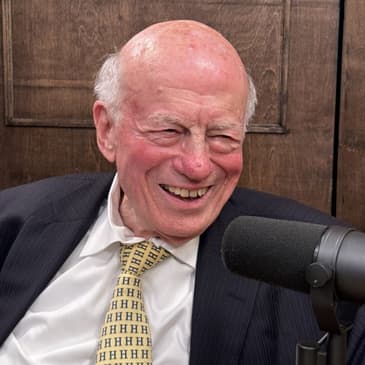
In this episode of The Jenny Beth Show, Richard Viguerie, Chairman of American Target Advertising, shares his pioneering journey in political direct mail marketing. Viguerie discusses his role in shaping the conservative movement, emphasizing the importance of grassroots efforts and effective marketing strategies. He highlights his innovative techniques that have revolutionized campaign fundraising and empowered conservative causes. Viguerie also provides insights into the current state of conservative politics and the critical need for strong leadership and effective communication. This episode is a must-listen for anyone interested in conservative marketing, grassroots activism, and the history of the conservative movement.
Twitter/X: @RichardViguerie | @jennybethm
Website: www.americantarget.com
[00:00:00] If you give the left eight years in the White House, they're mean, evil, dangerous, they lie, they're corrupt, and they will so rig the rules, change the laws in such a way, I don't know they will ever win a national election again.
[00:00:18] Keeping our Republic is on the line, and it requires patriots with great passion, dedication, and eternal vigilance to preserve our freedoms.
[00:00:26] Jenny Beth Martin is the co-founder of Tea Party Patriots.
[00:00:31] She is an author, a filmmaker, and one of Time Magazine's most influential people in the world.
[00:00:37] But the title she is most proud of is mom to her boy-girl twins.
[00:00:41] She has been at the forefront, fighting to protect America's core principles for more than a decade.
[00:00:48] Welcome to The Jenny Beth Show.
[00:00:50] Today, we are honored to have Richard Viguerie, a trailblazer in political communications as our guest.
[00:00:55] Richard pioneered the use of direct mail in politics, which empowered grassroots Americans and revolutionized campaign fundraising.
[00:01:04] His innovative techniques have helped shape the success of countless candidates, causes, and national organizations across the political spectrum.
[00:01:13] Richard entered the national stage in 1961 as the executive secretary for Young Americans for Freedom, where he played a crucial role in uniting conservatives, helping pave the way for Ronald Reagan's presidency.
[00:01:28] In 1979, Richard was recognized by Time Magazine as one of the 50 future leaders of America.
[00:01:35] And in 1981, People Magazine named him as one of the 25 most intriguing people of the year.
[00:01:42] Richard's legacy in conservative politics is undeniable.
[00:01:46] I hope you'll enjoy this insightful conversation with Richard Viguerie.
[00:01:51] Richard Viguerie, thank you so much for joining me today.
[00:01:54] My pleasure, Jenny Beth.
[00:01:56] Well, you have been active in the conservative movement.
[00:01:59] Well, you helped start the conservative movement, didn't you?
[00:02:02] Well, some people jokingly refer to me as 002, which means I've been active at the national level, 1961, of the conservative movement longer than every living conservative except for Dr. Lee Edwards.
[00:02:17] And so I've been around a long time and I've probably seen more of the inside of conservative nonprofit organizations campaigns than any living conservative.
[00:02:28] And what has, what have you, it's, I want to go into the history of what you've done in the movement, but let's talk just for a second about how you have this amazing direct mail marketing company.
[00:02:44] And you've used direct mail marketing techniques to help raise funds for countless conservative organizations.
[00:02:51] And you took a consumer direct to, you took a commercial direct to consumer idea and use that to help sway hearts and minds and raise money.
[00:03:05] You know, I should also say in part of my introduction that I'm 90 years old.
[00:03:13] I work 12, 13, sometimes 14 hours a day, five and a half days a week.
[00:03:18] Love every minute of it.
[00:03:20] I've been blessed with good health.
[00:03:21] And so I hate to go to bed at night.
[00:03:24] Can't wait to get up in the morning.
[00:03:25] Charge hell every morning with a bucket of water.
[00:03:27] But I got the opportunity, fortunately, to go in 1961, the summer of 61, to New York to run Young Americans for Freedom.
[00:03:39] And so I'm running into Bill Buckley and Frank Meyer and intellectual giants out there on a regular basis.
[00:03:47] So I'm a University of Houston kid.
[00:03:49] I didn't go to Yale, Princeton, Harvard.
[00:03:52] So I tried to catch up with them, start reading all the things I thought they were reading.
[00:03:56] And then after about a year and a half, I realized I wasn't making a lot of progress.
[00:04:01] And I literally made a conscious decision to change the course of my life and to begin to focus on marketing because we didn't have enough.
[00:04:10] But we had some people like Bill Buckley.
[00:04:12] We had some organizations.
[00:04:14] We had some candidates.
[00:04:15] We had some good elected officials.
[00:04:17] But we didn't have anybody that could market them, nobody to market our publications, our books.
[00:04:23] And so I literally went to my wife and we had two babies then.
[00:04:28] And I said, honey, could I be relieved of all household duties?
[00:04:32] No diapers, yard work, trash, et cetera.
[00:04:35] Because I've got something here that's going to change America, maybe the world.
[00:04:39] But I don't understand it.
[00:04:40] I've got to study it.
[00:04:41] She bought into it.
[00:04:42] So for seven, eight years, I made a deep study of marketing, grassroots marketing.
[00:04:48] And it changed everything in the conservative movement because in those days, we were like the tree that fell in the forest.
[00:04:57] Nobody knew about our candidates, our causes, our issues, because the left had a monopoly on the microphones of the country.
[00:05:04] They controlled, of course, most all the newspapers, the networks, entertainment, Hollywood, et cetera.
[00:05:10] But starting with direct mail, we could go around the microphone blockage at the left hand and go right into people's homes.
[00:05:17] And that changed everything.
[00:05:19] I can make a strong case that Ronald Reagan would not have been president of the United States without direct mail because in 1976 when he's running and again in 1980,
[00:05:30] his competitors, Jerry Ford, John Connolly, Howard Baker, Bob Dole, and others are getting the $1,000 contributions.
[00:05:38] Reagan had hundreds of thousands of $10, $15, $25 donors.
[00:05:42] And it just changed everything when he set the grassroots on fire and went around the blockage at the media head on the microphones of the country.
[00:05:52] So direct mail, you can make a case also there would be no conservative movement worthy of the name without direct mail.
[00:05:58] Most conservative organizations depend heavily on direct mail for their income.
[00:06:03] As does Tea Party Patriots Action.
[00:06:06] It's a very important tool even today in 2024 to use to raise funds and also to communicate a message.
[00:06:16] And when people are worried about being censored online and canceled online, one thing that is very reliable still is printing a message out on pieces of paper, putting it in the mail, putting a stamp on it, and it arriving directly to the person you want to get the message.
[00:06:33] I'm so glad that you said that, Jenny Beth, that it does more than raise funds.
[00:06:40] So many people, in fact, the vast majority of people who are using direct mail to run their organizations don't appreciate that direct mail is the third largest form of advertising in a country.
[00:06:50] And for most of the 60 plus years I've been involved at the national level, it was number two.
[00:06:56] First television, then direct mail.
[00:06:59] But now with the Internet, it's number three.
[00:07:01] But when conservatives mail these millions and tens and hundreds of millions of letters, they're actually encouraging people to be activists, to volunteer, to educating people, getting people registered, getting them to the polls on Election Day.
[00:07:16] So it's more than fundraising.
[00:07:18] It's actually helping to educate people, change their views, make activists out of them.
[00:07:25] And so I encourage everybody who's using direct mail out there to think of it as more than just fundraising.
[00:07:31] It's an advertising tool.
[00:07:34] It's educating people, giving them information.
[00:07:38] And it's important to understand if you are a new nonprofit or one who maybe hasn't engaged in this kind of marketing, it is an investment, isn't it, Richard?
[00:07:50] Oh, absolutely.
[00:07:51] When I started in the early 60s raising money for Young Americans of Freedom, then after a few years I left and started my own company,
[00:08:01] you know, I knew I didn't know the business and so I had to study.
[00:08:05] There was very, very little that was available in the nonprofit world.
[00:08:10] Now there's hundreds of books out there on nonprofit marketing and magazines and emails, et cetera.
[00:08:18] But in those days there was almost nothing in the nonprofit area.
[00:08:21] So I studied commercial marketing, commercial direct mail.
[00:08:25] And one of the earliest things that I learned was LTV, lifetime value of the donor.
[00:08:32] So it is really, really important to understand that getting that $10 today, you might break even in terms of the cost to acquire the $10 donor.
[00:08:43] But over that person's lifetime, they can give you hundreds and maybe thousands of dollars.
[00:08:48] One of our clients back in the 70s was Reed Larson, who ran the National Right to Work Committee.
[00:08:56] And there was some important legislation that the unions wanted called commensitist legislation.
[00:09:03] And Reed called me down one day, come down to his office.
[00:09:07] I did.
[00:09:07] And he wanted to mail 4 million letters opposing commensitist legislation in 1975 because Jerry Ford, president then, said he put the legislation on my desk.
[00:09:19] He said it to the George Meany, head of the FL, CIO.
[00:09:22] And John Upton, his secretary of labor, put the law on my desk.
[00:09:26] I'll sign it.
[00:09:27] Which means that if you've got a construction site or a building site or something and one union goes on strike, everybody quits working.
[00:09:34] That's against the law now.
[00:09:35] Everybody has to keep working if one union goes on strike.
[00:09:38] And so anyway, we mailed 4 million letters.
[00:09:41] A friend of mine, John Carlson, in the press office of the Ford, said he got 720,000 letters saying veto the legislation.
[00:09:50] He vetoed the legislation.
[00:09:52] Broke his word to unions.
[00:09:53] Broke his word to his secretary of labor, who resigned because he broke his word.
[00:09:58] Wow.
[00:09:58] All because of direct mail.
[00:09:59] Now, Reed Larson went to his grave a few years ago not knowing how much money the 90,000 people who gave to that appeal gave over their lifetime.
[00:10:10] Mailing cost about a million dollars.
[00:10:12] $700,000 came back.
[00:10:14] That's $300,000 shortfall.
[00:10:16] But he got 90,000 new donors.
[00:10:17] And so it was something north of $30,000, $40 million that those 90,000 people gave over the next 30, 40 years.
[00:10:26] And so that's the type of professionalism that you don't see often enough in the conservatives arena.
[00:10:35] The left understands this.
[00:10:37] The left does such a far better job than the conservatives do in terms of marketing.
[00:10:41] But the opportunity is there.
[00:10:44] The grassroots support is there.
[00:10:46] We just don't have the leadership at the national, state, and local level that we need.
[00:10:51] How do you think the left does a better job at marketing?
[00:10:53] Well, let me say that when I started doing my marketing for conservatives back in the 60s, all through the 70s, by the 70s, I was doing something no one had ever done before.
[00:11:06] And I began to catch an enormous amount of criticism.
[00:11:10] I was regularly attacked above the fold.
[00:11:13] New York Times, Washington Post, L.A. Times, NBC, ABC, all of the attacks that were there in the 70s stopped within a few hours.
[00:11:21] Election night, November 1980.
[00:11:24] Aha, that's what Vigery has been up to.
[00:11:26] And so the left had not done any grassroots marketing.
[00:11:30] They had relied on unions, taxpayers, and foundation for their money.
[00:11:35] And so they said, let us go out there and do what Vigery has done and build a big grassroots marketing effort out there.
[00:11:41] And I told my friends, Morton Blackwell, Lee Edwards, Ed Fulner at the Heritage Foundation, and others,
[00:11:48] don't worry, it's taken me 20 years to do this.
[00:11:51] It's going to take them 30, maybe 40 years because I'm smarter than they are.
[00:11:55] Not so.
[00:11:56] Within five years, the left caught up with us, and they do a far better job now than we do.
[00:12:02] They raise about 700% more money than we do from their nonprofits, from about 700% more donors.
[00:12:09] They have 20,000 single-issue nonprofit organizations.
[00:12:15] Conservatives have about 1,500.
[00:12:18] Every organization needs a president, a vice president, a secretary, a treasurer, somebody to do fundraising, somebody to do public relations, somebody to do events.
[00:12:26] So any organization might have six, seven, eight people doing important jobs.
[00:12:32] And so when the left has 20,000 of these, there's 120, 140,000 young, mostly liberals, learning how to be leaders.
[00:12:41] And they're going to be the candidates for state legislature, for Congress, even for the White House.
[00:12:47] In 2008, 2007, 2008, when Obama is running for president, he self-identifies as a community organizer.
[00:12:56] And so we have 1,500 organizations training maybe 15,000, 20,000 new leaders versus their 120,000, 140,000.
[00:13:07] That's a huge difference.
[00:13:09] It really is a huge difference.
[00:13:10] And what do you think about leadership?
[00:13:15] You're talking about how many leaders the left has, and they are training people on how to be leaders.
[00:13:22] Do you think that we have enough leaders on the right?
[00:13:24] Are we –
[00:13:26] Jenny and Beth, when I went to New York in 1961 to run Young Americans for Freedom,
[00:13:33] I identified at that time the number one need for conservatives.
[00:13:37] We needed more money, we needed more organizations, more good candidates, more elected officials.
[00:13:42] But number one above everything else we needed was leaders.
[00:13:46] 63 years later, same thing.
[00:13:48] And we're short of leaders.
[00:13:50] Every once in a while – and by the way, everybody who's active in the conservative movement at the state, local, national level, has a high profile.
[00:14:00] They're not necessarily leaders.
[00:14:02] Maybe they're spokesmen.
[00:14:03] And that's fine.
[00:14:04] It's not one that's better than the other.
[00:14:05] They just do different things.
[00:14:08] Well, but the talking heads, our friends on TV, you know, God bless them, and I wish them well.
[00:14:15] They're spokesmen.
[00:14:16] They articulate our issues very, very well.
[00:14:19] But they're not leaders.
[00:14:20] For example, I used to host a breakfast and a dinner at my home for 10 years in McLean, Virginia,
[00:14:29] and seven, eight, 10 young conservative leaders, the new right leaders back in the 70s, 80s.
[00:14:36] And then we'd reconvene in the evening, every Wednesday evening, with the same people for breakfast.
[00:14:41] This time we'd be joined by seven, eight young congressmen, Newt Gingrich, Vin Weber, Bob Walker, and others.
[00:14:49] And to the extent there could be anything that could be called Hillary Clinton's vast right wing conspiracy, that probably would have been it.
[00:14:56] But Gingrich was very unusual in that he was a spokesman for the cause and a leader.
[00:15:02] I mean, he's been to my home hundreds of times to participate in meetings.
[00:15:06] And he went to, you know, many other meetings, of course, in the course of the day or the week.
[00:15:14] So it's important to get out there and lead.
[00:15:19] And you're going to make mistakes.
[00:15:20] When I came to Washington, I'm just like I am now.
[00:15:24] I'm young.
[00:15:25] I was young, 27, 28 years old, full of energy.
[00:15:28] I had a lot of, I thought, good ideas.
[00:15:30] But nobody invited me to meetings.
[00:15:32] And so after a few years, I decided I'm going to call a meeting.
[00:15:35] And surprise, people came.
[00:15:37] And we had a good meeting.
[00:15:38] And so I said, let's have another meeting in a couple weeks.
[00:15:40] And more people came to the next meeting.
[00:15:42] And so after a while, they started inviting me to their meetings.
[00:15:45] And all you have to do is you don't have to climb the ladder of success.
[00:15:49] You just have to get on the first rung because everybody else is trying to climb it too.
[00:15:52] And they'll just push you right on up there.
[00:15:54] And I learned, Jenny Beth, one of the secrets to getting important people and lots of people to come to your meetings,
[00:16:01] serve good food.
[00:16:02] They'll show up.
[00:16:03] True.
[00:16:04] It's true.
[00:16:05] So when it comes to leadership, it doesn't sound like when you had that first meeting that you waited around for someone to give you the instruction of what needed to happen.
[00:16:16] You just picked yourself.
[00:16:18] Exactly.
[00:16:18] And I just urge young people regularly to don't wait for instructions from you or me or Donald Trump or anybody else out there.
[00:16:31] You know, pick yourself.
[00:16:34] Lead.
[00:16:35] And too much has been given.
[00:16:37] Much is demanded.
[00:16:39] And you sow sparingly, you reap sparingly.
[00:16:43] You sow bountifully, you reap bountifully.
[00:16:45] So take that first step.
[00:16:48] And it's scary.
[00:16:50] And you'll make mistakes.
[00:16:52] I like to use the example of 1927 in baseball.
[00:16:56] Babe Ruth is very famous for hitting 60 home runs in 1927.
[00:17:00] Set the major league record that stood for 50 or 60 years.
[00:17:03] But he also set a second record that same year.
[00:17:06] He struck out more in baseball than anybody else.
[00:17:09] So if you want to hit home runs, you've got to make mistakes.
[00:17:12] And that's okay.
[00:17:13] But pick yourself and lead.
[00:17:16] And you'll be surprised how many people will join you.
[00:17:20] And Gene and Beth, I know no other way to save our beloved country and save Western civilization than if the people at the grassroots don't get up and lead.
[00:17:32] And we're not going to be saved by, I think, the Republican Party leaders or others out there.
[00:17:43] It's going to be people at the grassroots who are busy with families, busy in their community, with their work and all that.
[00:17:50] But it's time that they're going to have to set aside sometime soon to also volunteer and provide that leadership.
[00:17:56] And leadership is, it takes courage.
[00:17:59] And courage is contagious.
[00:18:01] It's infectious.
[00:18:02] So once you start doing it, you'll find your neighbors will do the same and your family and friends.
[00:18:07] So take that first leap and serve good food and show courage because our country needs you.
[00:18:16] We need you.
[00:18:16] You know, the April of 1775, Lexington Concord, 3,000 Patriots fought that day.
[00:18:26] Maybe about 100 of them were under the command of two captains.
[00:18:30] But 98% had no leaders.
[00:18:33] They grabbed a musket and ran to the sound of the guns.
[00:18:37] So I urge everybody listening to us today to provide that leadership.
[00:18:42] Don't wait for anybody to give you instructions.
[00:18:44] Do what the Patriots did in 1775.
[00:18:47] Rush to the sound of the guns.
[00:18:49] And thank goodness they did.
[00:18:51] Because we wouldn't even be here if they hadn't.
[00:18:54] Yeah.
[00:18:55] And quite frankly, you're not going to.
[00:18:58] And we were, you know, I was thinking this morning how blessed I am.
[00:19:02] And I was thinking about the sacrifices that our, those who came before us made, you know,
[00:19:07] whether it was at Valley Forge or the Patriots in the 1770s and throughout our history.
[00:19:14] People have really, really sacrificed.
[00:19:16] And we have it so comfortable right now.
[00:19:18] So surely we can give up, you know, a Saturday morning, a Wednesday afternoon.
[00:19:23] And by the way, most people, Jenny Beth, are kind of normal.
[00:19:27] They're not like you and me.
[00:19:29] Just so dedicated to politics that it doesn't matter the day or the week we're there.
[00:19:34] But there is one issue, sometimes two, maybe even three issues, that people will give up
[00:19:39] a Monday evening or go to a rally on Saturday morning.
[00:19:43] And that is issue that's important to them.
[00:19:45] It might be the Second Amendment.
[00:19:46] It might be a school board issue.
[00:19:49] It might be overregulation of taxes for small business owners in the community.
[00:19:55] It might be crime.
[00:19:56] Whatever the issue is, focus on that one issue.
[00:19:59] And you'd be surprised how many of your friends and neighbors will show up to focus on that solution.
[00:20:04] It really makes a huge difference.
[00:20:07] So, Richard, let's let you're, you're imparting wisdom and lessons that you've learned.
[00:20:13] Let's stop at a step back for a minute and talk about how you got where, where you are today.
[00:20:18] And how old did you say you are?
[00:20:21] I'm 90 years old.
[00:20:23] 90 years old.
[00:20:24] So, we have to step back a little bit.
[00:20:25] But you helped start this conservative movement.
[00:20:28] And the people who are part of the MAGA movement, the people who are part of the Tea Party movement,
[00:20:34] the people who are part of the pro-life movement or the conservative movement,
[00:20:37] all of it began because you and others started the conservative movement and the new right movement.
[00:20:48] Yeah.
[00:20:49] But quite frankly, long before me, there were people out there starting the movement.
[00:20:57] In the 1950s, Bill Buckley, Brent Bozell, Russell Kirk, Frank Meyer, James Burnham, Bill Rusher.
[00:21:08] And we all stand on the shoulders of these giants out there.
[00:21:12] And young people particularly think, well, the conservative movement started with Donald Trump in 2015.
[00:21:18] Or maybe if they really are well-read, they say, oh, it all started with Ronald Reagan in 1980.
[00:21:23] No.
[00:21:25] Reagan, like us, stood on the shoulders of giants out there.
[00:21:29] And Barry Goldwater is one of them.
[00:21:31] As a movement, we have two fathers, one political and one intellectual.
[00:21:37] The political is Barry Goldwater.
[00:21:40] The intellectual was Bill Buckley.
[00:21:43] And most all major movements are started with first an intellectual foundation.
[00:21:49] And whether it's American Revolution with Edmund Kirk and Bill and all of the, you know, those intellectual giants and our intellectual giants, Thomas Jefferson and others.
[00:22:04] And they laid the intellectual foundation.
[00:22:06] And then the activists come along.
[00:22:09] And then after the activists, you know, clear the way, then those who run the government and make trains run on time come up.
[00:22:17] But first you have to have that foundation.
[00:22:19] You can build a very large high-rise building, many stories high, if the foundation is solid.
[00:22:26] And so we had a foundation starting in the late 40s, but really in the 1950s.
[00:22:35] Buckley started National Review and started, he called many, many meetings.
[00:22:40] I've been at many of them.
[00:22:41] And so Buckley was another one who not only was a spokesman, but was very, very much a leader for our cause.
[00:22:52] And in the 60s and the 70s, we mostly were just very, very frustrated and didn't see a way forward.
[00:23:03] And then some of us started meeting at my home and other places with the idea in mind, how can we come to power?
[00:23:12] How can we organize in such a way that we can be competitive with the left?
[00:23:16] And we weren't competitive with the left.
[00:23:18] And so something began to come together that the press identified as the new right, starting in 1974, 75, 76.
[00:23:27] And the difference between the new right and the old right was not ideological, except for the cultural issues, probably.
[00:23:36] The old right didn't focus on the cultural issues.
[00:23:38] New right did.
[00:23:39] But other than that, we were all the same, except we were operationally different.
[00:23:44] We would go to two, three, sometimes more meetings a day, many, many throughout the week.
[00:23:51] And we would get up in the morning and thinking, what two, three, four things can we do today to advance our cause, put the Democrats out of business, et cetera.
[00:24:00] And so now everybody thinks of themselves as new right kind of, and nobody wants to go back to the old days.
[00:24:09] However, I've noticed something that concerns me.
[00:24:14] You and I have been in meetings where I've expressed my frustration about how 95% of conservative activity is cussing.
[00:24:25] We do a really good job of complaining about the Democrats.
[00:24:28] Democrats are doing this bad thing.
[00:24:30] Democrats are doing this bad in education, in crime, in taxes, spending, whatever it might be.
[00:24:35] And a certain amount of that is good, but we spend almost no time coming to power.
[00:24:41] How do we come to power?
[00:24:42] How do we win?
[00:24:43] And we need to change.
[00:24:45] We need to spend a lot of our energy and resources on learning how to win.
[00:24:53] When the left, when they get together, that's how they start their meetings.
[00:24:57] We may or may not end a meeting with, we want to get registered, we want to do this, we want to do that.
[00:25:03] But 95% of our books, our magazines, our talking heads on television, our articles, et cetera, et cetera, are all complaining about the Democrats.
[00:25:13] And, you know, a certain amount of that is needed and important.
[00:25:16] But we do almost nothing in the area of winning and learning how to win.
[00:25:22] And we're not going to save America unless we reorder our priorities and begin to focus on how to come to power, how to beat the left.
[00:25:31] What are the lessons you've learned about how to win?
[00:25:36] Well, one thing Morton Blackwell says, you owe it to your philosophy to learn how to win.
[00:25:44] Read, read, study, study.
[00:25:47] At my tender age of 90, I spend two, maybe three hours a day, six days a week, studying marketing, studying business.
[00:25:56] And I love to read all the conservative books out there, but I do very little of it, quite frankly.
[00:26:03] And I spend most of my available time, when I'm not working at my company, studying how to win, how to be a better marketer, how to be a better communicator.
[00:26:16] And so I encourage people to, the number one thing maybe, just get started.
[00:26:23] Just, you know, take my car right now, turn it any way you want, doesn't matter, not going anywhere.
[00:26:28] But you start the motor, you start the engine, you can go to Maine, you can go to California, Miami, whatever.
[00:26:35] So when I'm a young person, I'm just full of energy and I want to do this and that.
[00:26:40] And I want to, you know, get married.
[00:26:43] I want to have a family.
[00:26:44] I want to, you know, help save Western civilization and all that.
[00:26:48] I didn't know how to begin to do that.
[00:26:51] But I put that energy out there and I'll start down one path and all of a sudden I find myself doing something very different.
[00:26:57] But I wouldn't have got there if I hadn't made that first step doing something else.
[00:27:00] So start your, start your motor.
[00:27:03] Go out there and start doing things.
[00:27:05] And God will take you down the right path.
[00:27:09] Richard, you read so much.
[00:27:10] What are some of your favorite books of marketing?
[00:27:13] Favorite books of marketing is about 20 I've identified.
[00:27:17] And I have written a book in the last year or so called Go Big.
[00:27:22] And it's Marketing Secrets of, secrets in quotes, of Richard A. Vigory.
[00:27:28] And it's how people can start organizations, raise money, get donors, et cetera.
[00:27:36] And in the back of the book, I have a list of about 20 marketing, advertising, business books that I recommend.
[00:27:44] And I would maybe want you could start with two authors.
[00:27:48] They used to write together.
[00:27:49] Then they wrote separately.
[00:27:51] And then one has passed away.
[00:27:53] One is still living.
[00:27:53] Al Reis, R-E-I-S, and Jack Trout, just like the fish.
[00:27:58] Jack Trout and Al Reis.
[00:28:01] And I tell my team and I tell others, whatever Al Reis and Jack Trout didn't write about marketing is probably not worth knowing.
[00:28:10] They really, really were just geniuses.
[00:28:12] And there's one book particularly that Al Reis wrote with his daughter, Laura, called The Origin of Brands.
[00:28:20] It's all about brand marketing.
[00:28:22] And I've developed something called Vigory's Four Horsemen of Marketing.
[00:28:28] Position, differentiation, benefit, and brand.
[00:28:31] Not a lot is original there.
[00:28:33] It's borrowed from this, stole from that one, et cetera.
[00:28:36] Kind of put it all together in a package of four horsemen.
[00:28:40] And in the first 25 pages of Al Reis's and Laura Reis's book, The Origin of Brands, 20, first 25 pages I've read seven, eight, nine times maybe.
[00:28:52] And it's really, really, really well written.
[00:28:55] And I tell my team, you don't read Al Reis and Jack Trout.
[00:28:59] You memorize them.
[00:29:00] They're that good.
[00:29:00] But those 25 pages talk about brand.
[00:29:03] And just very quickly, position in that.
[00:29:07] Let's say you use Rupert Murdoch as an example.
[00:29:09] 35 years ago, he went to start a cable television network.
[00:29:12] He brilliantly identifies a niche market the country had overlooked.
[00:29:17] Half of the country.
[00:29:18] Half of the country, 35 years ago, didn't have a television network that they could go and get the news information they were looking for.
[00:29:24] So he privately decided to, that was going to be holding the marketplace position.
[00:29:29] And then differentiation, he didn't go out there and brag, we're a conservative network that does this or that.
[00:29:34] He hired Megyn Kelly, Sean Hannity, Glenn Beck, Tucker Carlson, et cetera.
[00:29:39] And that told everybody what type of information you're going to get on his television network.
[00:29:44] Benefit is obvious.
[00:29:45] You get news and information you don't get anywhere else on television because you don't see people like, you know, people on Brit Bear and others on Fox television.
[00:29:57] And then the fourth is brand.
[00:30:00] Brand is the ballgame.
[00:30:02] That's everything.
[00:30:03] Products are not sold anymore.
[00:30:05] They're bought.
[00:30:06] And it's really, really important to get a brand.
[00:30:09] And most people don't understand what a brand is.
[00:30:11] A brand is not having a famous name.
[00:30:13] United Airlines, Delta, American, they have no brand.
[00:30:17] They have famous names, but there's not a brand.
[00:30:19] It doesn't matter to me.
[00:30:20] I'll fly tomorrow.
[00:30:22] And it doesn't matter to me which airline I'm flying.
[00:30:25] I want to leave at a certain time and arrive at a certain time.
[00:30:28] But when you're a brand, people will only buy your product.
[00:30:33] I regularly go to the supermarket, like to shop.
[00:30:35] I'm kind of Mr. Mom here.
[00:30:38] And regularly I buy paper towels.
[00:30:40] And if they're giving away all of the paper towels, I'm going to say, thank you very much.
[00:30:44] I'm going to pay money for Viva.
[00:30:46] And my dad before me, we were just Viva family.
[00:30:49] It's a premium paper towel.
[00:30:50] It's a brand.
[00:30:51] It's got a hole in the marketplace.
[00:30:52] It's the only national premium paper towel out there.
[00:30:56] So you want to really read and study Al Rees and Jack Trout.
[00:31:01] Seth Godin is a good one.
[00:31:03] He's written any number of them, 14, 15 books.
[00:31:06] One is called The Purple Cow.
[00:31:08] Right.
[00:31:08] And you want to be a purple cow in life.
[00:31:11] And so you're a purple cow.
[00:31:13] I am.
[00:31:13] We have hole in the marketplace.
[00:31:14] We do what nobody else does out there.
[00:31:18] And a professor from Arizona called Robert Chaldean.
[00:31:23] And he's written two books, Influence and Persuasion.
[00:31:27] They're powerful, powerful marketing books.
[00:31:30] So there are hundreds of them out there.
[00:31:32] I would say don't bother.
[00:31:34] Look and read the ones that I have in my book, Go Big.
[00:31:38] And I think you'll, if you're interested in running an organization, you run for office.
[00:31:44] Your name doesn't say anything.
[00:31:46] It doesn't say if you're left or right, higher taxes, lower taxes.
[00:31:50] So become the best marketer you can.
[00:31:52] And you'll be surprised how far it will take you.
[00:31:54] And whatever you want.
[00:31:55] If you want to raise, you want a promotion, you want a job, you want a spouse, you know,
[00:32:01] you want to separate yourself from all that competition out there.
[00:32:04] And Vigorous Four Horsemen of Marketing will help you.
[00:32:07] So I've got to make sure everyone knows to go get your book, Go Big,
[00:32:11] and then to read the other books that you recommend.
[00:32:14] And also to make a habit of reading.
[00:32:16] Very important.
[00:32:18] You're not just saying that you're reading marketing two to three hours a day,
[00:32:22] six days a week of reading.
[00:32:24] That keeps your mind sharp, doesn't it?
[00:32:26] It does that.
[00:32:27] No, I haven't really said this before,
[00:32:32] but when I left Young Americans for Freedom in December 1964, in January of 65,
[00:32:40] I started the world's first direct marketing company for politics.
[00:32:45] And, of course, as a conservative, we've always only worked for conservatives,
[00:32:51] people who have traditional values, et cetera.
[00:32:53] And with one employee today, our company has 90 employees,
[00:32:59] and we have about 25 clients,
[00:33:02] and we'll mail this year well over 100 million postal letters.
[00:33:06] And, by the way, there are four major ways to raise money
[00:33:10] through the new and alternative media.
[00:33:13] Postal mail, the Internet, phones, and TV.
[00:33:19] And of those four, over 90% of all money raised right now is from postal.
[00:33:25] That's going to change, but not for many, many, many years.
[00:33:29] So people think of postal as passe, from the past, not so.
[00:33:35] People, we haven't figured out how to market, quite frankly, on the Internet.
[00:33:39] A lot of young people on there who don't know marketing,
[00:33:42] a lot of people who are, quite frankly, not honest,
[00:33:46] they say things like,
[00:33:48] Hi, Richard, this is Donald Trump.
[00:33:51] I'm going into my finance meeting in 20 minutes,
[00:33:53] and the first thing I'm going to ask,
[00:33:55] have we heard from Richard?
[00:33:56] I mean, it's just a lie, you know.
[00:33:58] Yeah.
[00:33:59] And they say, we've got a 5,000-time match, 8,000 times.
[00:34:02] Well, if you give them to a candidate, it's illegal, probably.
[00:34:05] Right.
[00:34:05] You'll go over the limit.
[00:34:07] So we haven't figured out marketing on the Internet.
[00:34:10] We will.
[00:34:11] It might be tomorrow, it might be five years from now.
[00:34:14] But postal mail is very mature.
[00:34:16] There's a lot of good material out there,
[00:34:18] and it supplies the vast majority of the money that the movement makes and spends.
[00:34:25] And I highly recommend people who, young people particularly,
[00:34:33] if you want to get involved in the conservative movement,
[00:34:37] go to Leadership Institute, learn how to do anything that you want to do in politics.
[00:34:41] Leadership Institute will teach you and train you in that area there.
[00:34:45] But there's so many opportunities out there.
[00:34:48] One of the, you know, it's reality.
[00:34:51] I don't know if we'll ever change human nature.
[00:34:53] But if you're a bright, young liberal and you want to change the world,
[00:34:57] you go into the nonprofit world.
[00:34:59] If you're a bright, young conservative that wants to feed the world,
[00:35:03] you go into the private sector.
[00:35:04] And so there are always exceptions, obviously.
[00:35:08] But we need a lot more bright, young conservatives who dedicate their life to full-time movement activities,
[00:35:17] whether it's working in the nonprofit community, working as an elected official,
[00:35:22] as a staff person for an elected official, or in the nonprofit community,
[00:35:26] or like myself, having a for-profit company that works with the nonprofits.
[00:35:32] We need lots of people out there doing marketing.
[00:35:35] We need people doing public relations, media.
[00:35:39] There's so many opportunities out there,
[00:35:42] just thousands and thousands of opportunities for young people in the nonprofit world.
[00:35:47] Richard, so you mentioned that you were standing on, and even you,
[00:35:54] I feel like I'm standing on your shoulders and Morton and Ed Meese and others who I know,
[00:36:03] and Phyllis Schlafly, who's no longer with us,
[00:36:06] and who are a very important part of the conservative movement.
[00:36:10] But you mentioned we're standing on the shoulders,
[00:36:13] and you're standing on the shoulders even, of Buckley and Goldwater and Brent Bozell,
[00:36:20] not Media Research Center, Brent Bozell.
[00:36:22] Senior.
[00:36:23] Right.
[00:36:23] So who are those people?
[00:36:25] There are going to be people who listen to this who maybe they've heard the names
[00:36:29] or maybe they have no idea who they are.
[00:36:32] Well, one of the things you can do as you start your reading,
[00:36:36] it's important to know where you came from.
[00:36:39] And if you want to have an idea where you came from,
[00:36:46] otherwise you won't know where you want to go.
[00:36:49] And there's any number of books.
[00:36:51] My friend Al Regnery has written one called Upstream.
[00:36:56] Bill Rusher, the longtime brilliant publisher of National Review,
[00:37:01] wrote a history of the conservative movement.
[00:37:07] And some of my books, I wrote a book called The New Right, We're Ready to Lead.
[00:37:12] And there's probably half a dozen good books out there about the history of the movement.
[00:37:17] And it's important to know that, because I was talking to some young people recently,
[00:37:22] very bright young conservatives who want to make a career in conservative politics.
[00:37:27] They had no idea who Bill Buckley was or Barry Goldwater.
[00:37:30] These are just household names and giants, and there would be no conservative movement,
[00:37:35] in my opinion, without people like Bill Buckley and Barry Goldwater and John Tower,
[00:37:42] a giant senator from Texas, and people like Frank Meyer and Brent Bozell Sr.
[00:37:49] that you mentioned, and Russell Kirk, and James Burnham.
[00:37:54] They're just, and these people paved the way for all of us in the 50s, the 60s, and the 70s.
[00:38:00] And we wouldn't be here without them.
[00:38:03] The conservative movement didn't start with Donald Trump.
[00:38:05] It didn't start with Ronald Reagan.
[00:38:06] It started back in the 1940s, or even sooner, but certainly by the 40s.
[00:38:12] And in those days, back when I went to YAF in 1961, you know, there were just a handful of us.
[00:38:19] We could meet in the proverbial phone book almost, phone booth.
[00:38:25] And when Bill Buckley was speaking, we'd get, you know, maybe he'd speak 100 miles from here
[00:38:29] and say we live in Washington, D.C. now, speaking in Richmond.
[00:38:33] We'd organize a caravan of three, four, five cars, go down and hear him speak.
[00:38:37] It was a big deal when, and, you know, it's easy to be discouraged, quite frankly, Jenny Beth, right now
[00:38:44] because of the success of the left.
[00:38:47] Let me just say that the left has control of the leadership of every major institution in America,
[00:38:54] no exception, higher education, lower education, Hollywood, entertainment, big media, big tech,
[00:39:00] unions, big business, Wall Street, organized religion, the nonprofit community, goes on and on and on.
[00:39:05] Just one group out there that they don't control, and that's the voters.
[00:39:09] We still are a 50-50 country.
[00:39:12] And so as discouraging as it is right now, and it can be very discouraging.
[00:39:18] I, you know, suffer from that as all of us do, but I'm optimistic and confident we're going to prevail in the long run.
[00:39:25] But after Goldwater's loss in 64, the Democrats had two-thirds super majorities in the House and the Senate.
[00:39:32] Of course, they had Johnson in the White House.
[00:39:34] And it was a darkness of those days.
[00:39:37] Like, it was almost a biblical proportions.
[00:39:40] I wouldn't have been as surprised to see, you know, fleas and locusts that descend us and boils.
[00:39:48] And, you know, because we didn't have Fox in those days.
[00:39:52] We didn't have the Wall Street Journal playing the role it is now.
[00:39:55] We didn't have the Internet and the Daily Wire and, you know, and Tucker and Jesse Waters.
[00:40:02] And, you know, all of the wonderful people out there that we can turn to for information and all.
[00:40:08] We didn't have any of that.
[00:40:09] We were just, you know, a ragtag band of a handful of people.
[00:40:13] But we never gave up, never lost hope, and we just started meeting.
[00:40:18] And we just met and met and met.
[00:40:20] And all of a sudden, we put that energy out there.
[00:40:22] And that's one of the things I tell people, you know, energy.
[00:40:25] And I'm, quite frankly, critical of you.
[00:40:29] I'm like you, Jenny.
[00:40:31] You know most all the national leaders as I do.
[00:40:33] And, quite frankly, they're friends of mine.
[00:40:35] I love them.
[00:40:36] But most of them, 80%, 90% have low energy.
[00:40:40] The left has so much energy and cut with a knife at times, it seems like.
[00:40:44] But not our people.
[00:40:46] We're here.
[00:40:46] We're just, you know, a small bit away from losing our country, losing Western civilization.
[00:40:54] And we're just going about business as usual, you know.
[00:40:57] We don't really recognize, you know, the hangman is right around the corner there.
[00:41:02] And so, anyway, at my age of 90, I just hate to go to bed at night, can't wait to get a morning.
[00:41:09] And I just encourage everybody to show that energy out there.
[00:41:13] And don't worry about trying to figure out the solution.
[00:41:16] God's in charge, and he'll guide you directly.
[00:41:18] Start your motor, get going, and he'll guide and direct you as he has me.
[00:41:23] How did you get involved in politics?
[00:41:26] Interesting.
[00:41:27] Jenny Beth, I grew up in, I'm 100% Cajun.
[00:41:32] And from South Louisiana.
[00:41:34] The day my mother and dad got married in South Louisiana, they moved to Houston.
[00:41:39] And so I was born there two or three years later.
[00:41:43] And growing up as a kid, I never remember any ideological, political conversation at home.
[00:41:50] My extended family, the relatives and all that, friends of the family, never know.
[00:41:55] But I just came into this world as a conservative.
[00:41:59] So kids in the neighborhood, 12, 13 years old, 11, were playing cops and robbers.
[00:42:05] I don't tell anybody.
[00:42:05] I'm not shooting robbers.
[00:42:07] I'm not shooting Indians.
[00:42:08] I'm shooting commies.
[00:42:10] I just knew them as bad people.
[00:42:13] And I just was consumed with it.
[00:42:16] I would go to bed at night listening to the Rush Limbaugh's of that day.
[00:42:20] Fulton Lewis Jr., John T. Flynn, Dean Clarence Mannion, and others out there.
[00:42:28] Just giants out there on the radio.
[00:42:30] And I just, in 1961, I'm in the National Guard.
[00:42:37] And we had to do two-week summer camp.
[00:42:39] So I go to summer camp with my unit to a base right outside of Chicago.
[00:42:45] First Saturday we're there, the only Saturday.
[00:42:48] At noon, everybody goes into Chicago.
[00:42:50] Richard stays in his barracks and reads National Review.
[00:42:54] And I turned to the classified ads.
[00:42:56] And there was a little ad, about an inch wide, for four field directors of something called ACA,
[00:43:05] Americans for Constitutional Action, run by great conservative Admiral Ben Morrell.
[00:43:10] And so I had a buddy who wrote for Bill Buckley at National Review, David Franke.
[00:43:15] And so when I got back, I called David.
[00:43:18] I said, David, you know, I could hear the cannons going off in New York and Washington.
[00:43:22] The war was starting.
[00:43:23] The guns are firing.
[00:43:25] And I'm stuck in Houston.
[00:43:26] And I'm desperate to join the Army and join the war.
[00:43:30] And I said, David, I've got to have one of these four jobs for ACA.
[00:43:34] He said, it's not four.
[00:43:35] It's one.
[00:43:36] It was a blind ad to run Young Americans with Freedom.
[00:43:39] They didn't want the person who was running it then to know that they were trying to replace him.
[00:43:44] And I said, David, get me that job.
[00:43:46] I got the job.
[00:43:48] Very good.
[00:43:48] And then what did you do when you first got there?
[00:43:50] Oh, well, good question.
[00:43:53] I, so I closed up things and quit my job in Houston.
[00:43:58] I had a girlfriend.
[00:44:00] I took her out to San Joseon Monument Battlegrounds.
[00:44:02] And some of you viewers and listeners will recognize that.
[00:44:07] That's where Santa Ana met Sam Houston.
[00:44:10] Sam Houston beat him and won Texas independence.
[00:44:13] So being a traditionalist concerned, I thought it'd be kind of a cool idea to ask my girlfriend to marry me at the San Joseon Monument Battlegrounds.
[00:44:20] And she did.
[00:44:21] And I had serious competition.
[00:44:23] It gets back to a purple cow.
[00:44:24] I didn't know it, but she was dating a man who became chairman of one of the big oil companies.
[00:44:29] I don't know, Exxon Mobil or some of them.
[00:44:32] And so I had to say, honey, marry me and life will be like this, this and that, et cetera.
[00:44:35] So anyway, I arrived in New York, Manhattan, Sunday afternoon, and I'm sitting on top of the world.
[00:44:45] I'm just a junior officer in the war against the left.
[00:44:49] And I've got a fiancee going to get married in six months.
[00:44:52] And then I show up at the office the next morning, and I learned that they've got a handful of donors and $20,000 in debt.
[00:45:01] And they were being operated out of a PR firm by Marvin Liebman, a giant of the conservatives in those days.
[00:45:09] He had a PR firm, and he gave me three names to call and ask for money.
[00:45:14] J. Howard Pugh, a Sun Oil Company, and then Eddie Rickenbacker, founder of Eastern Airlines, World War I hero,
[00:45:25] and Charles Edison, the youngest son of the inventor.
[00:45:27] And I called all of them on the phone, went to see some of them, and they're all generous.
[00:45:32] They gave me checks.
[00:45:32] But I realized early on I didn't like asking many people for money.
[00:45:36] And so I started writing letters, and that seemed to work.
[00:45:39] So I hired a secretary, two secretaries, and more money came in.
[00:45:43] And so I got what was called a mimeograph machine.
[00:45:46] It was a big machine, and you cranked it.
[00:45:48] You rolled it, and your letters would spit out maybe 1,000 letters an hour.
[00:45:53] And that seemed to work.
[00:45:54] And so after about a year and a half with the organization, I asked to be relieved of all duties except direct mail.
[00:46:01] I wanted to focus on that.
[00:46:03] And so I did.
[00:46:04] And again, I put that energy out there.
[00:46:08] I didn't see when I went to New York.
[00:46:09] I couldn't see that I'd be pioneering political direct mail, that I'd do this, that.
[00:46:15] But I had that energy out there.
[00:46:16] And once you put that energy out there, you'd be surprised how you'd be guided in the right direction.
[00:46:21] So how long were you there, three, four years?
[00:46:24] Well, I was with – in New York, we were there for a couple of years.
[00:46:29] And by the way, I went there in September, August, September of 1961.
[00:46:35] In March of 62, we put on a rally at Madison Square Garden, 18,000 seats in there.
[00:46:43] We filled it, and there were people standing outside that couldn't get in.
[00:46:48] And Barry Goldwater spoke that night.
[00:46:51] Bill Buckley, Brent Bozell Sr., flew in from Spain.
[00:46:55] It was – if you want to date a birthday, you want a birthday for the beginning of the conservative movement,
[00:47:01] I would nominate March of 1962 when we – conservatives filled Madison Square Garden.
[00:47:08] We were covered the next day in the New York Times above the fold.
[00:47:12] It was a big, big – I was the old man at the time.
[00:47:15] I was 27 years old.
[00:47:16] Most of them were 20, 21, 22 years old.
[00:47:19] And we just put that energy out there.
[00:47:22] I mean, we had no right to think we could pull this off, and we did.
[00:47:25] And we just – it was a big, big deal.
[00:47:28] 18,000 people in New York in 1962.
[00:47:32] And what happened to that rally or that event?
[00:47:36] It was just electrifying, and it went – when we were kids, we didn't organize it well.
[00:47:41] It was after midnight before Goldwater spoke.
[00:47:44] And he was not a happy camper.
[00:47:47] Well, he should have been on Arizona time.
[00:47:51] He should have been okay.
[00:47:53] So, well, in fact, Peggy, his wife, was in the green room there, and somebody was admiring her tan.
[00:48:01] And he said, my gosh, where'd you get that lovely tan?
[00:48:04] And she said, Arizona.
[00:48:06] And I said, what are you doing in Arizona?
[00:48:08] Not knowing she was Barry Goldwater's wife.
[00:48:13] So, anyway, the – you know, again, we were just kids, and we just put that energy out there.
[00:48:20] And, by the way, one of the things I learned doing direct mail then, I started raising money for – to try to elect Barry Goldwater president, and as well as confront the young liberals on college campuses.
[00:48:37] And early on, I realized real quick, like, there was a lot of money people would give for a youth organization where – we're in our wheelhouse.
[00:48:46] We're fighting the left on college campuses.
[00:48:48] You want to give money to defeat the Lyndon Johnson?
[00:48:52] You're not going to give it to kids.
[00:48:54] And so, I learned early on, stay in our wheelhouse, which is operating to, you know, defeat the left on college campuses.
[00:49:05] Richard, so this happened in 62, and then you went down to D.C., and you started doing these – well, when did the new right meetings begin?
[00:49:15] The – yeah, and after – I think in late 62, we decided to – a new person became chairman, Robert Bauman, a page in Congress who later became a congressman himself.
[00:49:30] He was the new chairman of YAF, and he lived in Washington, D.C., so he wanted to move YAF there, which was fine with me because that's where the action was, and I was – we were all excited to get to Washington, D.C., so we did that starting in 62.
[00:49:44] But in the – so I'm starting to call these meetings, and so I'm meeting at Fuller.
[00:49:49] I'm meeting Paul Wyrick, and I knew Howard Phillips because he was on the board of YAF, and I was – but I'm meeting these conservatives.
[00:49:56] And so we're starting to have a little breakfast here, a little lunch here, dinner, whatever, and I was fortunate.
[00:50:03] By then, I had my company for five, six, seven years, and we had a monopoly.
[00:50:07] Nobody else was doing what we did.
[00:50:09] And so we were fortunate to be profitable, and so we had a nice home in McLean, 22 rooms.
[00:50:15] We live in help.
[00:50:16] And so we started having people come by for breakfast and dinner and all that, and we decided to meet in an organized way.
[00:50:24] And so we did for 10 years every Wednesday starting at 730, Paul Wyrick, Howard Phillips, Terry Dolan, Ron Godwin of the moral majority would fly up from Lynchburg, and then Ed Fuller.
[00:50:39] And after a while, we decided we were the outside effort.
[00:50:45] And by the way, we literally said we, those of us who were meeting at my home and our friends around the country like Phyllis Schlafly you referenced earlier and others who were out of town and couldn't be.
[00:50:58] There were maybe 15 or 20 of us.
[00:51:01] There were maybe 15 or 20 of us, but we were the alternative to the Democrats.
[00:51:04] It wasn't Bill Brock at the Republican National Committee or Hugh Scott in the Senate or Bob Michael in the House.
[00:51:11] It was us.
[00:51:12] And the press bought into it because we began to act like we were leaders, and we would hold press conferences.
[00:51:19] We would literally charter airplanes and fly around the country doing more press conferences, rallies.
[00:51:25] And all of that stopped with, of course, when Reagan was elected, he became the leader of the conservative movement.
[00:51:35] But through most of the 70s and through 1980s, for example, it's March of 1977.
[00:51:43] Jimmy Carter has been president a few months.
[00:51:46] And Paul Weirich calls me about 1030 at night, and he'd just come from a meeting of senators.
[00:51:51] And he said that Carter that day had proposed four changes in the election laws.
[00:51:57] He wanted instant voter registration.
[00:51:59] You're not ready to vote.
[00:52:00] You show up that day and say, I live down the street.
[00:52:01] I want to vote.
[00:52:02] Federal finance and congressional elections.
[00:52:05] And then change Hatch Act, abolish Hatch Act, let people in government participate in politics, and abolish the electoral college.
[00:52:14] And Weirich said, the senator said, this is terrible for the Republican senators.
[00:52:18] It's going to hurt the Republicans.
[00:52:19] Nothing we can do about it.
[00:52:21] I said, Paul, we can stop this, but it's late.
[00:52:23] I'm asleep.
[00:52:24] Call me in the morning.
[00:52:25] And he did.
[00:52:26] And so we began to meet at my home regularly.
[00:52:29] And we met for three or four months.
[00:52:31] And one day, one of the members of our group had seen an ad for an underground newspaper in San Francisco, say, send $5 with the photograph, and we'll send you an official-looking ID.
[00:52:46] And so we got some of the Republican House members to agree just to send their photograph in and say they were a Democrat chairman of this committee or that committee.
[00:52:54] And they came back, and we had big press conferences.
[00:52:57] And there was a newspaper there, a very popular newspaper called The Washington Star.
[00:53:01] And they did an eight-column banner headline across with our blown-up IDs.
[00:53:07] We had them about three by four feet, something like that, in our press conference.
[00:53:11] And Frank Thompson, congressman from New Jersey, Democrat, said some unpleasant things.
[00:53:16] And that was the end of Jimmy Carter's election law changes.
[00:53:20] We had a big party in August or September where we gave Paul Laxalt an inside award, myself the outside.
[00:53:28] And we were just kids, you know, but we sat there and we beat the President of the United States because we put that energy out there.
[00:53:33] The Republican senators said it couldn't be done.
[00:53:35] And so we did it.
[00:53:37] And so energy, energy, energy.
[00:53:38] Thank goodness you did because we may not have ever had a Republican majority in the House of Representatives if you had not done that.
[00:53:47] So then Carter was president.
[00:53:51] The country was in bad shape, very much like what we're seeing today.
[00:53:56] And Ronald Reagan came along.
[00:53:59] Did you know Reagan?
[00:54:00] Yeah, I knew Reagan.
[00:54:01] I was not close to Reagan.
[00:54:02] But one of the wonderful things about Reagan, and I say this also about Ed Meese.
[00:54:08] Ed Meese is just a giant in the conservative movement.
[00:54:10] And I've been in hundreds, as you have, of meetings with Ed Meese.
[00:54:15] Yes.
[00:54:16] You know, so many of our stars will come in the back door and go up to the head podium there, the head table, make their speech, and then go out the back way and never mingle with anybody.
[00:54:27] But regularly in the 70s, we'd have a reception or dinner, and I'm talking to friends, and I turn over.
[00:54:34] Oh, hi, Governor.
[00:54:36] Nice to see you.
[00:54:36] He just walks around with us, and he walked with us, and he came to our meetings, and it was just, he was just one of us.
[00:54:43] And so Reagan, you know, when he came to town, you know, he became the leader of the conservative movement in those days.
[00:54:54] But, no, Reagan in the 70s put an enormous amount of energy out there in becoming president.
[00:55:02] And he, one of the things that you've got to have to successfully run for president is you've got to have a base.
[00:55:08] Like the floor supports us right now.
[00:55:11] And so most candidates that run don't realize.
[00:55:14] They think that their base is their brain.
[00:55:17] I'm smarter than all those other people up on that stage.
[00:55:19] And the public, the voters say, no, you're all smart.
[00:55:22] You wouldn't be on that stage if you weren't.
[00:55:24] And so you've got to go back to Vigery's four-horsemen of marketing position, a hole in the marketplace.
[00:55:31] And Reagan's hole in the marketplace was, he had one and a half.
[00:55:35] His half hole in the marketplace was his wealthy California friends.
[00:55:39] And that's enough to get you to the starting gate.
[00:55:41] It does not get you to the finish line.
[00:55:43] His full base was the entire conservative movement.
[00:55:46] And so he could go into Oshkosh in Wisconsin at 10 o'clock at night.
[00:55:53] There'd be 200, 300 people there to welcome him, a band.
[00:55:57] And they'd make the morning news and the newspapers and all that because he had the movement supporting him out there.
[00:56:03] Donald Trump's base, in my opinion, was his $10 billion.
[00:56:08] And I tell people, give me $10 billion, I'll run for president.
[00:56:11] And so he had his own airplane and all that.
[00:56:14] And there's hundreds if not thousands of businessmen that are frustrated with government, want to do this, want to change that and all that.
[00:56:22] But they don't have $10 billion.
[00:56:24] So Trump's, and then he's going on to put a real solid base.
[00:56:29] He's got hundreds of thousands of people who just adore him and will jump off high buildings for him, as he's alluded to.
[00:56:40] But to get started, he had that base of money.
[00:56:45] So you've got to have a base you can start in politics.
[00:56:47] Once you get traction, you can add other elements to your base, but you need something that gives you traction.
[00:56:54] Trump also had a brand in his own name rather than in a product.
[00:56:58] So it wasn't just the name of paper towels like we were talking about earlier, but he branded himself.
[00:57:04] Oh, absolutely.
[00:57:05] He was a brand.
[00:57:08] And part of his brand is that he is, and his work stood him in very good stead to be really, really tough.
[00:57:16] And so he did, you know, quite frankly, in 2016 and 20 and even now some outrageous things, things that, you know, John McCain was not a hero, for example.
[00:57:28] You know, none of us would say that.
[00:57:29] If we did, we'd dig a hole, cover ourselves up, whatever.
[00:57:32] But that had an effect on people because people are saying, I don't agree with him.
[00:57:36] But when they went to him and said, will you apologize?
[00:57:39] No.
[00:57:39] Next week, will you apologize?
[00:57:41] No.
[00:57:41] Next month.
[00:57:42] People began to think, this man is different.
[00:57:44] Maybe we can trust him.
[00:57:46] He's not the typical politician.
[00:57:48] And so I think that brand of just being a really smart, tough guy really, really resonated with conservatives.
[00:57:56] We were looking for somebody different who wasn't a wet finger politician trying to find out which way the wind's blowing here or there.
[00:58:03] If Trump says something, you can take it to the bank.
[00:58:06] He says, I want to choose my Supreme Court justices from this list here.
[00:58:10] And he did.
[00:58:11] So that's a big part of his brand, that if he says something, he will follow through.
[00:58:17] When you look towards the future with everything you know from the past and as you look towards the future, what do you think is going – what does the future look like for America?
[00:58:30] Well, first, this year is really, really important.
[00:58:35] And it's really, really important because I don't know how you recover if you give the left eight years in the White House.
[00:58:46] They're mean, evil, dangerous.
[00:58:49] They lie.
[00:58:50] They're corrupt.
[00:58:51] And they will so rig the rules, change the laws in such a way, I don't know who will ever win a national election again.
[00:59:00] So this is all hands on deck.
[00:59:02] There's no going back from this.
[00:59:04] And they do rig the rules.
[00:59:07] Draining the strategic oil reserve as they did in 2022 to lower the gas price.
[00:59:14] If that's not rigging the rules, I don't know what it is, abolishing half a trillion dollars of college debt.
[00:59:21] If that's not rigging the rules, it's unconstitutional.
[00:59:24] So everybody can be a person of influence.
[00:59:31] You don't have to have a gazillion dollars to be a publisher.
[00:59:36] Everybody has got a mailing list of 25, 50, 100 people on their Christmas card list, family, friends.
[00:59:42] We can all email.
[00:59:45] We can forward articles, forward videos.
[00:59:49] And you can just talk to your grandchildren, your cousins, nieces.
[00:59:55] Become a Paul Revere.
[00:59:58] We need millions of conservatives being modern-day Paul Revere's.
[01:00:03] And this time it's not the redcoats that are coming.
[01:00:10] It's the socialists and the Marxists.
[01:00:14] These people are more and more acting like Marxists.
[01:00:18] And it's interesting how more and more conservatives are beginning to identify our opponents as Marxists.
[01:00:26] And by the way, I would say when you write, when those of you who have microphones you talk to, you do podcasts, you do blogs, you make speeches, whatever, I would urge you to don't lay our problems at the feet of liberals or progressives or socialists or even Marxists.
[01:00:43] It's Democrats that are causing the crime problems because socialists, Marxists, progressives is not on the ballot.
[01:00:51] But Democrats are on the ballot.
[01:00:53] And we need to brand them.
[01:00:55] They branded conservatives starting in the 1920s.
[01:01:00] All through the 20th century, they branded us as the party of rich, the big business, Wall Street, trickle-down economics.
[01:01:06] And they won a lot of elections that way.
[01:01:08] So we need now the reverse is true.
[01:01:12] They're the elite party.
[01:01:14] But we need now to brand these people.
[01:01:16] And whatever the issue is, your crime is your concern, it's caused by them.
[01:01:21] It's inflation.
[01:01:22] You know, it's high taxes.
[01:01:24] Whatever the issue is, it's caused by Democrats.
[01:01:26] Because I think there's a strong chance Biden is not going to be on the ticket in November.
[01:01:33] And so whoever is there, we need to identify our problems in this country as being caused by Democrats.
[01:01:41] Very good.
[01:01:42] Well, as we close out, are there any last words you want people to consider?
[01:01:46] Well, I guess I would repeat myself.
[01:01:50] And that is show energy out there.
[01:01:53] I mean, don't wait for Jenny Beth, anybody else to tell you what to do.
[01:01:59] You know, do what Ronald Reagan did and rush to the sound of the guns and educate yourself.
[01:02:06] Read, read, study.
[01:02:07] So you owe it to your philosophy.
[01:02:10] You owe it to your ideas and beliefs to be well-educated and knowledgeable so you can defend them with family, friends, neighbors, etc.
[01:02:18] And put that energy out there and you'll be surprised how you'll be guided in the right direction.
[01:02:25] Richard Vigery, thank you so much for joining me today.
[01:02:29] My pleasure, Jenny Beth.
[01:02:30] The Jenny Beth Show is hosted by Jenny Beth Martin, produced by Kevin Mooneyham, and directed by Luke Livingston.
[01:02:40] The Jenny Beth Show is a production of Tea Party Patriots Action.
[01:02:44] For more information, visit teapartypatriots.org.
[01:02:50] If you liked this episode, let me know by hitting the like button or leaving a comment or a five-star review.
[01:02:56] And if you want to be the first to know every time we drop a new episode,
[01:03:00] be sure to subscribe and turn on notifications for whichever platform you're listening on.
[01:03:06] If you do these simple things, it will help the podcast grow and I'd really appreciate it.
[01:03:11] Thank you so much.