
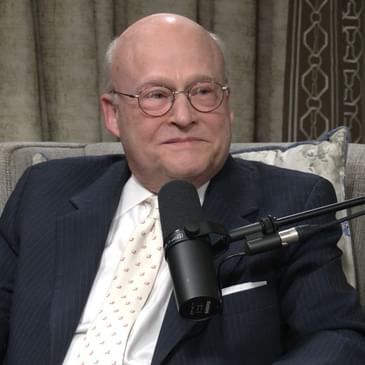
What was it like inside the Reagan White House—and how does that legacy connect to Trump’s presidency today? In this powerful episode, The Honorable T. Kenneth Cribb, Jr., former Assistant Counselor to President Ronald Reagan, joins Jenny Beth to share exclusive insights into the Reagan Revolution, the rise of originalism, and the conservative fight to reclaim America. From tax cuts and Cold War strategy to the roots of today's legal battles, Cribb reveals how Reagan’s bold leadership still shapes the modern conservative movement—and why Trump’s mission echoes that same spirit.
Website: https://yaf.org/people/t-kenneth-cribb-jr-njc/
Twitter/X: @jennybethm
[00:00:00] The Reagan administration was considered a revolution. It was called the Reagan Revolution. And the people who disliked it the most were Republicans of the old establishment. Of course they were. Of course. In fact, I would say that ground zero for the anti-Reagan sentiment in the country was the Republican National Committee at that time. Keeping our Republic is on the line, and it requires patriots with great passion, dedication, and eternal vigilance to preserve our freedoms.
[00:00:30] Jenny Beth Martin is the co-founder of Tea Party Patriots. She is an author, a filmmaker, and one of Time Magazine's most influential people in the world. But the title she is most proud of is mom to her boy-girl twins. She has been at the forefront, fighting to protect America's core principles for more than a decade. Welcome to The Jenny Beth Show. Today we're joined by Ken Cribb, who is the head of ISI, which is the Intercollegiate Studies Institute.
[00:00:58] He's also the treasurer for Young America's Foundation, which owns the Reagan Ranch. And his resume is quite extensive. He's on a lot of boards, so I'll let him tell you a little bit more about it. And he worked for President Reagan the entirety of President Reagan's presidency and the year before in the campaign. Thank you so much for joining me today. Well, thank you very much for having me, Jenny Beth. So how did you get involved with Ronald Reagan?
[00:01:28] Well, I knew it was the big one in my whole life. It was the big election in 1980. And I was about ready to take a three-week vacation, and I was feeling guilty. So I knew the general counsel of the campaign. I called him up, Loren Smith, and said, Loren, I'm getting ready to go to Italy, but I'm guilty, and I'll work for you for $1 if you need the help in the campaign.
[00:01:55] And I said, I'm going to go to Italy. He says, can you get here tomorrow? So I did. And I think the reason he was a little overwhelmed at first and needed the help was it was one of the very first campaigns under the new FEC law. So lawyers were having to tell the campaign people how to spend every dollar, and not just in the national campaign, but in the 50 state campaigns. Wow. Yeah. And the FEC really does just create all sorts of headaches.
[00:02:24] Oh, my gosh. Everyone. That's right. And everything we were doing as lawyers was setting precedence, you know, because it was one of the first elections under that law. Wow. So there was no FEC before that? There was an FEC, but they redid the law. Okay. And this was one of the very first presidential campaigns to do that. Okay. So then you worked on the campaign as an attorney. Yes. And then Reagan is elected. Yes. And you went into the White House.
[00:02:54] That's right. First, we did the transition. Ed Meese was the head of the campaign. The chairman was Bill Casey. William Casey was later director of the CIA. But Edwin Meese III, who later became attorney general, was Reagan's key aide and headed the campaign on a day-to-day basis. And my department, the legal department reported to him.
[00:03:20] And he asked me to do the Department of Justice and the executive and regulatory agencies in the transition in 1980. And we got off to a pretty good start with that work. And he wanted me to join him in the White House. And so I did that. Okay. And in the transition, that was helping staff the agencies? Or what was that doing? My part, no. There was a separate group that did personnel.
[00:03:46] My part did the planning for what would happen when these departments and agencies were under President Reagan's authority. Sort of like the executive orders Trump has been dropping. That kind of thing. The substantive part of that planning. Okay. The personnel was very important, too. But that was a separate operation. Okay. And then Meese went into the White House and you went into the White House. Yes. And how did you, what were your roles there?
[00:04:16] Yes. So Ed was counselor to the president and all policy reported through him, even the National Security Council. And he had several big offices that reported him. One of them was cabinet affairs. So he put me in cabinet affairs. The reason that was significant and why he wanted me there was, it was the way issues were developed and put before President Reagan for decision. It was done through his cabinet.
[00:04:45] The reason that Meese designed it that way was so that the cabinet members became insiders in the White House, representing the president out to those agencies instead of the other way around, which normally, normally the State Department is in there fighting for their turf with the president. Instead, these cabinet officers were ambassadors for the president. And that worked well? It worked beautifully. I would recommend it. And why? Why?
[00:05:14] How is that different? How did it make a difference? All right. So if you are holding things tight in the White House, making all the decisions in the White House, then the cabinet members are not invested in that. They've not been part of it. They might not even like it because they haven't seen what the other options were.
[00:05:35] But instead, what we did was to appoint subcommittees of the cabinet in various areas, like the legal area or the economic area. And you say the Secretary of Treasury became the head of the Cabinet Council for Economic Affairs. And other cabinet departments that were relevant to the economy were sitting on that. They were actually helping design the policy.
[00:06:00] In other words, you had the highest office of the land in the White House several times a week, helping make the policy that they would later administer. So it made them, that's what I mean, that they became insiders and they became ambassadors for Reagan's policies. That is pretty significant. It had not been done since Eisenhower. And I think it was done much more comprehensively than even with Eisenhower. Okay.
[00:06:29] And then what are the kind of things that Reagan did, especially for, we'll go to his second term, but in his first term, that were different, that really changed the way Washington works? Because that's what Reagan did. Yes. And until we had Trump in the White House, we, I don't think we, I think Reagan and Trump are the two in my lifetime who have disrupted Washington. I think that's right.
[00:06:54] And I think probably they're the only two from the conservative side that have done that even since Coolidge. And by the way, President Reagan loved Coolidge. And one of the first things he did on day one in the West Wing, he had a big portrait of Coolidge put in the cabinet room. But yes, the, the, the, the Reagan administration was considered a revolution. It was called the Reagan revolution.
[00:07:21] And, uh, the, the people who disliked it the most were Republicans of the old establishment. Of course they were. Of course. And in fact, I would say that ground zero for the anti Reagan sentiment in the country was the Republican National Committee at that time. So, uh, he, he, he wanted to do, to enlarge the scope of human freedom. Every policy he did could be boiled down to that question.
[00:07:49] And that divided into two great categories. One was the national security category where his, his, his, his, he wanted to win the Cold War, not to coexist with it, uh, as the previous Republican presidencies, but to actually win the Cold War.
[00:08:05] And then the other thing he wanted to do was to reduce the influence of the federal government in our daily lives so that freedom became a much more, uh, uh, uh, real for the average citizen. And one of the chief ways he did that was to drastically reduce marginal tax rates so that people earning money would keep more of what they were earning.
[00:08:32] And, uh, that, so that was really the big, uh, push in the first couple of years was what was called the economic recovery act. Uh, it's been a long time and people probably forget how desperate the economic situation was under his predecessor, Jimmy Carter. With, uh, uh, uh, interest rates, uh, in, uh, uh, double digits, uh, inflation and double digits. It was a bad situation and people were suffering.
[00:09:00] And, uh, he, so he, he, he, he attacked that with the one lever of the president United States has that makes the most change. And that is marginal tax rates because if you affect, if you change the tax rate at the margin, say your, your, your, your tax rate is 40%. If you bring it down to 35 cents, you want to work harder to get that lower tax rate on the, on those other dollars.
[00:09:24] He found that out in the movie industry because when, when he was in the movie industry, the top marginal tax rate was 90%. So he wasn't making too many movies after he, after the 90% level, he just stopped working. And so did the other actors. Uh, so 90% just to make it very clear. That means that for every dollar earned, he keeps 10 cents. Right. Absolutely. That's insane. It is insane. It's the opposite of the amount you give to God.
[00:09:54] Yes. Yes. Yeah. Right. Uh, and you know, the, the marginal tax rates when he took office were 70%, 50%. Um, so he was drastically reducing them down to about 35%. And at the Reagan ranch, they have photos of him signing that, right? Absolutely. He happened to be when that, those bills were finally passed through Congress. Uh, he was at the ranch and there's a table which were, which is called the tax table. Yeah, absolutely.
[00:10:25] But, um, the way we got it through, you know, we carried the Senate with us in the 80 campaign. I think Reagan carried 44 states and that included about six to eight senators. I don't remember the exact number. It was a lot of senators and we had a majority in the Senate. We never had a majority in the house. There was never a Republican house in the whole eight years of Reagan, but we had a blue dog Democrats. They were real in those days.
[00:10:54] The way you had conservative Democrats, many of them in the South, but other places as well. And, um, they actually wanted some of the same things for the country that Reagan did. So we had working majorities in the house of representative, but not Republican majorities. Okay. And so they passed this and I was listening to Steve Moore, the economist the other day, and he said, one of the, the mistakes or the lessons learned, whatever we want to want to call it
[00:11:21] from the Reagan administration is that it took entirely too long to get that bill passed. Absolutely. And because of that, there wound up being a recession and the relief really started at the end of 82 and really took off in 83. Right. Yes. The, oh, the old policies were in place until the economic recovery act passed. So unfortunately that meant there was a lag in the prosperity. The prosperity came pretty quickly after the act was passed, but then you're right.
[00:11:50] And it took a while to get it done. Um, and I think, I don't remember, you may remember when it was passed. I don't remember how long it was by the end of 81, but that's a whole year, a whole year. Yeah. Which is one thing Steve Moore right now is warning people about with the, um, the package in, in Congress right now, right. That we want to make sure the reconciliation package that it sends the Trump tax cuts and adds any new tax cuts.
[00:12:18] If there are any, uh, gets happens quickly because people need that economic relief right now. Oh, that is so smart. I, I was actually having me at lunch with Ed Meese today and I missed that talk. So I'm glad to have that, that brief on it because I agree with that completely. Yeah. Okay. And I'm not picking on Reagan, but it's important that part of the reason that we look back at history is so that we learn from it. And so we don't repeat. Absolutely.
[00:12:44] The goal is not to repeat the same mistakes and, and, and when it took off the economy flourished. So those long gas lines, the high interest rates, everything started coming back. Coming back. Huge number of jobs created. I think Reagan created more jobs than all the rest of the, uh, Western economies together in the, and the, during that period. So that's amazing, isn't it? Yeah. Um, and during this time while you were in the white house, what were, were you and, and Ed Meese doing?
[00:13:14] Well, of course, it was Reagan's right hand man, right hand man. And I was Ed's right hand man. And so we were all working on the same stuff. And, uh, early on it was heavily, um, economic, but, and we were sort of disciplined about that. And so that, cause we had a lot of educating to do with a democratic controlled house and everything. We had to work pretty hard on, on the, on the outreach on that.
[00:13:41] And, uh, but all the time he was making steps, making strategic moves, getting ready, prepping the ground, uh, to do something about the Soviet Union. So, and, and the main thing he was doing was entering upon the largest defense buildup in peacetime in the history of the world, not just the United States, but of the whole world in terms of the billions that were put into it. And why was that important?
[00:14:09] Well, he invented the phrase that we still use now peace through strength. And you look, if you want peace, there's one way you should get it. You arm yourself to the teeth and nobody will attack you. So that's how that's the best way to get peace. It's naive to think that we can do it through diplomacy alone. Human nature doesn't work that way. And we've had to learn that over and over and over in the course of 6,000 years of recorded history. But, uh, yes.
[00:14:39] And so when he went to bargain with the Soviets by 85, he was doing so from a position of strength. And, um, they were actually not as strong as they had been in 1980 because they were struggling to keep up with our defense buildup. And in the past, the way they had done it was to steal our technology through spies.
[00:15:05] So one day in 1983, uh, Reagan kicked every Soviet spy out of the country. Wow. We knew who most of their spies were. They knew who most of our spies were, but because of, of a Democrat administration preceding Reagan and Frank Church as head of the intelligence committee, we had basically been blinded. Uh, the CIA was no longer effective in human intelligence within the Soviet Union.
[00:15:36] Our satellite capabilities were greater. We could read a grocery list in the, in the parking lot of the Kremlin, but, but we didn't have good human intelligence. So we didn't lose anything by kicking their spies out because we were already blinded. And so they could no longer steal our secrets. And, uh, that's when the strategic defense breakthrough came. We'd leapfrogged the technology of nuclear, of nuclear deterrence, uh, by designing a capability
[00:16:06] that could intercept and shoot down incoming missiles. And they were desperate because they didn't have an answer for that. And they couldn't afford to develop the technology on their own. And, um, when, when Reagan first said he wanted to end the cold war, what do people think of that? They thought it was unrealistic. They, they, they thought he was the only one saying that. And I will be honest with you, Jenny Beth, his aides also were pest, did not know how we
[00:16:35] were going to actually, uh, in the cold war, at least on our terms, um, because it had been a complete stalemate all these years and, uh, under Democrats and Republicans. But Reagan had a certain vision on that, that was born of his own experience battling communism in his own union. He was president of the Screen Actors Guild. And of course the communists figured out early that Hollywood was our soft underbelly
[00:17:04] and that if you wanted to influence opinion in the United States, uh, one way to do it was to take over the entertainment energy, uh, industry. And so they went after Reagan's union. Reagan was a liberal Democrat at the time. He was a big supporter of, had been of FDR, but, um, that got him rethinking things and, um, he stopped them and, uh, started work. Uh, he, he, he kept them out of the Screen Actors Guild and, but he became a lifelong student
[00:17:33] of communism. So he knew more about communism than the so-called experts. And what he knew about them was that they, they too had a soft underbelly, that all of the power was right at the top and that the Russian people were not prospering and they didn't like the regime. And so he started collecting their jokes. He, he was a great collector of, of, of jokes from under communism. I'll give you an example.
[00:18:02] Uh, he, he said that, uh, a commasar communist commasar comes in to, to the, see the peasant on his farm and says, comrade, how are the crops this year? And the president said, Oh, wonderful. So, so many crops you will be eating in luxury. He says, and the potatoes. He says, comrade, the potatoes. So many, if you piled them up, they would reach God, the feet of God. And the commasar says, this is the Soviet Union. There is no God.
[00:18:31] The president says, that's all right. They're no potatoes either. So, you know, uh, what was going on in during the early eighties was in their effort to keep up with our defense buildup. They were just eating out their substance. They was, there's not, that was not, they were in desperate economic situations and, um, that was showing up in the intelligence. And so Reagan decided it was time to talk. It was time to do some Indian wrestling.
[00:19:00] And that led to the five, four, excuse me, four summits with, with Gorbachev. Um, and those were very significant. Yes. Had we had those kinds of summits at all with other presidents? We had, but what we had never prospered in those summits because the, a dictatorship hasn't, has an advantage over a democracy in those kinds of negotiations because the,
[00:19:26] the democratically in, in elected head of state has to be looking over his shoulder. Does, do I have the people with me? How far can I go? That's, is not a worry if you're a dictator, right? And so you would find the phenomenon of presidents and even Republican presidents doing something popular with the people, with the electorate rather than doing something good for the negotiation. So, um, but Reagan changed that.
[00:19:54] And, uh, he was a tough negotiator and, um, he met with Gorbachev in, in, in, uh, Vienna. And the first thing he said to him, he leaned over the table and he said, Mr. Mr. General secretary, let me tell you why we despise your system. And then he just went down, you know, the, the, uh, trampling on human, human freedom, the lack of, of, of an, of an economy that would produce prosperity for the people.
[00:20:23] And it's, it really put Gorbachev back on his heel. And he realized it was a different kind of a president he was dealing with. Um, and I think that that is one of the things that, that Donald Trump is very good at negotiating.
[00:20:39] And he walks in, it seems to me from what I've heard that he's walking in with these world leaders and they're not used to his style, but he, where Reagan had the advantage of understanding from his life experience, what communism was like and having to fight communism. Trump has had to negotiate business contracts and understands that most people are willing to deal somewhere in there. Right. Yeah, absolutely.
[00:21:08] And there are other parallels like that. I mean, Trump went through a big defense buildup early in his first term. And that was, we had been, after winning the cold war, we had been spending down the peace dividend. You know, when Reagan left, we had 600, 600 ship Navy. And now I think it's in the, you know, between 250 and 300 ship Navy. I mean, we're not strong as we were.
[00:21:34] And, um, and Trump wanted to reverse that in his first term. And he's making every sign to be wanting to do that again in, in this term. Um, and I think that with Reagan's vision of ending the cold war, it shows he was a visionary and a leader and he brought other people with him. And he thought of what could be done and aspired to it and convinced others to follow him down, down this path.
[00:22:03] Sort of like, um, John F. Kennedy saying we're going to put man on the moon in, in less than a decade. Absolutely. Because it's easy, but because it is hard. It's interesting that you put it that way. You know, some people, Russell Kirk, for example, traced modern American conservatism to Edmund Burke in England. Burke had a phrase called the moral imagination. And he opposed it to the diabolic imagination.
[00:22:31] And he was saying that, yes, you have to paint a picture of a more perfect society if you want to reach that perfection or not approximate that perfection is a better way of saying it. But, uh, so, so yes, Reagan had a, a vision of the world free of the Soviet Union. He said over and over, echoing Lincoln that, that the world can't exist half slave and half free.
[00:22:57] And of course, under President Ford and under Henry Kissinger, that's exactly what they were settling for with the time. Right. That, that is what they were settling for. Um, and I think that, that Trump has that same kind of vision.
[00:23:12] And here's specifically where I, I think of how, how that is exhibited when he went down those escalator, the escalator in 2015, he talked about securing the border and people mocked him and laughed at him. And in the mainstream media and, and, and in the left, you know, they all, they just, they were like, Oh, the border secure. We don't have to worry about this. He doesn't know what he's talking about. There aren't drugs coming across it.
[00:23:39] You, you know, whatever it was that he said, they attacked it. And then in recent polling before and after the, the election in November of last year, Americans, they don't just want a secure border. Now they want to deport the people who are here illegally. All of the people who are here illegally, criminals and others and, or hardened criminals and, and others.
[00:24:06] Cause if you've come here illegally, you've committed a crime. But, um, that, that takes a vision to be able to say, we're going to secure the border. And most people think it's impossible or not necessary. We're going to end the cold war. Maybe they didn't think it was possible or necessary. And in both instances, they're convincing Americans to follow them. Absolutely. That's a very good parallel. You're right.
[00:24:33] And I will say that my experience in government was in those nine years of, of, of Reagan. And, um, no one thought we could, uh, reform the immigration problems of those days. I mean, it did take a, a, a, a certain leap, imagine a leap of imagination for Trump to figure out that this, why, why not? I saw problems like this in business. I can solve this. Yes.
[00:25:02] And he's, he, he taught us all a lesson, didn't he? He, he did. Um, and I, I'm not going to, I know that our podcast isn't about Trump, but I was, since I was just speaking of him, one of the things about Trump and Ronald Reagan, they did not come from politics. They didn't go to college to study law, to go into politics, to, to be legislators or whatever else. Right.
[00:25:28] They lived a very full life before they ran for president. Right. And, um, I think that there is a vis visual demonstration of, of Trump's skills and ability that just seem like such common sense, but in Washington, everything seems, it's just upside down and backwards. So Trump as president goes to North Carolina, sees that we're still dealing with hurricane
[00:25:56] and flood damage four and five months after maybe even more like six months, almost after the hurricane. And he sees this in the very next day, bulldozers show up and earth movers show up and they're moving the, the fallen trees and the debris out of the way. And anyone else who has ever been to a construction site or looking, you know, has ever had to help
[00:26:20] their neighbor cut up a tree after a hurricane or tornado, which I have knows you, you know, there's only so much you can do with a chainsaw. You're going to need some bigger equipment to get this stuff out of there. There had to be people from FEMA in there and from the federal government who were looking at the problem and all they knew how to do was push paper. And he comes in and the next day they're moving, they're literally moving the earth out of the
[00:26:45] way to, to clear it, to solve the problem and turning on the water in California. And it's like the people in Washington, the bureaucrats, they've lost touch with reality somewhere along the way. And they did a long time ago. Yeah. You face the same thing. Absolutely. FEMA was one of the most impenetrable bureaucracies in the government, even under the, in the Reagan day. So, but here we have a president who was doing something about it.
[00:27:13] I liked his instinct and his instinct remember was to say, you know, we don't need these decisions being made so far away up in Washington. And they should be, this should be decentralized so that people closer to the victims in North Carolina and California are, are people who have an understanding of the local situation are making these decisions. That's, that's, that's what our founders envisaged in the whole federalism thing.
[00:27:39] When, when the, each state would be a laboratory of how to solve problems and that we'd figure out how the good ones are, are work and implement those more generally. Um, in, when Reagan was building up the weapons to, to have strength through P or peace through strength. Um, I remember in elementary school, no, I guess it was probably high school.
[00:28:06] So like 84, 85, I had a few teachers, especially a particular Spanish and French teacher who really did not like Reagan. Right. I babysat for her kids. She was a very lovely lady, but she did not like Reagan. And, um, and she, she complained about Reagan. I heard other teachers and other chitter chatter about people saying, oh, Reagan is going to take us to a nuclear war.
[00:28:30] And there was some television show when I was maybe like 82, 83, when I was still in elementary school about the world, like collapsing because of a nuclear war. Yeah. And yeah, they were wrong. It actually achieved peace. How, how was it for you and Mies and Reagan and others to have to fight that, that cultural battle? Well, it was a real fight.
[00:28:56] I mean, people forget it's been a long time and people forget that, uh, even the, uh, kinder, gentler establishment press of those days was still left wing and still hated Reagan. I remember one time, uh, I called up the head of the FCC who had been co-counsel with me in the 80 campaign and I was teasing him, but I said, uh, Mark, um, they're killing the president every night on the, on the networks. What are you going to do about it?
[00:29:23] And he laughed and he says, nothing, but there are three networks now. And when I leave, there'll be 103 networks. So we addressed it with policy. In other words, we look to the future and say, well, if you really want to do something about the, the news monopoly, maybe you should democratize the news. And so that's when the tape, the explosion of cable channels came. Wow. Yeah. That kind of thing.
[00:29:49] So you really, the president was speaking over the head of the media to the people. That was his main technique. He used a lot of Oval Office, office addresses. He resumed the Saturday afternoon, uh, radio cast that fireside chats that Reagan, excuse me, that, um, FDR had had. And, uh, but one of the main ways he did it was his demeanor as he would walk to the helicopter,
[00:30:17] uh, on Fridays on the way to, uh, Camp David. The commentators would be saying, yelling ugly questions to him and the voice over from the studio would be very anti-Reagan. But what the people saw was the smiling genial man waving to the cameras and it completely ignoring all that, that tumult. So he, he sort of rose, uh, rose above it.
[00:30:42] He used to tell us, Jenny Beth, uh, when somebody would argue, argue politically to him and he would say, wait a minute. He says, let's, what I need from you is your advice on the merits. I'll take care of the politics. So he, he really was trying to, he, he didn't, he, he was not very curious about what was in the, uh, newspapers. Uh, he, and that's probably, um, a good thing if you're president of the United States. Yeah, I, I think so.
[00:31:12] Beth, I think if you're any kind of, um, public figure at all, just ignore what's in the paper as much as you can. Right. Okay. Now, um, in the second term, Ed Meese became attorney general. Right. And you went with him? Yes. He, um, he, he was not named by, by the president and, uh, he asked me to do his transition. So I had a good long time to work on it because he had a long confirmation hearing.
[00:31:39] He was Reagan's most effective aid and the other sides knew that, uh, the Democrats knew that. So they, they were desperate to try to prevent him from becoming attorney general. It was a long drawn out process. So we, we had ample time to plan it very meticulously. And, uh, when we got over there, uh, he said, now, remember Ken, when you're bringing me recommendations for the, uh, these offices at justice, I value gray hair.
[00:32:09] And, and I, I went and I did my best and I came back and I said, Ed, there's no one with gray hair that agrees with us. So we went with younger, we went with younger, brilliant, uh, intellectually savvy, uh, young people who, uh, are still around a lot of them. And, uh, we put 35 year olds on the federal bench, uh, and Edith Jones, who was later chief
[00:32:35] judge of the fifth circuit, which is based in Texas, but all those States down that way. Uh, she was 35 when we put her on the bench and now she's still at it. She's still at it. Um, and so that was part of the revolution. Part of the revolution was getting a farm team, uh, that could carry on beyond Reagan's day. And what were, um, you've got, there's this new book out, right? Yes.
[00:33:04] That you have told me about. Now I interviewed Ed Meese for my podcast, um, several months ago when the Reagan movie was coming out. This book was not out then. And, um, it's, tell me about this book a little, a little bit. And why is it important that there is a book about former attorney general Ed Meese? Very good question. The book is important because for the first time it tells the whole story of something
[00:33:33] called originalism. Originalism was a, uh, a movement in the law started by Ed. And I can tell you a little bit about that, that wanted to get back to the actual constitution, to the words of the constitution, instead of all the opinions and palaver about it that had been encrusted over the years. And what had happened was by the time of Reagan running for office in 1980, there was really
[00:34:02] a lot of lawmaking from the federal bench from by judges. It had started under Roosevelt where the Supreme Court was out, was, uh, ruling unconstitutional certain key elements of the new deal. So the very first court packing scheme was Roosevelt's trying to pack the Supreme Court back in the, uh, thirties. Uh, it was about as successful as the one just now.
[00:34:28] In other words, it didn't go anywhere, but he had four terms to work on who the membership of the court. So over that time, uh, progressive justices began, uh, legislating from the bench. They would, uh, make policy decisions for the people. The Republican presidents after Roosevelt and Truman were slow to pick up on that.
[00:34:51] Uh, they, and they, they, they, they weren't careful in their appointments so that, uh, Earl Warren was appointed by Eisenhower, William Brennan, very liberal justice appointed by Eisenhower, uh, Nixon appointed Harry Blackman, Ford appointed John Paul Stevens. So by the time we were there, that was called the burger court. Warren burger was a, a constitutionalist, but he was in the minority.
[00:35:20] He was chief justice, but he was in the minority. And in the very liberal majority of the burger court, there was only one Democrat. Thurgood Marshall, all the others were Republicans. So we had a lot of work to do. In other words, we had to reform the entire process. And when Mies became attorney general, uh, the president said, now the main thing I want you to concentrate on is restoring fidelity to the written constitution.
[00:35:48] So that's what the Mies justice department was all about. And, um, we tried to do it through, through, uh, with a sort of four pronged, um, effort. And the book describes all of this. Uh, by the way, the book is written by two law professors, one from Yale, uh, and Northwestern, uh, Steve Calabrese and Gary Lawson from, uh, Boston university and Florida, um, endowed chairs,
[00:36:16] um, know their business, but they're also worked in the Mies justice department back in the day. So they were eyewitnesses. And Mark Levin did the court and he worked for, for Mies as well, right? Yes. Uh, when I went back to the white house after they needed me because of Iran Contra and the cleanup after that, um, Mark Levin became chief of staff of the justice department.
[00:36:38] So, and he, he's taught, I've learned so much from Mark Levin, um, reading his books and listening to his program. And when I get really frustrated and down about America, I just turn on his show and I'm like, yes, yes, yes, yes, yes. He's fighting for us. Yes, he is. Absolutely. Most people are like, wait, Mark Levin gets you excited and cheers you up. Yes. That's my life. Underneath all that passionate argument, he is a brilliant constitutional lawyer. He is.
[00:37:07] And, and that's what I love about him. He takes the issues of the day and he ties it to the constitution and explains why we should fight and, and what the underlying principles are that we're really fighting for. It's not just the issue of the day, but there's a principle in there that we're standing for. Absolutely. So what did we do differently, which was how we got started on this from the other Republicans, from the Republicans who had preceded us and not done much about the problem.
[00:37:34] Well, first thing we did was to elevate judicial selection to the very top of the administration. It wasn't an afterthought. It wasn't something that we did quietly over the Department of Justice. It was, it was staffed at the Department of Justice, but then the attorney general and his people would bring it over to, to the president's chief officers. We would meet in the Roosevelt room, just steps from the Oval Office and really hash it out at that level, at a cabinet level. Wow.
[00:38:03] And then take it into the president. He'd make his choice. And then the president, he was, we, it wasn't just us working on it. A very important development was the big, one of the scarcest commodities in the free world is the time of the president of the United States. Right. He would call every single nominee for the, for, for, to be a judge on the telephone, tell them what the stakes were, what he was expecting about reviving the constitution.
[00:38:31] And so that was a huge investment and unprecedented investment of his, of presidential time. It was a signal of how important it was. And the other thing we did was we stopped asking conclusory questions. Like we didn't ask the candidate, do you believe in judicial restraint? They would always say yes, of course. They wanted to be a judge. Or I said, would you legislate from the bench? No, of course they wouldn't. So what we would do, we would actually just put a fact situation to them. That's all we would do. Say, here are a bunch of facts.
[00:39:01] How would you rule? And then it was on them. And we could pick up whether they would be an activist of the left or the right. We wanted the constitution followed and not manipulated by anyone, including by, by conservatives. And so that's, that's, that's how we did that. I mentioned the farm team.
[00:39:23] Not only did we populate the government with brilliant young lawyers, a new organization had been formed in those days called the Federalist Society. And they were pretty young, right out of law school, but they knew what they were doing. They had Judge Bork, Judge Robert Bork and Judge Antonin Scalia as their advisors.
[00:39:47] And so they, we hired many of them into the Mies Justice Department and into the Reagan administration generally. And then they matured and got better and better and better. So by the time Reagan and Mies leave office in 1989, Federalist Society is a thriving organization. It's now 70,000 strong. It's organized at every single law school.
[00:40:15] It has lawyers chapters in all the major cities. It does not take positions on red meat controversial policy questions, but it does all the intellectual work getting people ready to do that in their own lives.
[00:40:32] And it's, it's been a, Judge Scalia, Justice, later Justice Scalia, Ed Meese and Judge Robert Bork, all three told me in different conversations over a period of about two years that they considered the Federalist Society as the institutionalization of their own work. Wow. So, Jenny Beth, when we're starting to win these big cases before the Supreme Court, now it took 45 years to get there.
[00:41:01] But the process that carried us there is still vibrant and strong. I think that's one of the important things for people to understand. The Tea Party movement recently turned 16 years old. And when we look at why we started constitutionally limited government, free markets and fiscal responsibility, which we now talk about in terms of personal freedom, economic freedom and a debt-free future. Right.
[00:41:30] There have been days in the last 16 years where it just seemed like those were really nice sounding values that we would never actually see again in America. But we kept standing for it and working for it. And we studied the constitution along the way. And by studying the constitution along the way, we realized that change takes a long time to achieve in America.
[00:41:55] And there's a reason for it because if things change on a dime, it creates chaos. People don't like change. And that makes them, it can lead to uprisings in a country. But if you get people to agree with you and you bring them along the way and you get more and more people to support your cause, you can make a difference and have something like Doge happening. No question. Which is what we're having right now.
[00:42:22] The Tea Party also was a revolution and it took its name from a revolutionary example, right? That's right. Yeah, absolutely. And it was constitution-based, is constitution-based just as Reagan's work was and is. So that's so important. And, you know, your insightful words about how sudden change can sometimes be counterproductive. The founders understood this.
[00:42:50] They had made a huge study of the old, the Greek Republic and the Roman Republic and the ancients and then the modern kingdoms and nation states in Europe. And they understood that the enemy of self-government is power. And power is what one uses when one makes sudden changes. So they made it difficult to make sudden changes.
[00:43:18] What they did was the phrase I like to use is they divided power against itself. Yes. And they did it horizontally with the separation of powers between the three branches and vertically between the federal government and the national government. But, and then many other checks and balances all throughout.
[00:43:41] So it's what you can act more quickly in the British Parliamentary system, but you can also ruin the United Kingdom more quickly. Right. And what we have opted for is a process that sometimes is frustrating because it slows things down, but it does preserve freedom. And that's why it took 45 years in some instances for you to see the fruits of your labor.
[00:44:07] But it still will, even when it takes a long time, worth standing for and fighting for. Right. Even when sometimes you look around and think you're the only one standing out on a limb. Yes. That's absolutely correct. That is correct. And so organizations like the Tea Party and the Federalist Society actually counteract that loneliness. You see that you are not the only one that sees this problem, and it gives you courage. It does.
[00:44:36] And it keeps you going. And then you watch as other things pop up, like there are all these Trump groups and MAGA groups now. And they want the same, they want what's best for our country, and they want more freedom in their own lives. Yes. And we have that struggle between freedom and power. I think there's a third element to it with the human nature, the tug of war. It's freedom and power and security.
[00:45:07] And all three are constantly pulling against the other. I like that. I like that. You know, human nature you mentioned, and I think Madison said that if men were angels, you wouldn't need a government, right? And they aren't angels, and that's what we call human nature.
[00:45:28] And so you have to be realistic about the fact that actors in government are going to want to acquire power, and eventually it's going to corrupt them, and they'll have too much power for the good of liberty. So what you want to do is have other powerful entities contending with them. And I think Madison said in the same passage, let ambition counteract ambition. And it works well, and we have a lot of ambitious people in America.
[00:45:59] As you look back, Reagan accomplished his goal. He ended the Cold War. What did you think when that happened and the Soviet Union came down and the wall came down in Germany? I remember where I was because I was going to give a speech in Puerto Rico, which is not as far as it from—I was in Philadelphia Airport. It's about a three-hour flight. The speech, I couldn't give the same speech the day the wall came down.
[00:46:27] Three hours was enough to write a speech. Right. And so I remember thinking that when Reagan said in his speech to the British Parliament in 1982, early, he said that before we were done, Marxism would be on the ash heap of history.
[00:46:52] And that's the day that we knew that to be true. So the other thing I was thinking about was his tear-down-this-wall speech, which is prominently displayed in the Reagan movie that you were talking about. By the way, I think that movie gets Reagan right. Finally, there's a movie that actually gets him right.
[00:47:20] But the sentence, rather, right after Tear Down This Wall is, I saw spray-painted—this is Reagan talking—I saw spray-painting on the wall. This wall will fall. Beliefs become reality. And once again, that's the moral imagination. Once again, you have to be able—see, he spoke it. Yes. He was giving them an image of the wall coming down. He said it wouldn't fall to bombs or bulldozers.
[00:47:48] He said it would fall to ideas. And it did. And it did. And he fought the Cold War, but we still are fighting the remnants of Marxism. And I'm not sure when we'll be done with that completely, but we are still fighting. I mean, we've seen that play out even in America in the last five years with the COVID lockdowns. No question.
[00:48:13] I mean, it isn't that they were—well, some of it really—DEI and critical social justice theory, those are rooted in Marxism, to be sure. Why isn't it equality? It's equity, not equality. Right. They don't want equality. No. They want to favor certain groups over other groups. Right, right. And so we are constantly still having to go back and make sure people understand what freedom and liberty and capitalism are about.
[00:48:41] But I think right now we're at a turning point in the country yet again. And that is a good thing, as long as we remember what our founding principles are. Absolutely. Absolutely. I've always thought that it being hard to ruin America because of our constitutional system, that we always had time to come back. But part of the attack over the last four years was on the Constitution itself.
[00:49:12] And I was really wondering, you know, what it would take to get us back. But now it's happening more quickly than I hoped. Yeah. With this last election and with the new administration. Yeah. Donald Trump is unlike any other figure we'll ever know in our lifetimes. Correct. He and I think part of the reason for it is because he, like Reagan, they're not they didn't become president as children.
[00:49:41] They didn't become politicians. They lived a rich, deep, meaningful, productive life before they ever made the sacrifice to run for office. And they were older when they were elected. Yes. Reagan was the oldest president at the time he was elected in those days. Right. No longer, but in those days. Right. And the gray hair comment that you said that Ed Meese had. I mean, there's not that Donald Trump actually has gray hair.
[00:50:10] We all have seen it's not quite gray. But there's wisdom as you get older. And it's easy sometimes when you're young, when you're in your teenage years, in your 20s and even your 30s to discount that wisdom. Right. But I think it's a wisdom that in both instances with Reagan and with Trump that we're going that future generations will look back in and say that wisdom helps save America. Absolutely. Absolutely. One last question for you.
[00:50:39] There are people who are going into the Trump administration right now. Some of them were in the first administration and some of them were not in it at all. And you were there for the entirety of Reagan's, for the entirety of Reagan's presidency. What would you tell someone who's in, in that position to hold on to while they're, because they're in the middle of it and they're drinking from a fire hose and there's so much going on and they probably aren't taking the moment to savor it.
[00:51:07] But what are the, like the most important lessons you would give them? I'd give them sort of an ethical advice, but also a tactical advice. Let me start with the ethical advice.
[00:51:24] What I found is that if you, you're coming in there for the right reasons, you're not, you're not worried about how the job in government is going to help you in private life later. That is part of human nature, that kind of calculation. And that is not a good calculation.
[00:51:43] But, and what I've seen there, Jenny Beth, is that the people that come in and actually do their duty, understand that only one person has been elected president and are honest about that and not playing false, playing out of both sides of one's mouth. They're the ones who actually prosper as opposed to the ones who are always maneuvering. People that are always maneuvering get found out and people quit working with them.
[00:52:12] So I would say be true to the ethical reason, the first principles, reasons that you want to come into government. And then the tactical, you're so right, is that the urgent overwhelms the important. There's been a study of the Mies Justice Department by a fellow named Steve Teller, I think is his last name.
[00:52:39] I couldn't have that last name off a syllable. But he called it transformative bureaucracy. I don't like the word bureaucracy. But what he meant by that is that you need to actually design structures that help you address the long run, that will force you to address the long run.
[00:53:03] For example, we had something called the legislative, the judicial strategy group. And the judicial strategy group determined how we would use the litigation authority for the entire government, because justice litigates for the whole government before the appellate courts and the Supreme Court, to help do an audit on the Reagan agenda in all the other departments.
[00:53:33] In other words, that you're not just scribbling at your desk because of what you've read in the Washington Post, but that instead you're working on the long run. It's not easy. So you have to actually invent little structures like the judicial strategy group in order to make that happen. Okay, that's very helpful. Well, I think this has been very interesting. I hope people appreciate and like what they've learned from you.
[00:54:00] And when we sat down, I didn't exactly know I was going to tie a lot of it to what we're seeing with Trump. But as you're talking, I'm just like, oh, and this. It's so there are a lot of similarities. Absolutely. In the two presidencies. Well, I give you a last similarity. You know, they called Reagan the great communicator. It was true. I don't think that was the most important thing about him, but it was a decisively important thing about him.
[00:54:25] And one of these surprising insights that President Trump has come up with in both elections, well, all three, but both terms, the one that's really got my interest in this cycle is how one of his chief criteria for high office and high cabinet positions is the ability to communicate. And it's already making a difference. I can promise you that was not a high priority in previous Republican administrations.
[00:54:53] It's almost like we went with the dullest people we could find. Right. That wasn't our purpose, but we were going for gravitas and that sort of thing. And Trump understands the importance of that communication. And you're already in the first month, you're seeing them all over the media. Right. Doing what it does is instead of one big megaphone, you've got a big one and then a lot of medium sized ones. And it's I think it's really the echo effect is helping. Absolutely. Well, thank you so much, Ken.
[00:55:23] I really appreciate you sitting down with me today. Thank you, Jenny Beth. Enjoyed it. The Jenny Beth Show is hosted by Jenny Beth Martin, produced by Kevin Mooneyham and directed by Luke Livingston. The Jenny Beth Show is a production of Tea Party Patriots Action. For more information, visit TeaPartyPatriots.org.
[00:55:48] If you like this episode, let me know by hitting the like button or leaving a comment or a five star review. And if you want to be the first to know every time we drop a new episode, be sure to subscribe and turn on notifications for whichever platform you're listening on. If you do these simple things, it will help the podcast grow. And I'd really appreciate it. Thank you so much.