
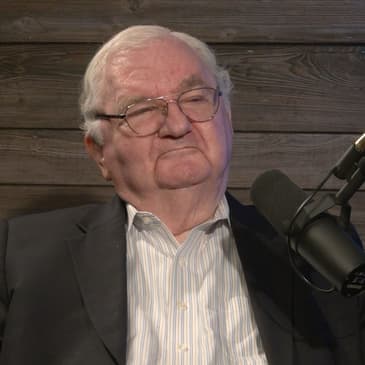
In this second part of The Jenny Beth Show with Morton Blackwell, President of The Leadership Institute, Blackwell reflects on his time working in the Reagan administration and the importance of conservative leadership in American politics. He shares his experiences leading the National Youth Effort for Reagan, his work as a Special Assistant to the President, and his efforts to place true conservatives in key positions within the administration. Blackwell discusses the critical role of personnel in shaping policy, the continued fight for traditional values, and the importance of empowering the next generation of conservative leaders.
Twitter/X: @MortonBlackwell | @LeadershipInst | @jennybethm
Website: www.leadershipinstitute.org
[00:00:00] There's no question that there was a general feeling that the country was falling apart under Carter. But there were constant reassurances that Reagan really understood what was necessary to be done in this country.
[00:00:20] Keeping our Republic is on the line, and it requires patriots with great passion, dedication, and eternal vigilance to preserve our freedoms.
[00:00:28] Jenny Beth Martin is the co-founder of Tea Party Patriots. She is an author, a filmmaker, and one of Time Magazine's most influential people in the world.
[00:00:39] But the title she is most proud of is mom to her boy-girl twins. She has been at the forefront, fighting to protect America's core principles for more than a decade. Welcome to The Jenny Beth Show.
[00:00:51] Today, I'm joined by Morton Blackwell, a man who has trained more political activists than perhaps anyone in the conservative movement.
[00:01:00] As the founder and president of the Leadership Institute, Morton has spent decades equipping conservatives for success in politics, government, and the media.
[00:01:09] In this episode, we'll explore his experiences working in the Reagan White House and his pivotal role in fostering the next generation of conservative leaders.
[00:01:20] So Reagan went on and became president, and you worked for him in the administration.
[00:01:24] What was your job, and what was that like working for President Reagan?
[00:01:28] Well, in the Reagan campaign in 1980, after the New Hampshire primary, Reagan put in a new campaign manager, a man named Bill Casey, who later on wound up CIA director.
[00:01:44] Wonderful guy. I knew him slightly.
[00:01:48] I was on the Senate staff at the time working for Senator Gordon Humphrey of New Hampshire, and I'm sitting there at the desk in the winter of 1980, after the New Hampshire primary, which Reagan won.
[00:02:03] And Bill Casey calls me. He had a unique voice. When he opened his mouth, I knew who it was.
[00:02:10] And he says, Morton, everybody tells me that you're the one who should run the national youth effort for Reagan. Would you be interested?
[00:02:19] And I could hardly believe this. And I said, of course I would be interested.
[00:02:25] And my boss is a big Reagan supporter, and I can do this as a volunteer in my spare time.
[00:02:32] And he said, well, put together a plan and give me a budget and present it to me.
[00:02:37] And so we put together a written plan with budget and program description and timetable.
[00:02:48] And he looked at it, and he approved it, and eventually we did it.
[00:02:52] We did five training schools around the country, trained 300 people.
[00:02:58] We were looking for 30 field reps to put into targeted states to build a youth effort.
[00:03:12] And we hired 30 of those 75 we found out of the 300 we thought would be competent.
[00:03:21] And then we began hiring them, and we wound up hiring 30 of the best ones.
[00:03:26] And we did a mass-based youth effort, particularly in targeted states.
[00:03:31] And I say immodestly there's never been a Republican youth effort at the national level that was as successful as that.
[00:03:41] And so my intention was to leave the Senate staff and go out and be full-time head of my leadership institute in early 81.
[00:03:53] And who were you working for in the Senate at the time?
[00:03:55] Senator Gordon Humphrey of New Hampshire, a wonderful conservative who served two terms in the U.S. Senate.
[00:04:03] And then after the election, the senator detailed me to work in the office of the president-elect.
[00:04:14] So I was in the personnel office of President-elect Reagan and struggling hard to get as many Reaganites as possible into government.
[00:04:25] And that was not easy because the Republicans who had the nicest resumes were people who had served in the Gerald Ford administration or in the Nixon administration.
[00:04:36] And here's an interesting fact.
[00:04:39] We were able to identify just one Republican who had had a position in a previous Republican administration as high as assistant secretary.
[00:04:53] Only one of them had supported Reagan for the nomination.
[00:05:00] And that was a man who had been assistant secretary of the interior, James Watt, Jim Watt.
[00:05:06] And he wanted to serve.
[00:05:08] And so he became secretary of the interior.
[00:05:11] The left just hated him, but he was a wonderful man.
[00:05:14] And I had lots of pleasure working with him.
[00:05:21] But we were struggling because the Reagan people, folks who had nominated and elected Ronald Reagan, had not had previous executive branch experience.
[00:05:35] And so it was a struggle.
[00:05:36] And there were the Reaganites and the non-Reaganites.
[00:05:41] And some of the people in the personnel department weren't conservatives.
[00:05:45] They were professional headhunters.
[00:05:47] And so it was a struggle.
[00:05:50] And I'll give you an example.
[00:05:54] I've been friends for years with a Californian named Lynn Nosticker.
[00:06:00] He had been part of Reagan's administration as governor.
[00:06:04] He was very active in the Reagan campaign to nominate and elect Reagan.
[00:06:10] Very competent guy.
[00:06:13] And he, after the election, took a vacation.
[00:06:22] And about three weeks later, he walks into the transition office, sees me, and he says,
[00:06:30] Hey, Morton, how are you doing?
[00:06:32] I said, Lynn, where have you been?
[00:06:36] We are fighting desperately to put Reaganites in the Reagan administration and all these people from previous Republican administrations,
[00:06:45] who, by the way, we called retreads.
[00:06:49] They're the ones with the beautiful resumes, and we're losing battles.
[00:06:53] And he said, Well, give me an example.
[00:06:59] And I said, Well, take the office of head of administrator of the General Services Administration.
[00:07:07] The General Services Administration operates all the federal buildings across the nation,
[00:07:14] and it's a huge operation and a big budget.
[00:07:18] There are two candidates for appointment.
[00:07:24] One of them was deputy director in the Ford administration, and he's got a beautiful resume.
[00:07:34] I said, Our candidate is Jerry Carman of New Hampshire.
[00:07:43] Lynn said, Jerry Carman?
[00:07:46] He was our chairman in the primary.
[00:07:49] He was our chairman in the general election.
[00:07:51] We owe Jerry Carman.
[00:07:53] He should get any job that he wants.
[00:07:57] You're like, Get back from vacation.
[00:07:59] What can I do?
[00:08:00] I said, Lynn.
[00:08:03] And Lynn by that time had been designated to be political director in the Reagan White House.
[00:08:09] So he was a big cheese.
[00:08:11] Right.
[00:08:11] Smart, wonderful, eccentric fellow.
[00:08:14] Lynn hated to wear neckties.
[00:08:17] And when he had to wear a necktie, he wore a Mickey Mouse necktie.
[00:08:22] And he didn't put the knot up close.
[00:08:25] He had it loose.
[00:08:27] He was a wonderful, wonderful guy.
[00:08:31] So he said, Morton, what can I do?
[00:08:33] And I said, Well, you need to sit down and write a letter to the presidential personnel director and demand that Jerry Carman get this job.
[00:08:47] And in this case, Lynn looked at me and he smiled and he said, Tell you what, Morton, you draft the letter and I'll sign it.
[00:08:57] So I drafted a letter that he could legitimately sign demanding that Jerry Carman, who was a major player in the nomination and election, get this position.
[00:09:11] And the letter was sent to the head of presidential personnel.
[00:09:16] Two days later, it was announced that Jerry Carman was going to be the head of general services administration.
[00:09:23] So there were lots of battles.
[00:09:26] So anyhow, Reagan got sworn in.
[00:09:29] The transition was over.
[00:09:31] I was still on the Senate staff, but people knew I was getting ready to resign.
[00:09:35] And I went to a reception to a friend that was held at AEI where I had worked in the early 70s.
[00:09:45] And a good friend of mine, whom I had helped get a job at AEI in the early 70s, had just been appointed to be a special assistant to the president for public liaison and to be Reagan's liaison to the business community, the trade associations, the major corporations.
[00:10:06] And my friend's name was Wayne Vallis.
[00:10:09] And we had remained friends over the years.
[00:10:12] We are now just after the inauguration in 1981.
[00:10:17] And I said, just out of curiosity, who is going to be the liaison from the Reagan White House to all the conservative groups?
[00:10:31] He says, funny you should mention that.
[00:10:33] Actually, there's never been such a job on the White House staff, but it's been decided that there will be.
[00:10:41] And I said, well, tell me who's in line for that job.
[00:10:45] And he told me the person he thought was in line for that job.
[00:10:48] And I knew this person well, a nice person.
[00:10:51] But I said, no, that person can't do the job.
[00:10:55] So it's extremely important that there be very close relations between the conservative movement and the Reagan administration, because there are lots of people in the Reagan administration who aren't conservative.
[00:11:07] And so it's got to be somebody who can help smooth the passage.
[00:11:14] And when there are frictions between administration personnel and conservative groups, somebody has got to be there to hold it all together, because it's much in the interest of conservative principles to have cultural relations between the conservative movement and the Reagan administration.
[00:11:31] And having made that little talk, I looked at him, and he looked at me, maybe 15 seconds.
[00:11:39] And I said, Wayne, what about me for that job?
[00:11:44] You'd be great, Morton.
[00:11:46] Give me your resume.
[00:11:47] I'll take it over there.
[00:11:50] Elizabeth Dole was the head of the Office of Public Law.
[00:11:53] He says, you take to me.
[00:11:55] I'll take it to Elizabeth.
[00:11:56] You'll get this job.
[00:11:57] You're the best one for it.
[00:11:58] You know all these people, et cetera.
[00:12:00] I said, Wayne, I don't have a resume.
[00:12:03] I have not had a resume for many years.
[00:12:05] Oh, no.
[00:12:05] I have not needed a resume.
[00:12:08] He says, type one up, and I'll take it over, and you'll get the job.
[00:12:13] And he took it over, and she offered me the job.
[00:12:16] And so for the first three years, I was on Reagan's White House staff as a special assistant to the president for public liaison.
[00:12:24] And they gave me the groups that I had to deal with.
[00:12:27] They gave me more groups than any other person at that level.
[00:12:30] There were six of us special assistant to the president for public liaison, one guy in charge of labor unions, et cetera.
[00:12:38] I got all the conservative groups, all the armed service veterans organizations, all the civic and fraternal clubs.
[00:12:50] The first two years, I also had all 500 federally recognized Indian tribes.
[00:12:58] And I worked there for three years, and it was a magnificent experience.
[00:13:03] And I had spent, because I'd been a Reagan alternate delegate in 68, Reagan alternate delegate in 76, Reagan delegate in 80, and I had run the national youth effort for Reagan.
[00:13:18] I'd had interactions with Reagan, but working on his staff, I had wonderful opportunities to be with him.
[00:13:27] Because every time there was a meeting by a conservative group, a veterans group, a religious group, generally it happened because I wrote out a schedule proposal, and generally I was there.
[00:13:39] So I got to interact with Reagan a lot.
[00:13:42] And just last night, I saw a preview of this new movie, Reagan, which is going to be released towards the end of the summer, I think.
[00:13:54] And it's a wonderful movie, and it captures many of the important and thrilling moments of Reagan's life, and particularly his campaigns and his presidency.
[00:14:09] It's a terrific movie.
[00:14:11] So it was a super opportunity for me to get to know that man.
[00:14:15] And I can tell you, he was famous for his wonderful, friendly appearance in public.
[00:14:20] He was just as friendly and personable in a one-on-one or three people in the room.
[00:14:31] Reagan had a remarkable opportunity, or rather a remarkable ability to say unpleasant things pleasantly.
[00:14:45] Reagan really cared about people and cared about people and how they thought of him, which was unlike Barry Goldwater, who was a tough old cowboy sort.
[00:15:01] And Goldwater didn't care if he insulted you or not.
[00:15:04] I loved him.
[00:15:05] I worked my heart out for him in 64, but Reagan really had a winning personality.
[00:15:14] It was – you had the feeling that you were in the presence of a very good man.
[00:15:21] Looking back on it now, people view him as one of the greatest presidents we've ever had.
[00:15:30] There are many people who put him on the same level or a very, very close level to George Washington and Abraham Lincoln, just one of the best presidents.
[00:15:40] Well, think about what he did, Jenny Beth.
[00:15:43] He won the Cold War, as Margaret Thatcher said, without firing a shot.
[00:15:49] And the whole Soviet Empire crumbled, and he set about to do it.
[00:15:55] It was his intention.
[00:15:56] He had previously said privately – when somebody asked, what's your theory about this Cold War?
[00:16:05] And Reagan said, my theory is we win and they lose.
[00:16:10] And he was quite serious about it and did it.
[00:16:13] So he won the Cold War.
[00:16:16] He completely turned around what was a disastrous economy and brought prosperity after making changes which led to the prosperity.
[00:16:27] He won a landslide in 1980, and he won all but one state in 1984.
[00:16:38] Just a terrific achievement.
[00:16:40] And the other thing he did, the country was, as Jimmy Carter said, suffering a malaise.
[00:16:47] And Reagan restored the vigor and enthusiasm and patriotism of Americans.
[00:16:55] I mean, that's an enormous achievement.
[00:16:57] It is.
[00:16:59] I have a couple questions to follow up on that.
[00:17:01] The first is, while you were watching all of that happen, did you realize how much greatness you were witnessing?
[00:17:09] Well, I expected it to be an extraordinary and rewarding period.
[00:17:16] I mean, I never expected that I was going to work for three years in the White House.
[00:17:26] I expected good things.
[00:17:27] So that was, I expected good things.
[00:17:32] But there were constant reassurances that Reagan really understood what was necessary to be done in this country.
[00:17:44] If you have ever gone out to the Reagan ranch, Mrs. Reagan had cleaned everything out of the ranch when Young America's Foundation bought the building.
[00:17:58] And then later she decided to return many of the things that were in the ranch.
[00:18:04] And she included the books in Reagan's library at the ranch.
[00:18:10] And the books that Reagan himself brought out to the ranch to read are there for you to see.
[00:18:17] And it's just filled with wonderful books, books that I have read, books that I have recommended.
[00:18:24] Witness by Whitaker Chambers, Road to Serfdom by Hayek, Capitalism and Freedom by Milton Friedman.
[00:18:35] I mean, just incredibly deep books.
[00:18:39] And that's, Reagan was a serious intellectual and deeply committed to conservatism.
[00:18:47] You mentioned that Carter said there was a malaise in the country.
[00:18:52] I would see right now in 2024, I don't know that there is a malaise in the country.
[00:18:58] It seems like we're pretty sharply divided.
[00:19:00] Yes.
[00:19:01] Yet I think that there is a malaise towards what America is able to accomplish.
[00:19:07] I think that on both sides of the aisle, and I don't know if I'm right about this.
[00:19:11] I'm speculating that if you looked at polling, people would wonder whether America really can be great again.
[00:19:18] Whether we not, and I'm not saying that they don't believe that with the right president that can happen.
[00:19:24] We watched it happen under Trump already.
[00:19:27] But whether it can be lasting, whether our country is going to survive.
[00:19:32] Do you see similarities between the Reagan-Carter race and now the Trump-Biden race?
[00:19:40] Well, absolutely.
[00:19:42] There's no question that there was a general feeling that the country was falling apart under Carter.
[00:19:52] There certainly is such a feeling now when you can have massive demonstrations and violence on college campuses across the country
[00:20:03] in behalf of Hamas and overt, explicit anti-Semitism on college campuses in America,
[00:20:15] considering the history of the 20th century, how anybody with his right mind would do it.
[00:20:20] And so it's worthwhile to think about how and why things have deteriorated.
[00:20:28] I recently read a new book, which was published just in April, which I strongly commend to you.
[00:20:37] The book is named Next Gen Marxism.
[00:20:43] Next Gen, G-E-N.
[00:20:46] Next Gen is Next Generation Marxism.
[00:20:50] Its authors are a guy named Mike Gonzalez, who works at Heritage,
[00:20:55] and Katie Gorka, who happens to be the wife of Sebastian Gorka.
[00:21:02] This is an exceptional book explaining what is going on,
[00:21:08] how the Marxists, which pushed all on revolution for economic reasons,
[00:21:15] and when the Soviet Union collapsed, they realized that wasn't working,
[00:21:19] and they shifted over to cultural Marxism,
[00:21:23] attacking the values of our country, the principles of our country.
[00:21:28] And this is a superb book, which I commend to anybody who wants to understand what is going on,
[00:21:35] how it is possible that the country has been sufficiently infiltrated
[00:21:43] and organized by people who know exactly what they're doing
[00:21:47] and are trying to undermine the country,
[00:21:49] and it's possible for them to use what they already have on the ground
[00:21:55] and generate riots at any time or place they want, including at the national level.
[00:22:01] And it's a superb thing.
[00:22:04] And exposure of that is going to make it less attractive to their targets.
[00:22:11] Yes, it will.
[00:22:15] I've got to read that book.
[00:22:17] I interviewed Mike Gonzalez for my podcast related to patents and patent rights.
[00:22:24] And in that interview, we wound up talking about his family coming from Cuba
[00:22:29] and how he just couldn't believe that here he is in America having to fight the problems
[00:22:36] that his family had to fight in Cuba.
[00:22:39] And...
[00:22:40] Jenny Beth, when we finish this conversation,
[00:22:42] let's go up to my office and I will present you with a copy of this book.
[00:22:46] I would love that.
[00:22:47] I want to read it.
[00:22:50] Reagan had a message of optimism and hope in what America could be.
[00:22:56] Do you see similarities between that kind of messaging
[00:22:59] and the messaging that Trump is offering?
[00:23:03] Well, I think as a practical matter,
[00:23:05] anybody who sees how Trump performed as president,
[00:23:10] I mean, there are lots of people who are not charmed by Trump's personality,
[00:23:15] but if you look at what happened in this country,
[00:23:19] what happened economically, what happened in foreign policy,
[00:23:24] Trump had a remarkable record of success as president.
[00:23:30] And I think there's no reason to think that he would not continue
[00:23:38] the thrust that he had in his first term.
[00:23:41] And when you...
[00:23:42] I mean, Reagan asked the famous question in the 80 campaign,
[00:23:47] asked the public,
[00:23:49] are you better off now than you were four years ago?
[00:23:52] And the answer at the end of the Carter administration
[00:23:55] was perfectly obvious that we were worse off under Carter.
[00:24:01] That question is answered even more emphatically
[00:24:05] if Trump asks it to the public, and I expect him to.
[00:24:11] I do, too.
[00:24:12] I do, too.
[00:24:15] You were mentioning personnel with Reagan
[00:24:18] and the transition in personnel.
[00:24:22] And you and I have had conversations outside of the podcast
[00:24:25] about personnel, presidential personnel,
[00:24:29] especially when Trump was president.
[00:24:32] It's, I mean, why is that so important
[00:24:34] to get people who agree with the president ideologically?
[00:24:38] And I would argue that right now,
[00:24:40] even the newest, freshest Trump supporter
[00:24:45] would understand that he needs people in there
[00:24:47] who support him,
[00:24:48] given all of the weaponization of government against him.
[00:24:53] But stepping back from that,
[00:24:55] why is that so important for any president,
[00:24:59] especially conservatives in the future?
[00:25:02] Well, conservatives started out in the Goldwater era
[00:25:06] believing somehow that being right
[00:25:09] in the sense of being correct was sufficient to win.
[00:25:12] And we got a lesson from the school of hard knocks with that.
[00:25:18] When Richard Vigery and Lee Edwards
[00:25:22] and Paul Weirich and Ed Fulner and I and others,
[00:25:30] I was Vigery's assistant organizing these meetings,
[00:25:33] we spent innumerable meetings,
[00:25:38] at least once a week, sometimes twice a week.
[00:25:41] We'd meet for lunch or supper,
[00:25:43] thinking about how we could turn things around
[00:25:46] so that conservatives could win,
[00:25:48] because we sure weren't winning as conservatives
[00:25:52] in the Nixon administration.
[00:25:54] And one of the things that we came up with,
[00:25:58] and I think Richard Vigery and Ed Fulner will tell you
[00:26:03] that I'm the first one to articulate that
[00:26:05] that they ever heard.
[00:26:07] I came up with personnel is policy,
[00:26:12] that if you hire people
[00:26:15] who do not share your political philosophy,
[00:26:19] then it is almost impossible to tell them
[00:26:23] I want you to be a conservative
[00:26:25] and expect that they're going to truly be conservative
[00:26:28] and fight for conservative principles.
[00:26:30] Reagan saw this,
[00:26:31] and we figured this out in the transition.
[00:26:38] Reagan had in the personnel office of the president-elect
[00:26:43] a number of directors,
[00:26:46] each one in charge of certain departments and agencies.
[00:26:51] And early on,
[00:26:53] he came up with a file card about this big
[00:26:59] that had on it what conservatism is,
[00:27:04] the various principles.
[00:27:05] And he told the people,
[00:27:07] the associate directors of personnel,
[00:27:10] that they had to take this card
[00:27:12] and they had to carry it with them at all times
[00:27:14] because not all of those people were true conservatives
[00:27:18] and didn't really understand it.
[00:27:21] And if you don't understand it,
[00:27:23] then it's very difficult to be able to enact it.
[00:27:26] Exactly.
[00:27:27] And frankly, it's not possible.
[00:27:29] Right.
[00:27:30] Unless something happens coincidentally.
[00:27:34] Especially when it comes to conservatism and government
[00:27:37] because conservatives want different things from government
[00:27:42] than a lot of people who make a career in government.
[00:27:45] Well, the movement that nominated Barry GoWater,
[00:27:48] developed into the movement that dominated and elected Ronald Reagan.
[00:27:54] And we came up with what the basis of conservatism was.
[00:28:01] You could encompass it by saying limited government,
[00:28:06] free enterprise, strong national defense,
[00:28:10] and traditional values.
[00:28:13] And some people were stronger on one of those than others.
[00:28:17] But if you were for one of those four things,
[00:28:20] you figured out that you needed to work in concert with the other three.
[00:28:24] And there was a movement orientation, which still exists.
[00:28:29] I mean, there are fine conservative organizations out there
[00:28:33] that are still focused on those four principles.
[00:28:39] And in our organization, Tea Pretty Petriots Action,
[00:28:42] we have not been focused on all four.
[00:28:44] And one of the things we said when we first started back in 2009,
[00:28:49] so we're Tea Pretty Petriots Action.
[00:28:52] In the beginning, it was a little bit different.
[00:28:54] But no matter what, what we said was there are other groups
[00:28:58] who are doing some of these other items.
[00:29:00] And what we didn't see was a grassroots movement
[00:29:03] to support the economic and the limited spending portion.
[00:29:10] And so we focused on that because we knew
[00:29:14] that there was grassroots support for the social values.
[00:29:18] And since COVID happened and people saw what was happening
[00:29:22] in classrooms around the country,
[00:29:24] I think that they've realized we need to pay attention
[00:29:27] to a lot of the traditional values
[00:29:31] and common sense values even a lot more.
[00:29:34] Well, you think about this.
[00:29:35] In the last two years,
[00:29:39] who has come from nowhere,
[00:29:44] entirely unknown to becoming a heroine
[00:29:49] for traditional values conservatives
[00:29:54] to the point where you call her name Riley Gaines
[00:29:59] and every conservative knows who she is.
[00:30:03] I mean, for two years now,
[00:30:05] we've been sponsoring Riley Gaines' campus appearances.
[00:30:09] She has set up her Riley Gaines Center
[00:30:14] here at the Leadership Institute.
[00:30:19] And she's a remarkable person.
[00:30:21] She's very smart.
[00:30:23] She's very articulate.
[00:30:24] She's very principled.
[00:30:26] And she has marvelous charisma.
[00:30:30] But you call her name,
[00:30:32] and any conservative will know who she is
[00:30:35] and what is her main thrust.
[00:30:38] I mean, I think she's conservative across the board,
[00:30:41] but she's conservative on traditional values.
[00:30:44] And the left, I think,
[00:30:48] has in the case of this process
[00:30:54] by which biological males can claim that they're females
[00:30:57] and then demand to participate in women's sports,
[00:31:02] they started out and looked like
[00:31:04] they were going to roll over everybody.
[00:31:06] And the thing was going to end
[00:31:08] and women's sports were going to now be dominated
[00:31:10] by biological males who claimed they were females.
[00:31:17] But the reaction has been enormous.
[00:31:19] I think 20 states have passed laws
[00:31:22] that in their educational organizations,
[00:31:28] high school and college,
[00:31:29] that it's not legal for biological males to participate.
[00:31:38] And Riley Gaines, I think, is extraordinary.
[00:31:44] She draws crowds wherever she is.
[00:31:47] She's tough as nails.
[00:31:49] At one point, she was kidnapped.
[00:31:53] She was kidnapped.
[00:31:54] Yes.
[00:31:55] They demanded that she pay a ransom
[00:31:58] to get free at San Francisco State University.
[00:32:02] The left is in the process of overreaching,
[00:32:06] I think, in many ways.
[00:32:08] They made such political progress
[00:32:11] that they thought they could achieve anything.
[00:32:13] And it turns out that there are things
[00:32:16] that the American public will not stand for.
[00:32:20] Thankfully.
[00:32:21] And it's sort of that silent majority.
[00:32:25] It rears its head,
[00:32:27] sometimes in the most unexpected ways.
[00:32:31] Well, Riley now has had a number of female athletes
[00:32:38] come to contact her.
[00:32:41] Suffered the same things that she suffered.
[00:32:45] Three of them she's taken on to be surrogates for her.
[00:32:51] So next fall, not only is Riley going to go out
[00:32:55] and talk to 23 more campuses in the fall,
[00:32:58] these three people are now under training
[00:33:03] and they're going to go out
[00:33:05] and multiply the number of people
[00:33:07] who bring this matter to the public
[00:33:12] and particularly to college campuses.
[00:33:14] That's fabulous.
[00:33:16] And she's doing what you have been teaching people to do,
[00:33:19] multiply and grow.
[00:33:20] Exactly.
[00:33:21] And not just try to do it all by yourself,
[00:33:24] but make sure that you're expanding.
[00:33:26] Well, Morton, one last thing.
[00:33:28] About Reagan.
[00:33:31] What do you look back on
[00:33:33] that is one of the most memorable experiences
[00:33:36] that you had with Reagan
[00:33:37] or that you would want to remind people about Reagan?
[00:33:47] It was the evidence that came out time and time again
[00:33:54] about Reagan's way of dealing with criticism.
[00:34:03] In 1982, I came up with an idea
[00:34:07] that we would offer invitations to the White House
[00:34:13] to the 125 top leaders of religious activity in the country,
[00:34:19] the heads of all the denominations
[00:34:21] that had half a million or more,
[00:34:25] religious broadcasters, et cetera.
[00:34:27] And I came up with this idea and I said,
[00:34:30] I think I can get the leaders of the Protestant denominations,
[00:34:35] the Catholic Church, the Mormons,
[00:34:38] I can get them all here
[00:34:42] for a conference at the White House.
[00:34:45] And many of these organizations really don't like each other.
[00:34:50] And there was a possibility of sparks flying.
[00:34:54] But I came up with the idea of inviting these groups
[00:34:58] to come for a conference
[00:35:00] on the religious organizations' charitable activities.
[00:35:06] And I asked each of these groups,
[00:35:10] the heads of every denomination
[00:35:11] and the major religious broadcasters,
[00:35:14] I said, I know you all have charitable activities.
[00:35:17] Give me 125 copies of a report
[00:35:21] on your organization's charitable activities.
[00:35:25] And then we'll make up a packet
[00:35:27] and everybody can go back with a packet
[00:35:29] of the descriptions of the charitable activities
[00:35:32] of all the groups
[00:35:33] and we'll have panel discussions,
[00:35:35] we'll have lunch with the president.
[00:35:40] And that will be an attraction
[00:35:42] so that everybody will come.
[00:35:45] And people looked at it from different directions
[00:35:48] and thought, well, it might work.
[00:35:50] So they allowed me to put it together.
[00:35:53] And it worked very smoothly.
[00:35:55] There was just one sour note at it.
[00:36:02] And that was at the luncheon
[00:36:04] after Reagan gave his wonderful talk to them,
[00:36:08] they opened up questions.
[00:36:11] And the stated clerk of the largest
[00:36:17] of the Presbyterian denominations,
[00:36:21] got up and asked the only hostile question
[00:36:26] and he stood up and he said to the president,
[00:36:30] why is it that so many people believe
[00:36:33] that you don't care for the poor people?
[00:36:46] Reagan came out with a marvelous example
[00:36:52] of the kind answer that turneth away wrath.
[00:36:57] I mean, he just explained what his principles were
[00:37:01] and he did it in such a way that the guy,
[00:37:05] I think he probably felt embarrassed
[00:37:07] that he had destroyed the camaraderie
[00:37:12] which was going on in that use.
[00:37:17] Now, final thing I'll tell you,
[00:37:19] we're about to end, right?
[00:37:20] Yes, sir.
[00:37:21] Well, if I can close on this,
[00:37:25] I've come up with a list of 45 maxims
[00:37:30] about how to succeed in the public policy process.
[00:37:35] And I call it the rules of the public policy process.
[00:37:39] And it's 45 pieces of advice.
[00:37:42] And number 45 is this,
[00:37:47] pray as if it all depended on God
[00:37:49] and work as if it all depended on you.
[00:37:53] And by then I knew a lot of the heads
[00:37:56] of these religious organizations
[00:37:58] and I spent much of the day
[00:37:59] with this, that one saying on a piece of paper
[00:38:05] and went and asked each of them,
[00:38:08] do you think that this statement is theologically sound?
[00:38:16] And every one of them,
[00:38:18] from Catholic cardinal to president
[00:38:20] of the Southern Baptist Convention
[00:38:22] to the presiding bishop of the Episcopal Church,
[00:38:26] every one of them thought about it
[00:38:28] and said, yes, it's theologically sound.
[00:38:32] Well, I think that's the advice
[00:38:34] that conservatives need.
[00:38:36] We got to pray as if it all depended on God
[00:38:38] and work as if it all depended on us.
[00:38:42] That's right.
[00:38:43] That's very good advice.
[00:38:44] Yes.
[00:38:45] Morton Blackwell, thank you so much for your time today.
[00:38:48] Thank you.
[00:38:49] A real pleasure.
[00:38:50] Always a pleasure to be with you.
[00:38:51] The Jenny Beth Show
[00:38:53] is hosted by Jenny Beth Martin,
[00:38:56] produced by Kevin Mooneyham,
[00:38:57] and directed by Luke Livingston.
[00:39:00] The Jenny Beth Show
[00:39:01] is a production of Tea Party Patriots Action.
[00:39:04] For more information,
[00:39:06] visit teapartypatriots.org.
[00:39:11] If you liked this episode,
[00:39:12] let me know by hitting the like button
[00:39:14] or leaving a comment or a five-star review.
[00:39:17] And if you want to be the first to know
[00:39:19] every time we drop a new episode,
[00:39:21] be sure to subscribe
[00:39:22] and turn on notifications
[00:39:23] for whichever platform you're listening on.
[00:39:26] If you do these simple things,
[00:39:28] it will help the podcast grow,
[00:39:29] and I'd really appreciate it.
[00:39:31] Thank you so much.
[00:39:32] Thank you.