
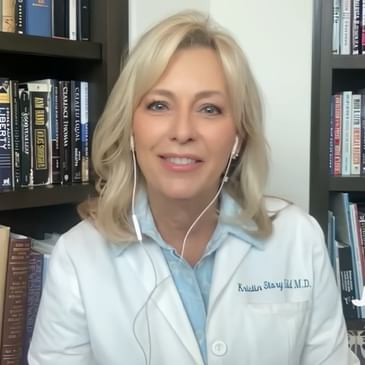
Is your healthcare really in your hands? Dr. Kris Held, a leading voice for medical freedom, exposes how government regulations and insurance bureaucracy have taken control of the healthcare system—limiting patient choice and access to care. In this eye-opening conversation, she reveals how insurance companies ration treatments, how policies like Obamacare have failed Americans, and why direct patient care is the key to restoring the doctor-patient relationship. Learn what’s at stake and how you can take back control of your health decisions.
Don't miss this must-hear discussion!
Dr. Kristin Held is an award-winning and board-certified opthamologist in San Antonio, TX. She is the past President/Director of Association of American Physicians and Surgeons (AAPS), a Senior Fellow at Independent Medical Alliance (IMA), and the Co-Chairman of Congressman Chip Roy's Healthcare Advisory Council.
[00:00:00] You can't be afraid. You know, we have to be bold and courageous. Just like you fight for any sort of freedom, we have to fight for our health care freedom. And it's, we need to remember that every day of our life. Keeping our republic is on the line, and it requires patriots with great passion, dedication, and eternal vigilance to preserve our freedoms. Jenny Beth Martin is the co-founder of Tea Party Patriots. She is an author, a filmmaker, and one of Time Magazine's most influential people in the world.
[00:00:30] But the title she is most proud of is mom to her boy-girl twins. She has been at the forefront, fighting to protect America's core principles for more than a decade. Welcome to the Jenny Beth Show. Today, I'm joined by Dr. Kris Held, who is a doctor in San Antonio, and she is the co-chairman of Congressman Chip Roy's Healthcare Advisory Council.
[00:00:53] She is a board member of the American Association of Physicians and Surgeons, and a past president of that association. And I think you're going to really enjoy this conversation. Kris, thanks so much for joining me today. Thank you, Jenny Beth. I'm so happy to be here with you, and thank you for all you do. Oh, well, it's my pleasure, and I love working with you and other freedom-oriented, doctor-patient-oriented doctors.
[00:01:18] Kris, why are you so active politically in the healthcare sphere in addition to treating patients? Jenny Beth, that's such a good question. And I really became pulled into healthcare policy back in 2009, I think, when the Tea Party Patriots formed, because it was just a shock.
[00:01:41] You know, we grew up experiencing freedom, whether it be healthcare freedom, freedom of speech, freedom of expression. And suddenly, that became in question. And so I think that just like you did and I did, I had to really sit down and evaluate what was going on with my profession. And I had been trained. I went into medicine to serve my patients, to take care of them with dignity, each individual patient.
[00:02:10] And suddenly, there was a worldview emerging, and we hit head on. There was a huge chasm of Hippocratic medicine on one side, where we do what's best for the individual patient, versus really what was, you know, 2,500 years ago, the Plato's-type medicine, where you did what was best for the good of society.
[00:02:33] And when we saw the Affordable Care Act being created, and the architects of that, like Ezekiel Emanuel, who is, you know, known as Dr. Death, he specializes in death and dying. And he wrote that infamous article in The Atlantic, Why I Hope to Die at 75, and, you know, you and your family should too, and created the complete life system of rationing, along with Don Berwick, Obama's one of his acting heads of CMS,
[00:03:03] who believed that we as doctors did too much for our patients, that government needed to step in. And in order to make things cost-effective and have more social justice in medicine, that government need to step in between the doctor and the patient. They wanted to treat this starting at medical school, and try to treat, have us treat groups, not individuals.
[00:03:26] And there were some very stark things there that, you know, when you looked at what they were doing with life, for example, insurance companies, and this happened even as early as 1977, that would say, we're not going to give you chemo for your cancer, but you can have an end of, you can have a drug to help you end your life.
[00:03:51] When they would have babies be born and let them sit on the floor until they died without providing them care. And, you know, as we remember back in the day, Obama supported that. We had to ask ourselves, what does that say about where we are going? And so I made a choice at that time to look at health care policy, fight for Hippocratic medicine and health care freedom in the United States. And that is something I will never let go of.
[00:04:20] And I think that we saw a cascade of laws. We have devolved. And I read every word of the Affordable Care Act. In fact, when that was happening, I had a group of friends and patients. We tweeted every word of it so that because people, you know, it was passed in reconciliation so that we could find out what was in it after we passed it. And it was shocking.
[00:04:46] It gave the Secretary of Health and Human Services unprecedented power and money. And it really destroyed the patient-physician relationship. You know, we all remember that convoluted chart with all of the Obamacare inner workings and regulatory capture and payoffs. And way down here, the patient. And way down here, the doctor.
[00:05:09] And what we want to do as part of Chip Roy's plan, and I'm so thankful to be a part of Texas 21 and have someone as brilliant as Chip and his staff. What we want to do is put the patient back in the center, holding the health care dollars, making their own decisions. Because no one makes decisions better for ourselves and our family than we do.
[00:05:33] And, you know, my good friend C.L. Gray, who wrote about the battle for America's soul with regard to health care freedom, reminds us that whoever pays holds the power to choose. And when insurance companies and big corporations are paying, they're choosing. And that's why in Texas right now, one out of every five claims are denied. They are denying patients rationing care.
[00:06:03] It's unethical. That's unbelievable. One out of every five claims. That's like 20% of the treatment then is denied. And so then either the patient has to figure out how to pay for it on their own or they don't get the care at all. Isn't that right? That's absolutely right. And I think there are perverse business models that exist, Jenny Beth, such that they have an automatic denial.
[00:06:29] Say, for example, you need a certain drug that your doctor has prescribed. And a prescription is a medical order, not a request. They deny it first. And then you can try to do prior authorization and all these other hurdle jumping maneuvers. And if they deny it, they found that if they deny it a second time, 70% of people just give up. Either the doctor tries to get you samples, the doctor does it for free, the patient pays for it, or they just go without.
[00:07:00] And that's what really makes me sad, Jenny Beth, is that a lot of patients just go without. Yeah, it's really quite disturbing. I, a couple, well, it's been over a decade ago, had to have two discs replaced in my neck. And the doctor wanted to do artificial discs instead of doing a fusion because he said I was just too young to do something that was going to limit my mobility.
[00:07:26] The insurance company denied it at first, and we wound up, I wound up pulling an attorney in to help write up why I should, should be approved just because I needed to have the surgery. And I wanted to make sure that I could override what the insurance company was saying. But it's insane that I had to get an attorney involved so that I could get the surgery that I, that the doctor said that I needed based on my medical history and my age.
[00:07:56] It's just, it's, it's very frustrating because they just look at formulas at the insurance company. They're not actually looking at the patient at all. So who are they to decide exactly whether I need the treatment or not? And you, who are they to decide that your patients don't need the treatment when you've gone through medical school and actually are looking at the patient and their history and making a qualified professional decision? It's crazy. It's absolutely crazy.
[00:08:25] And that just proves that coverage is not care. You know, we were mandated to have coverage. Coverage is not care. Every promise was broken. When we were told under the Affordable Care Act that the costs would go down 2,500 a year, they absolutely have not. If you look between 23 and 2017, the premiums doubled right now in the United States. The average family pays $25,000 a year for health insurance.
[00:08:49] Most people are tied to the employer, which is really sad because then when you leave your job, there's no, you can't take your insurance with you, which contributes to the preexisting condition problem. It's really a convoluted system. And that's another topic of interest, how it devolved from that. But that what you went through denying your care is just wrong. And you're forced to pay the premiums. They're not forced to deliver.
[00:09:19] So they keep the money. And they also do things like say, well, Jenny Beth, you can have your surgery, but you have to do two weeks of physical therapy first. Well, my gosh, if you're in excruciating pain and can't move, how can you do physical therapy? That's also two weeks. You're not able to work. You're not able to take care of your family. You're suffering. It is absolutely perverse. It is the equivalent of if our car insurance would, instead of saying, well, pay for your car when you total it. You know, nope, you can't get a new tire yet.
[00:09:49] Or nope, when he, you know, you can't fill with gas yet. You can't drive X amount of miles away from your home. But yet you have to pay a huge payment every month. It's unbelievable that we let that happen. And so when I, in 2015, and one of the reasons I absolutely love Association of American Physicians and Surgeons is they empower the patients and they empower physicians. It is a voice for the private physician. And our motto is all for the patient.
[00:10:17] And so in 2015, I, 10 years ago, I 100% opted out of all 30 third party agreement. Every commercial insurance and I went private contracted opted out of Medicare. I found it morally untenable to work under the rules. Like you said, when I put it right in prescription, they deny it. When I say a patient needs this MRI, they say no. That is unacceptable.
[00:10:42] So now in a direct patient care model, and five years ago, I called it eye surgeon direct. I have low costs. In fact, patients can come to me and get the same treatment outside of their insurance, less than it would cost to use their escalating deductibles and co-pays. And I'm able to immediately say, let's go do the surgery. Let's get you this medication. Let me get you right now and treat you. Let's get an MRI.
[00:11:11] Wow, we can get the MRI for $400, not the $2,500 that your insurance company has negotiated. There's a delta there. There's amount that you bill and the amount that the insurance company allows. And that is vastly different. That money, what happens to that? It's kind of like what's happening with USAID. That money is laundered to layers upon layers upon layers of third party data collectors, rationers.
[00:11:40] And all of that money does not go to patient care. It builds a corrupt system of regulatory capture and payoffs and revolving door. And boy, did we see the consequences of that government medical industrial complex with COVID. When we were denied care, mandated to have vaccines, forced to lock down. I couldn't even go to the OR.
[00:12:06] I had colleagues in Texas, even, that were threatened by the medical board for trying to take care of their patients. It doesn't even make sense. These are, it doesn't make sense. They're doctors who know how to take care of patients. There was a doctor in the middle of COVID. We, as you know, we were very active working with doctors, trying, helping them sign letters and get the letters to the White House,
[00:12:36] to members of Congress about how to reopen and the need to reopen. One of the doctors who signed the letter, we went back and did a form, a survey, and asked the doctors to fill out the survey to tell us other things that they were seeing, to try to figure out what they were seeing around the entire country to have a better understanding of what was happening. There was one doctor in Indiana who told me he was an ER doctor,
[00:13:06] and a patient came in and had cut his hand on a can, like canned food item. But because the hospitals were locked down and everyone was told, don't go to the hospital unless you have COVID or unless you're dying, he did not go in to get treated. And this is a routine treatment. It was a cut hand. He probably needed to have it cleaned out and stitches, something that would be fairly routine, but you can't do that at home. You need medical care to do it.
[00:13:35] But he did what he heard on the news, so he stayed home until it became so incredibly infected that he went to the hospital. The ER doctor saw him, had to admit him into the hospital. He actually had sepsis and died. He was only in his late 30s and left behind a wife and two children.
[00:13:58] So when the government and insurance companies make all these kind of decisions just based on the good of the whole, rather than looking at the individual patient and letting the doctor and the patient work together, there are so many unintended consequences that come from that, that it is just so completely wrong. It is so wrong, Jenny Beth. And there's so many tragic stories like that.
[00:14:27] We had a complete and total public health nightmare and disaster. During that first period of time when we shut down and, you know, it was going to be the two weeks to flatten the curve and all that, which, of course, extended. And we were not allowed to see anything but emergency patients. Well, who was deeming what was an emergency? I went into my office every day. I felt that as a physician, this was our call to the front lines. We should be in the office.
[00:14:55] This is when we take care of our patients. It's not like we go to war and our frontline militia hides under the bed. Excuse me. So I was shocked. So I went in every day and maybe I had a day where I'd see two patients, three patients. But I recall one day where a patient called and he said, Dr. Held, something's going on. I'm losing my vision. He was a little bit out of town. He said, my doctors won't see me. I don't know what to do. I said, get here.
[00:15:23] He got to my office and he was having a massive stroke. We got him to the hospital. He had a block, almost a complete total blockage in his carotid artery. He was able to have emergency surgery. We saved his vision. We saved his life. The next time I saw him a year later, he had gotten remarried. He was fine. But had he stayed at home like your patient did, he would have been dead or paralyzed and blind.
[00:15:53] And you can't be afraid. You know, we have to be bold and courageous. Just like you fight for any sort of freedom, we have to fight for our health care freedom. And we need to remember that every day of our life. And I think one of the problems has been so many physicians now are employed because of that convoluted best system. Payments are higher when you're employed by a hospital.
[00:16:18] Payments to you do the same surgery in a hospital or in your office or an ambulatory center. You're going to get paid way more in a hospital. So the hospitals go by practices. So now it used to be that physicians were all in private practice, very directly involved with their patients. Now the majority of physicians are employed by hospitals. If you're an employee, you can be fired.
[00:16:44] And when hospitals are being paid for certain diagnosis and rewarded for patients that are diagnosed with COVID, for example, or end up on a ventilator. When they get tremendous amounts more money, they're going to encourage that. And doctors that don't do that are subject to being fired. So this day and age, employed doctors have to do a certain amount of what they call conversions. Like for X amount of patients you see, so many have to have surgery.
[00:17:14] For in your clinic, patient doctors that are bought out by private equity. You better see a patient every seven minutes or you're going to be penalized. So there's that side of it. And that's no quality of care. That's no relationship. That's pulling a protocol down. And the other side of that coin is going back and then to medical education. When we used to have the MCAT, we emphasized biology, chemistry, and physics.
[00:17:43] Now they've changed it to help you try to select people based on social and behavioral sciences. So it used to be that the majority of doctors believed in God, were pro-life, loved their patients. Now, you know, I think like DEI and all sorts of things, there is ideology that they're able to choose who will matriculate in med school. And so I think that is another reason that things have changed.
[00:18:13] Also, costs have gone so up, people are in debt. And so they, as an employee, they're afraid to speak up because their livelihood is threatened. And I think one of the reasons that I was able to stand strong is that I was opted out of all the third party. I couldn't be kicked off an insurance panel or whatever because I was not employed by them.
[00:18:41] And it's all of that was created as a result of perverse health care policy. Because, again, where the money goes, that's where the power goes. And that is it's how it works with the health care system. It's how it works, as we're seeing with USAID. And it's what happens in the entire government.
[00:19:07] And it just creates a very twisted system that takes the purpose and the initial good intentions of whatever the system may be and completely perverts them. Chris, I want to go back to something that you were talking about in the beginning. And that is, well, a lot of this, I think you and I both, well, I certainly learned a lot of it from C.L. Gray.
[00:19:35] And it sounds like you may have as well, but maybe you knew it already. We did a documentary back in 2000 and maybe 10 or maybe, no, I think it was 2012, about the government takeover of health care. And we did it based on a philosophy of health care that Dr. C.L. Gray describes. And the film is called The Determinators. It's available on YouTube if people want to go and watch it.
[00:20:05] The interesting thing about the documentary that we did is that we started out explaining this philosophy about medicine, not just the government being involved, but the entire philosophy of it. And you were talking about Plato and Hippocrates, and then you were talking about how Ezekiel Emanuel once wrote the article saying that he wanted to, wants to die when he's 75 years old.
[00:20:29] And by the way, I just looked up his age and he, I think he's about 67 or so years old right now. So he doesn't have a lot longer to live. His clock's ticking, eight years. That's right. It would be interesting to see like in 10 or 12 years if he's still alive, if he actually still thinks he should have gone ahead and died. But explain what does that mean when they're pushing more of a Plato approach to health care rather than the Hippocrates approach?
[00:20:59] I understood, but the audience may not. Okay, so I want to say one thing about Ezekiel Emanuel's article. He's not saying he wants to die, but he just won't take any care because he doesn't want to consume any resources. So tying this into what you were saying, he authored the complete life system of rationing, where they take care from the very young.
[00:21:24] Because, you know, if you're five, you're not as worthy of society because you haven't been. It's going to take too many resources to get you being five, you know, to 15 where you're big and strong. And you're not really worth a lot after 40. So what they do under his model is they take all of our resources and they target them to people between the ages of 15 to 40. And because they're looking at how does this benefit society?
[00:21:53] Not how does it benefit individual patients? So the old, the sick, the disabled, the very young don't get care as opposed to Hippocratic medicine where your doctor is with you and will talk to you and do what is very best for you. Decision making that the two of you make. And it's a it's a very godly Hippocratic approach. I remember C.L. Gray so well.
[00:22:22] I love him. And that was a great, great documentary movie that y'all made. That was awesome. He always would tell the story of Peter Singer, who was the ethicist, the professor. Was he at Yale? I can't remember exactly where he was, but he actually said, you know, maybe we should not decide when life exists. You know, maybe what if it's not till a baby's 18 months old?
[00:22:50] What when is societal worth being able to decide that that's worth a life? And there were some such extreme ideology on that very far group, societal serving the common good side that it really shook you at your very core. And that's been going a long time. That's been a long game that they've played. And when we talk about the battle for America's soul, we need to bring it back to where we are.
[00:23:18] The American people are loving. We're compassionate. We help people. True charity is not compelled. If I want to take care of someone, I want to do it out of the calling within me, not because government's forcing me to or not, and forcing me to do things that are against my conscience or for the good of the government. We were really moving astray. And I feel very, very much better now that under this new administration,
[00:23:46] I'm hoping there's going to be some health care revolution and restoration. Our core principles that we were founded on as a people. And I hope that RFK Jr. gets approved today. I think he will. I think maybe that's happening. I think that I got an alert right as we were starting to record that he did make it through the United States Senate. So we now have a new Secretary of Health and Human Services.
[00:24:15] How do you feel about that? Do you think he's going to be the right man for the job? I think he's going to be the perfect man for the job because he's courageous. He understands the workings of the convoluted web of the government medical industrial complex. As an attorney, as someone who is very knowledgeable about health matters,
[00:24:40] as someone who has seen the corruption and the graft and the grift firsthand, he is going to be able to untangle it. And, you know, people who said, well, he's not a physician. You know, look who we had under President Biden. We had, you know, Becerra, Xavier Becerra. Before that, Alex Cesar. They were not physicians. They were attorneys.
[00:25:06] And Becerra was the one who, if you look way back when he was trying to sue the nuns to make them cover abortion, when he was an attorney out in California. This is the type of person we have. I think under RFK Jr., we're going to have a person that wants the best for American patients, wants us to get healthy, wants to untangle the convoluted perverse web. And remember when he said if he could do anything, he truly felt called.
[00:25:35] You know, his life was changed from being wild, crazy, addicted to really having a new, refreshed start. And he said he felt called if he could even save one child's life. There you go. And so I think that is a dramatic change. And when we talk about this collision of worldviews, I'm just so thankful where we are now. I think we've been given it a chance. I cannot imagine if we had continued down that road.
[00:26:02] One of the things with AAPS, several things that we've done is we have taken bold stances. We have taken stances for, for example, early COVID treatment when we published our early COVID treatment guide. We have taken a stance against the transgender mutilation of children under 18.
[00:26:24] We have taken a stance against vaccine mandates, against forced organ harvesting across the world. So we are being able to be bold and courageous. And, you know, we have sure taken our arrows and been demonized just like everyone. You know, that's what they do. They get on Wikipedia and they write the worst thing in the world about you. And now we know where all of this funding is coming from.
[00:26:52] It's been a propaganda war, Communist Chinese Party style. And we have just been the victims. And now I think we can stand up. And, you know, we're never done with our work. But I think there's vindication and think there's got to be justice. There can't just be words. There has to be transparency, accountability and justice so that this doesn't happen again.
[00:27:18] And with what President Trump's done coming in and saying no more gain of function and getting out of the World Health Organization, those are huge, two huge pillars that needed to be set up from day one. I'm just so thankful. Yeah, I think it is so incredible. And I'm very, very thankful. I'm thankful that the American people followed President Trump's lead and that he is president again.
[00:27:47] And the cabinet that he is appointing, they're doing amazing. The ones who've already been confirmed are already doing amazing work. And the ones who are still moving through that process, I know we're going to see amazing results from them very, very quickly. One of the things that I'm looking forward to the most about Robert Kennedy Jr. is that I don't know him well. I have met him.
[00:28:15] I'm sure he wouldn't know me from Adam. But I got to know him a little bit during the COVID situation. And then I know a lot of doctors like you who are in much closer contact and are working with him. And one of the most fascinating things to me is that he really wants to understand the data and understand how the departments and the agency itself is making the decisions.
[00:28:45] And is the data truly sound data or are there biases in it or are there things that maybe are not being made public when that goes kind of to your transparency point? The public really should know when they're going about making decisions for their health care. And I think that's tremendously important, even when it comes to, say, vaccines.
[00:29:09] It may be that when you look at the data, we see that there is a greater risk for a certain population. I have no idea. I'm just throwing that out. And I'm certainly not a doctor. But some people may think that that risk is still worth the benefit of being vaccinated. And others may not want to take on that risk.
[00:29:30] I think that that kind of decision should be made between the individual patient and their doctor who's looking at them, can see where they are physically, like looking at their body to make those kind of decisions, whether it's about vaccines or surgeries or anything else health-related.
[00:29:49] And then making the right decision for them individually rather than this whole of society approach that began, as we've been talking about, with Obama and just really came to light. Like our worst nightmares came true when COVID got here. And it wasn't that our worst nightmares came true because we have horror stories about pandemics.
[00:30:16] The worst nightmares came true because we saw total government control. We did. We saw authoritarianism, totalitarianism. And we acquiesced shockingly in a very cowardly fashion. Because at that point in time, I think we trusted our government more than we do now. They have shattered the trust.
[00:30:36] The agencies that I'm hoping that RFK will go in and just completely get to the very core of it are particularly like the CDC and the FDA. And he will. You know, the CDC has had willful blindness. We have excess death. We have all sorts of things that they have not looked at. And our perverse system has people are going to code.
[00:31:04] There was a law, remember MACRA, the Medicare Access and Chip Reauthorization Act, with MIPS, merit-based incentive payment system. So government payment models are adopted by the commercial payers. And they pay physicians and practices on a score. There was a thing called the physician composite score.
[00:31:25] And if you did what government said in, you know, for example, in their four categories of cost, quality, electronic health records and practice improvement, you would get paid Medicare plus 20%. If you didn't, you'd get paid Medicare minus 20%. So you had doctors doing the same thing, being paid a 40% differential. I'm, you know, rounding off here. Now, let's look at what you got paid for. You were a good doctor.
[00:31:54] If you got 10 points for cost, you were a good doctor if you paid zero, if you spent nothing on your patients. If you were a doctor that actually wanted to work patients up, get the labs, get an MRI, you got zero points. So I wrote a piece one time, I called it the Scarlet Zero. So the doctors that got in there, spent time with their patients, took care of them, you know, quality. They say all the blood sugars have to be less than 100.
[00:32:19] Well, if you do that, you've got a certain percent of patients that are feigning and passing out because their sugar too low. We're not robots. We're all different. So if you didn't do exactly what the government said on all of those protocols, you got a poor score, you were a bad doctor. And that is meaningless. Yet that's what people are going to strive to achieve because they want to get paid. And same thing with the hospitals.
[00:32:47] If they would code a certain way, you know, the ICD-10, the International Classification and Diagnostics, the coding ICD-10, that was another thing that I said, I'm out of here in 2015. Because you're coding and filling in blanks so that you can get paid. And so what happens is suddenly the codes have become more important than reality. What's really going on with the patients? Because people are going to code to the highest level to get paid the most.
[00:33:15] And I know of times, you know, we used to round and go see our patients. I know now sometimes interns in the hospital are relegated to coding and entering things in the computer. They're not at the bedside. And they have nurses and specialists rounding with them in the hospital to tell them how to code to the highest level to get the most money, rather than spending time talking about the patients. So that's a very, very perverse model.
[00:33:40] And I hope that those sorts of things will be dismantled because the data that we collect from that doesn't tell you anything about reality. It tells you how to get the most money for the person coding. So that is a big farce. And there's willful blindness on the part of the CDC and the FDA with drugs they're coming out with. If you look at how they've hidden vaccine adverse events and this sort of thing, that needs to all come out. And they need to look at every state.
[00:34:09] You can take, for example, the vaccine records and the death records and correlate them. How about remdesivir, people that were put in the hospital? That data is waiting there to be looked at. We should know the outcome of every single patient that got remdesivir in the hospital because that data exists because the government paid for that drug. We should know that now. That we don't is criminal. It's withholding very important information. Maybe we'll find out it was great, but maybe we'll find out it won't and we shouldn't have been mandated.
[00:34:38] So I cannot wait for him to get in there and get data that is meaningful, that will help us be better. And one of the things I love about Chip, you know, one of the things we have in common is that in the, you know, I think 2012, 2013, I don't know exactly when he was, but we were both diagnosed with cancer and went through treatment. Obviously, we're both here. We survived. We are very thankful and beholden to our doctors and nurses and our care that we received.
[00:35:06] But we also saw it from every side and we see what's happening with that. And I'm so thankful that he has taken on health care freedom and tying us back to reconciliation, you know, take us back to when they brought the Affordable Care Act in through reconciliation. We've got reconciliation going on now. And this, we have a very slim margin in the House, a very slim margin in the Senate.
[00:35:35] We are not going to get 60 votes on anything, but we could sure try to get some very important things into reconciliation. We have a few months to do this and it has to be done quickly. And he has his Health Care Freedom Act. He has his Personalized Care Act.
[00:35:53] And these are amazing, very simple and the Direct Patient Care Act, one and two page pieces that can allow us an exit ramp out of this system to choose to let patients control their medical dollars and decisions. And we're not saying, you know, if you like your Obamacare, keep your Obamacare. If you like your Medicare, keep your Medicare. If you like your Medicaid, keep your Medicare. If you like the VA, keep your...
[00:36:21] But if you want something else, there's an option. We've got to allow that to happen for the American people. Yeah, I think it is so incredibly important. And I think that if we are saying that if you like it, you can keep it, it actually is something we intend to help people do, unlike the lies we were told in 2009 and 2010 to get Obamacare passed.
[00:36:50] When it comes to the different acts that Chip Roy has, the different bills that he's trying to get passed, what is it? Do you know what is in the Health Care Freedom Act? And if you don't, it's okay. But you mentioned it. I'm just wondering if you know what... I did. Okay. I do. We've been working on this. It was introduced in the last Congress. We've been working on it for a long time. It's actually right now has a number, HR 317. What it does... Okay.
[00:37:18] So right now, we spend, in the United States of America, $4.9 trillion a year on health care. And our life expectancy has gone down. Our access to care has gone down. Our premiums have gone up. Our deductibles have gone up. It's been a nightmare. And we mentioned $25,000 a year is what families are paying on health care to go through what we've mentioned. And the current amount that you can contribute to a health savings account is like $4,000 an individual and $8,000 a family.
[00:37:46] What this does is it takes it up to... If it's going to cost your family $24,000 a year to have health coverage, this increases the ability to put in $24,000 a year into a health freedom account or a health savings account for a family or $12,000 an individual.
[00:38:05] Now, if you could do that and get the triple tax advantage like those in employer-sponsored insurance plans do, which is 180 million people in the United States get it through employee-sponsored care.
[00:38:19] If you could afford the individual American, the small mom and pop, small business owner, individuals, that same tax advantage ability to put money in a health savings account right there, we can really solve most of the problem. So you can take this money, you can put it into the health savings account, and you can use it for your premiums, for your direct patient care, for your medications. You can use it for everything.
[00:38:47] And if you're healthy that year, the next year, think about how much more you have. Then you could invest that. Your health savings account could grow. And imagine if these accounts started when you were a baby. You'd have it your entire life. You would never have the problem with portability of losing your insurance when you change jobs. You would totally eliminate the pre-existing conditions because the only thing your pre-existing condition is, is you were born. So you could make these choices. And then there would have to be competition.
[00:39:17] Because if you have your money, you're not going to go get the Affordable Care Act plan that is tremendously expensive. You're going to get another plan. Maybe you'll get a health sharing ministry. Maybe you'll do a high deductible plan. All of a sudden, now the insurance companies will have to just provide insurance, not rationing gatekeeping and coverage. So we'll get a robust offering of plans that we could take in conjunction with our health savings account. Costs will come down.
[00:39:45] Access will go up because patients will pick doctors that will communicate with them, spend more time with them, know them. It's just the beginning of a wonderful revolution putting us back in the center. And there will have to be, you're going to get, there's going to be competition for meds. Because if you can go get a generic med, why would you go pay the expensive one that, you know, United Healthcare makes you get at CVS or whatever it is. So I think that that is extremely important, that that is tax advantage. There's portability.
[00:40:13] Now, the Democrats will complain and say false things like, and it's not just the Democrats. Both parties are corrupt in this. But the only way we have to get this through is to go with Republicans and reconciliation and pray maybe some Democrats come over. But usually they stick together. But they're going to say, well, only the rich can put into a health savings account. And did you know that's not true? You know, about 70 percent of us put into it.
[00:40:39] But most people that put into a health savings account, the majority earn under $110,000 a year. And did you know the Obamacare subsidies, how expensive they are? You can get an Obamacare subsidy with family making up $600,000. Now, that's insane. Medicare, 66 million of us on Medicare. It's about to be bankrupt with all the, you know, baby boomers going on. And you can't, once you get Medicare, you can't put money in a health savings account.
[00:41:06] Congressman Roy's plan, everyone from veterans to seniors, everyone can continue to put money into a health savings account for their entire life. And wouldn't it be nice if they could be passed on generationally? Or as beloved citizens of our community, we could donate if we have people that are born into poverty. What, there's so much we could do here. Put into people's individual health savings account. Empower the individual. Empower the patient. So it's a beginning.
[00:41:36] It's very simple. And I'm really hoping that we'll get some of this maybe into the reconciliation bill. Just something, even if we can just expand that. I would say if we can expand contributions and make them for every American. No more discrimination. Yeah, I think that that's exactly how it should be.
[00:41:59] And you're right, they will say things about the access to care, which you and I both understand doesn't mean care. It means the access to coverage for people who are more poor. However, when I started fighting Obamacare, I had just come out of bankruptcy. And my then husband and I had gone through, basically we went through financial crisis. And not basically, we did.
[00:42:28] We went through financial crisis. And one of the things during that time, we had to have some sort of surgery. He had to have a surgery. And we had to work out a payment plan with the doctor. The doctor told us that because the doctor took, I don't remember if it was Medicaid or Medicare, but he was taking some, he accepted some program from the government that he could not donate the services to us.
[00:42:58] Otherwise, he would have donated the services. So he gave as much of a cash discount as he was allowed to give. And we paid it off over time. But I found that to be one of the most bizarre things in the world that because the government is getting involved, doctors who actually want to be able to donate their services to help families in need are prohibited from doing so.
[00:43:21] And it's another one of those perverse incentives that happen when the government gets involved. And then another thing that we noticed during that time, we were able to work things out with our doctors. So when we were saying that we were opposed to Obamacare and the government takeover of health care, reporters would say, well, what about the poor people? And I would say, you know, I'd go through what I had just been through in the last like 12 and 18 months.
[00:43:49] And I knew more about the health care system and what a person who isn't making as much money would experience than the reporter did. He was just kind of giving out talking points and questions that they, I guess, had memorized and they thought they were the ones they needed to say. But another thing that I found really interesting is that there are grocery store chains and eventually like Walmart and I guess Target, I'm not sure about Target, started following suit.
[00:44:17] They would offer certain generic drugs at a such a deep, deep discounted price that if you really could not afford care, you basically could either get your prescription, depending on what it was, for four or eight dollars a month. It wasn't even very much money. But the point is America's an extremely generous country. We are an extremely generous people.
[00:44:44] And when we see people in need, we don't have to be coerced by the government with the threat of the IRS taking something out of our check or jail time to be good to other people. We just genuinely step up and help take care of people. And I experienced that when I was going through my financial crisis. I'm sure that you as a doctor, I mean, you already talked about how there was a man who was having trouble and you told him to come down and he was in the middle of a stroke and you helped save his life.
[00:45:14] It seems like that that happened and the government doesn't even have to be involved at all. We just do that naturally as Americans. You know, Jenny Beth, I had to opt out of all commercial insurance and Medicare because of such a perverse policy.
[00:45:32] If I had stayed as a participating provider in Medicare, if I were to see a patient on a Medicare HMO that was not in my group or if someone had no money, I would be committing fraud if I saw that patient for free. Also, with a Medicaid patient, if I don't take Medicaid and I see the patient for free, when I write a prescription, they won't honor it. Now, with Medicare, they will.
[00:46:02] But those are two policies that should be fixed right now. Now, so because I'm not in any insurance, a patient, if they're if your deductible is five thousand and you don't have it, I can do your surgery for one thousand. If I'm in with that, if I have an agreement with that insurance company, I have to charge the five thousand.
[00:46:23] OK, so by opting out, I am able to offer direct care to the patient at less cost without facing. Federal penitentiary and fines for committing fraud. It's absolutely incredible. So I can deliver true charity care, which I love. People also have dignity, Jenny Beth. And if they can pay forty five dollars for a visit, they're so proud to do that.
[00:46:51] And so I people say, well, you can only do that because your office is in some fancy part of town. That is not true. I may have the most famous person in Texas as a patient sitting next door to a patient that walks to work or has no money or is 90 years old and can't get there. And I can care for those patients.
[00:47:18] In exactly the same fashion with the exact same type of care. And in fact, I just created the I the Century Club. I have so many patients over 100 now. I don't charge them. They're on Medicare. I charge them zero. I was going to move it down to 90, but so many people are living to be 90. I'm putting it around 95. But this other thing about medications, you know, many states have in office dispense. So physicians and I think Josh Umber with Atlas MD does such an exquisite job of explaining this and doing this.
[00:47:46] You come into your doctor and if you need Lipitor, you know, you can get your whole months of drugs as part of your DPC fee, your direct patient care fee. I could keep drops in my office like for glaucoma, five dollars a month. You come in, you see me, you leave, you pay your five dollars, you're out of there. Now, Texas of all states does not have in office dispense. We cannot do that. So Michael Garrett in 2019, this is another thing that happened with Institute for Justice.
[00:48:11] We filed a law suit against the state to allow Texas physicians to have in office dispense. Well, COVID came and it got delayed and everything. I'll tell you, I'll cut to the chase. It got appealed all the way up to the Texas Supreme Court and we lost. But had we had in office dispense during COVID, the patients could have come to our office. We could have given the meds and they could have gone home. To me, I was like, oh, this is the perfect time. They're going to prove it. Absolutely not. Instead, what did government do? Oh, no.
[00:48:41] Pharmacists need to start turning down physicians prescriptions. You know, it's a convoluted mess. So the only way in Texas we're going to get anything like that through again is every two years, bring it through the legislature. And every two years we do. And every two years, big pharma beats us down. You know, but for the states that have that, like you said, utilize direct patient care. Utilize in office dispense of your drugs. Just give us this off ramp and let us use our direct patient care dollars tax free.
[00:49:10] You know who's not insured right now, Jenny Beck? The working American between 55 and 65. Because if you own, if you're self-employed, you can't, you and your husband, how can you afford the first $25,000 of your earnings to go to insurance premiums? Not care. At least under this plan, that $25,000 would go into your health savings account. We've got to get this in.
[00:49:40] Yeah, it is such an important thing to get past. So, Chris, as we're wrapping up, when, as people are listening to this, what can they do to be involved to help the work that you were doing with Chip Roy, with Congressman Chip Roy, and also, I'm sure that you're going to be doing things that help the Trump administration and Robert Kennedy Jr. as Health and Human Services Secretary, which he's approved now.
[00:50:10] It's very exciting. Oh, so wonderful. What can people do to help out and be active? Okay, so important. People need to know, and you preach this all the time, who our representatives are. I mean, it's easy. We only have two senators, and we have one U.S. representative. So, at the federal level, you need to contact your representative and say, what are you doing about health care freedom?
[00:50:40] They need to sign on to these bills. If they are a Republican, or I don't care what they are, they need to get that through reconciliation. And we need to call them and write them. They don't even know what it is. I think there are representatives in there that don't know the difference between Medicare and Medicaid or Obamacare. And, by the way, Obamacare just put everybody on Medicaid. But they've got to contact them and get them to get going on this.
[00:51:06] And then, as far as, for example, RFK Jr., if you have had real-life experiences, and we've seen this with our eyes. I have my own brother-in-law, who's a physician, who had a huge blood clot after the COVID vaccine. These things, make sure they're reported. Report what you've seen. Report what you've lived. Don't let them hide it. Let's pursue truth at the agency level and then at the state level.
[00:51:32] Get your attorneys generals and get your governors and get your representatives to get things like in-office dispense. Fight these battles. Educate them, because we have to be educated ourselves. So then there are groups like AAPS, Association of American Physicians, that patients can join and be, you don't even have to pay dues or anything.
[00:51:58] Join as a patient or non-physician member, and you have accesses, access to where are the direct patient clinics and doctors across the country? What are the Medicare laws? What can we do? So you have to do advocacy at the community level, the state level, the federal level, and then at an organizational level. And talk to your doctors. I think that's so important.
[00:52:26] Talk to your doctors face-to-face about what they're doing and what you're doing, and that's where it starts. Very good. And I think that last point of talking to your doctors is sometimes overlooked. But if you can have that kind of conversation with your doctor, you can help them begin to become active as well. And we need more doctors who care about the doctor-patient relationships speaking up and taking action.
[00:52:54] Well, Chris, thank you so much for joining me today. I hope that everyone learned a lot. They can go check out the Determinators and check out the American Association of Physicians website, AAPS. And then where can they follow you online for more information? So I think it's super easy just to go on X. A lot of people do that. It's ChrisHeldMD, but it's at KKSHeld. But if you just put ChrisHeldMD, hopefully you get there.
[00:53:22] And I love to interact with people and share things and talk. And it's just so important, everything from just praying for one another when we're sick or injured or what to do, to sharing stories that have happened. And it's just important to connect as a people. Very good. Well, thank you so much for joining me today. And thanks for everything you are doing to help stand for a health care freedom. Thanks, Jenny Beth. Thanks for all you do.
[00:53:47] The Jenny Beth Show is hosted by Jenny Beth Martin, produced by Kevin Mooneyhan, and directed by Luke Livingston. The Jenny Beth Show is a production of Tea Party Patriots Action. For more information, visit TeaPartyPatriots.org. If you liked this episode, let me know by hitting the like button or leaving a comment or a five-star review. And if you want to be the first to know every time we drop a new episode,
[00:54:17] be sure to subscribe and turn on notifications for whichever platform you're listening on. If you do these simple things, it will help the podcast grow. And I'd really appreciate it. Thank you so much.