
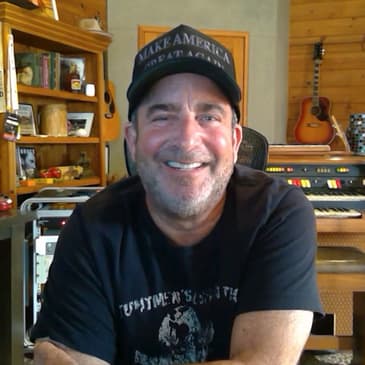
In this episode, Jenny Beth sits down with singer-songwriter Jon Kahn to talk about his hit song 'Fighter,' an anthem for resilience and patriotism inspired by the unwavering resolve of President Trump. The song went viral, was shared by President Trump on social media, and ultimately hit number 1 on iTunes and Billboard's Digital Sales Chart. Jon shares his journey as a conservative artist, the inspiration behind 'Fighter,' and his experience navigating the music industry between Los Angeles and Nashville. Discover how 'Fighter' has become a rallying cry for patriots and gain insight into Jon’s thoughts on freedom, faith, and the future of America. Listen now for an inspiring conversation.
Twitter/X: @mrjondavid | @jennybethm
Instagram: @jonkahnmusic
[00:00:00] In today's episode, I'm joined by singer-songwriter Jon Kahn, who shares the inspiring story behind his song, Fighter, a powerful anthem about the resilience and strength of President Donald Trump that went viral and topped the charts. We dive into what inspired the song, his journey as a conservative artist, and his hopes for America.
[00:00:51] And broken bones in this ring alone.
[00:01:01] I'm a fighter, doubt just yet.
[00:01:20] No cash in that last bet.
[00:01:23] Cause I hit order when I'm tired.
[00:01:28] I'm a fighter, that's what I do.
[00:01:40] I didn't soldier on this farm, just to lose.
[00:01:47] So take your shot, is that all you got?
[00:01:52] Oh, that's how just yet.
[00:02:11] Don't cash in that last bet.
[00:02:14] Cause I hit order when I'm tired.
[00:02:37] But I'm a fighter.
[00:02:47] Don't cash in that last bet.
[00:02:50] I'll just, yeah.
[00:03:15] Jon Kahn, thank you so much for joining me today.
[00:03:18] Jenny Beth, it's good to see you again.
[00:03:20] It's been a long time.
[00:03:21] It has been a long time.
[00:03:23] And since we saw each other last, you've had a number one song.
[00:03:26] How exciting is that?
[00:03:28] I know it's been kind of a crazy ride.
[00:03:30] I'm super grateful that the song has been embraced the way it has.
[00:03:34] So you have the song called fighter and president Trump tweeted about it or posted about it on X and people started downloading it.
[00:03:45] And I can see I knew about it before Trump posted it because I heard it and I was like, oh, this is great.
[00:03:52] I shared it with all my friends.
[00:03:53] But I think that Trump sending it on was much more influential than than I was.
[00:04:01] What was the inspiration behind the song?
[00:04:04] Well, the song it started.
[00:04:06] A lot of people think that the song was written after the first assassination attempt and it was a response to that.
[00:04:11] But it actually wasn't.
[00:04:13] President Trump has had more more thrown at him than any human being I've ever seen in my life.
[00:04:18] And the actual origin of the song came about when I was watching him kind of, you know, it was in response to that bogus New York trial and that bogus conviction.
[00:04:30] And I, you know, he walked up to that bank of microphones afterward and he just has that swagger about him that, you know, you can throw whatever you want at me, but nothing's going to nothing's going to faze me.
[00:04:41] And I was just sitting on the couch and I shook my head and I thought, man, what a fighter this man is.
[00:04:46] And I went over the piano, which I don't play very well, and it's out of tune and hasn't been tuned in 20 years.
[00:04:53] And I had a few chords and got a melody and a few lyrics and I took that idea to Nashville, where I was set to write with a guy named Chris Wallen, who's an amazing songwriter.
[00:05:04] He's written songs for Toby Keith and Trace Atkins and all these famous country singers.
[00:05:11] I had never worked with them before.
[00:05:12] And that's always kind of a weird thing when you go into a room in Nashville where you just don't know how you're going to vibe with somebody.
[00:05:18] And I played him the idea and he said, let's do it.
[00:05:22] And in about an hour and a half, we came out with that song.
[00:05:26] And did you have that song?
[00:05:28] Was it finished and recorded before the first assassination attempt?
[00:05:35] You know, I can't remember the exact timing.
[00:05:37] All I know is when I saw the Butler rally, as did the whole world, and saw President Trump stand up and yell fight, fight, fight with his fists in the air.
[00:05:45] I got goosebumps down my whole body.
[00:05:48] And I called Chris and said, we got to get this out because it felt very providential that we had a song called Fighter.
[00:05:53] And those were the words he said.
[00:05:56] And we either hurried up and produced it or we got it out.
[00:06:02] You know, we chose our moment.
[00:06:04] We got it out after that.
[00:06:06] Well, I'm I it really just is pretty amazing.
[00:06:11] And the song, the words are exactly the kind of man he is.
[00:06:15] We do need a fighter and he is a fighter.
[00:06:18] He fights with everything that's thrown at him.
[00:06:21] He still stands up and keeps fighting.
[00:06:23] And he's fighting for America.
[00:06:26] He wants the best for America and Americans.
[00:06:29] And it's something that I think that Americans are longing for.
[00:06:35] I know that that there are millions of Americans who are longing for that.
[00:06:40] And I hope that we find out on election night that the majority of Americans are longing for it as well.
[00:06:46] I think they are.
[00:06:48] I think it's, you know, for us, it was is not only the song, it was the video as well that accompanies the song.
[00:06:55] And it was really important for us to show President Trump in a light that the establishment media tries so hard to deny.
[00:07:02] And I think that was part of the success of why the song went so big is that I think people we kind of released at a time where people were a little bit.
[00:07:11] I wouldn't say low energy, but a little bit down and we released the song and a kind of I think reminded people not that they needed reminding, but it just was it was a weapon for them to say, hey, this is my guy.
[00:07:25] And if you don't have a platform like like yours or you don't have a platform like Breitbart, you know, people in the face of this giant gaslighting machine that we witnessed over the last few months, people are shaking their head going, what can we do?
[00:07:39] What can I share? What can because they're they're not representing things the way that they actually are.
[00:07:44] And so the video was a very important part of this and hopefully gave people a morale boost.
[00:07:50] And that's why it got shared so widely.
[00:07:53] And what did you think about how how many people watched it and how it was number one on iTunes?
[00:08:00] Did you expect that when you released it?
[00:08:02] Well, no, I mean, Jenny Beth, I've known you for a long time.
[00:08:05] I've been writing songs for a long time and, you know, I've had some songs and movies and I've had success in other ways and music as well.
[00:08:13] But, you know, when you write a song, you just kind of hope that it reaches somebody.
[00:08:17] And and if it moves one person, that's a gift for a songwriter.
[00:08:23] This one to reach this many people is sort of mind blowing for me and is very humbling.
[00:08:31] And I also realized that although President Trump inspired it and it was for him, it was for all the people fighting alongside him every single day, because that's always easy.
[00:08:41] Particularly I live in L.A. It's not easy being a Trump supporter.
[00:08:44] And even more broadly than that, you know, everybody's got their own daily battles.
[00:08:49] You know, they're fighting illness or financial problems or relationship problems or whatever it is.
[00:08:53] And I think that hopefully, you know, in a in a more broad thematic way, this song, you know, will hit people in the heart, you know, past the election.
[00:09:01] I hope that it does. And, you know, you mentioned the people like who support President Trump in L.A.
[00:09:10] and then the people who have personal personal struggles as well, who have to keep on fighting.
[00:09:16] And then there's this whole group of people who supported President Trump and stood by his side.
[00:09:21] And they've been indicted. They've had law licenses removed.
[00:09:28] They've had all sorts of attacks against them personally.
[00:09:32] And many of them are still going through those challenges and they have to be fighters as well.
[00:09:37] That's right. Well, I mean, that's that's part of the tactics of the left is intimidation.
[00:09:42] They want people they want people to get quiet.
[00:09:44] They want people to not fight.
[00:09:47] And, you know, part of my thought process behind the song is if President Trump can take two impeachments,
[00:09:54] de-platforming from social media, lawfare, raids on Mar-a-Lago, two assassination attempts, a three on one debate.
[00:10:02] I think that we can stand up and fight alongside him.
[00:10:06] That is absolutely right.
[00:10:09] John, you mentioned that you have been writing songs for a very long time.
[00:10:14] And you tell a little bit more about your background.
[00:10:19] Well, my background is probably everything it shouldn't be to be a conservative.
[00:10:25] I grew up in Los Angeles.
[00:10:26] I went to Stanford undergrad where I was a writer and I had something produced on HBO when I was still in college.
[00:10:34] And then I went to film school.
[00:10:36] I became a writer director.
[00:10:39] I directed a movie.
[00:10:40] I wrote a movie and taught myself how to play music.
[00:10:43] I went to film music later on and had some success.
[00:10:48] Like I said earlier, I got a lot of songs and film and TV.
[00:10:51] And then somehow in Los Angeles, I met Andrew Breitbart in what was a conservative speakeasy for people in the entertainment industry.
[00:11:02] It was like 2008, I think.
[00:11:05] And it was right before the Obama election.
[00:11:08] And people needed a place for fellowship because they could not espouse their political beliefs without losing work.
[00:11:17] And I made a joke or something at this first lunch and some guy with the laptop and a McCain hat came over to me and said,
[00:11:24] Hey, I'm starting this website called Big Hollywood, which is currently now our entertainment pages at Breitbart.
[00:11:31] He said, Would you write for it?
[00:11:33] I said, Not using my real name.
[00:11:34] I can't do it.
[00:11:35] And he says, Doesn't matter.
[00:11:37] Use a pseudonym.
[00:11:37] And so, I don't know if most people know this part of the story, but he said, Pitch me something.
[00:11:44] And I said, Well, I think it's got to be funny.
[00:11:46] He says, Yeah, we need funny on our side for sure.
[00:11:47] I said, What if I date liberal women on purpose and report on it?
[00:11:52] And he burst out laughing.
[00:11:53] He says, You got to do it.
[00:11:55] And so, I wrote like four or five of them.
[00:11:59] And, you know, I embellished them.
[00:12:00] But, you know, they were real dates.
[00:12:01] And they kind of were popular because nobody else was really writing that kind of material at Breitbart.
[00:12:08] And I met a girl at a Venice Beach barbecue who, when she found out I was conservative, basically started foaming at the mouth.
[00:12:17] I was like dodging spit particles when she found out.
[00:12:20] And I just asked her one question.
[00:12:22] I said, Don't you love this country?
[00:12:24] And she says, No, I don't.
[00:12:26] And I called Andrew on the way home.
[00:12:28] I said, They don't love the country.
[00:12:29] He goes, Now you got it.
[00:12:32] And I went home.
[00:12:33] And that's when I wrote American Heart, which is, I believe, the song, which is how we met.
[00:12:37] Right.
[00:12:38] On the tea party circuit.
[00:12:41] Yeah.
[00:12:42] Actually, I think that we met at the memorial for Andrew in Washington, D.C.
[00:12:47] And then you performed that song at a rally the next day in Washington, D.C.
[00:12:53] I think that it was a rally against Obamacare.
[00:12:56] Oh, no.
[00:12:56] And at the time that you released American Heart, you were still using the pseudonym, right?
[00:13:02] Yeah.
[00:13:03] Yeah.
[00:13:03] So, the way that started was, when the tea party movement started, Andrew, I think it
[00:13:10] was one of the first ones ever.
[00:13:12] It was in Quincy, Illinois.
[00:13:14] And Andrew said, Hey, I got asked to speak at a tea party.
[00:13:16] You want to come play your song?
[00:13:17] And I said, What's a tea party?
[00:13:18] He goes, I don't know.
[00:13:19] Yeah.
[00:13:20] And I mean, it was like right at the very beginning.
[00:13:21] We just didn't know how big that movement was going to become.
[00:13:25] So, I went with Andrew and played the song in a hat and sunglasses because I was still
[00:13:30] afraid of losing work if people knew I was a conservative.
[00:13:36] And so, we just went from town to town.
[00:13:38] He would speak.
[00:13:39] I would sing.
[00:13:40] And then we'd keep moving on.
[00:13:41] And it was an amazing year to be around him at that time.
[00:13:46] And then I got a call from the Wall Street Journal.
[00:13:49] And they said, Listen, we caught wind of what you're doing.
[00:13:53] And we'd like to do a front page story about you in the journal with that etch drawing,
[00:13:59] which I didn't know what that meant at the time.
[00:14:01] But all my political friends were going, They're offering you that little etch drawing?
[00:14:04] I was like, Yeah.
[00:14:04] Aren't they doing that for everybody?
[00:14:07] But they had a couple of conditions.
[00:14:09] And the conditions were I had to give them my real name.
[00:14:12] And I had to give them the name of a liberal that I was working with currently in Hollywood
[00:14:16] who didn't know I was conservative.
[00:14:18] And at that time, I was writing all the lyrics for an album, a pop singer's album that was
[00:14:26] being produced by a guy named Walter Afanasiev.
[00:14:28] He's produced Mariah Carey, Josh Groban, Barbara Streisand, Kelly Clarkson.
[00:14:34] I mean, this was somebody I had been sitting in a room with for like a year, listening to
[00:14:38] talk, listening to him talk about how bad Republicans are, how racist we are.
[00:14:43] And, you know, I wanted the work.
[00:14:45] I wanted to be on that album.
[00:14:46] And I nodded my head and said, Absolutely, they're terrible.
[00:14:51] And when push came to shove and the Wall Street Journal offered me that, you know, I talked
[00:14:57] to Steve Bannon at that time.
[00:14:58] He goes, We'll cover the Wall Street Journal.
[00:15:00] You're doing it.
[00:15:01] You got to do it.
[00:15:02] You got to do it.
[00:15:02] And so and all my friends said, Look, we got your back.
[00:15:06] And so I ended up doing it.
[00:15:08] And they interviewed him for the story.
[00:15:09] And I've never written a song with him since.
[00:15:14] Well, then you know that when you were concerned that you might lose work, that that was a real
[00:15:21] concern, wasn't it?
[00:15:23] Oh, absolutely.
[00:15:24] It's totally it's 100% accurate.
[00:15:27] But the I mean, I know people today in today's climate that are massively successful that
[00:15:31] think the way we do, who are completely and totally undercover.
[00:15:35] They have, they have Twitter handles without their real names on them, because they want
[00:15:40] to follow it.
[00:15:41] And they want to say what they want, you know, what they believe without getting, you know,
[00:15:45] some social media footprint.
[00:15:47] And and it's, it's, it's worse today than I think it was back then.
[00:15:51] Because now you've got all the DEI, you know, permeating Hollywood.
[00:15:55] And, you know, these are people that, that are so talented, and it's, it's just not a
[00:16:00] meritocracy.
[00:16:01] So if they find out that you believe the way we do, they're willing and more than willing
[00:16:07] to punish you for it.
[00:16:09] Yeah, it's pretty brutal.
[00:16:11] It seems like you have to be so big, that no matter what they do, they, they can't take
[00:16:17] you down.
[00:16:18] Or you, you have to do, if you want to be successful in the entertainment world, you
[00:16:23] have to do something sort of along the lines of what you're describing and what you, what
[00:16:27] you did.
[00:16:28] Because if you want to be in that industry, you have to still be able to get work.
[00:16:32] Otherwise, you're not in the industry.
[00:16:34] Yeah, I mean, it's interesting.
[00:16:35] It'll be interesting to see what happens after this song.
[00:16:39] You know, when I put, you know, I have an Instagram, you know, like many people do as
[00:16:43] a songwriter.
[00:16:43] It's, it's a great, it's a great tool to have.
[00:16:48] And, you know, I made a decision to post everything that happened with the song and the video and
[00:16:53] everything.
[00:16:54] And I lost a lot of LA friends and gained a lot of Nashville friends.
[00:16:58] So, you know, I don't feel in Nashville, it's a little bit more open.
[00:17:01] And, you know, there still is that, you know, when I've been there, I've been in these writer
[00:17:07] rooms with other songwriters.
[00:17:09] And there still is that dance that you have to do when you're feeling somebody out.
[00:17:14] And generally, you'll pick up on clues and you go, are you, do you lean to the right?
[00:17:19] And they go, yeah.
[00:17:20] And then all of a sudden, there's a big sigh of relief and you can talk freely.
[00:17:22] But there also is that same bias in Nashville because you see the labels are going woke too.
[00:17:28] So, you know, it's tricky business.
[00:17:30] It's always fascinating to me that this inclusive party of tolerance is so not tolerant of our side.
[00:17:39] No, they're not tolerant at all.
[00:17:41] And they're very prejudicial.
[00:17:44] They decide and they decide that everyone who thinks in a conservative manner must be all these
[00:17:53] bad things.
[00:17:54] And they just put that judgment on every single person, regardless of whether they know the
[00:18:00] person or not.
[00:18:01] They're the most prejudiced people, I think, that there are.
[00:18:05] And they're not tolerant.
[00:18:06] No, they're not.
[00:18:07] And frankly, not to get too personal, but it's really affected my dating life here in L.A.
[00:18:11] Because you can't even mention Trump.
[00:18:15] You just need to get out of L.A. and to date people.
[00:18:18] You know, I need to move to Nashville, probably.
[00:18:22] Probably.
[00:18:22] Or pretty much anywhere else other than L.A.
[00:18:25] Now, you mentioned a few minutes ago that you worked with Chris Wallen in Nashville on this
[00:18:32] song.
[00:18:33] Had you worked with other people in Nashville before on songs?
[00:18:37] And what is it like when you're working on a song?
[00:18:39] What does that mean?
[00:18:40] Well, it's so Nashville is really amazing.
[00:18:43] I've written a lot of songs.
[00:18:44] My biggest artistic outlet has been going to Nashville for a couple of weeks at a time.
[00:18:49] When I joined Breitbart after Andrew passed, part of the deal that Larry and Steve gave
[00:18:55] me when I joined up was that I could still do my artistic endeavors.
[00:18:59] And so, periodically, I'll go to Nashville.
[00:19:02] And it's kind of like a pickup basketball game.
[00:19:05] And you go into like a writer's room, a very small room.
[00:19:09] And you get to know somebody.
[00:19:10] And I like to bring in ideas because I'm an outsider.
[00:19:14] And, you know, these guys write professionally.
[00:19:17] They do it every day for a living.
[00:19:18] So, being an outsider from L.A., I like to come in with an idea or two.
[00:19:22] And then I've been fortunate enough to write with some really amazing writers, one of which
[00:19:27] is Jeffrey Steele, who kind of paved the way with these.
[00:19:32] He wrote this song called Am I the Only One with Ira Dean and Aaron Lewis that Aaron
[00:19:36] Lewis sang and went to number one.
[00:19:38] And it was a real hard-hitting, you know, Dem slamming anthem.
[00:19:42] And that was the first one of these songs that went to like Billboard number one without
[00:19:46] any radio play and just the support of the conservative movement.
[00:19:50] But, you know, every room is different depending on what kind of writers you're working with.
[00:19:54] Some, you know, it's just like you go into a room with anybody.
[00:19:56] They have different personalities.
[00:19:58] They have different writing styles.
[00:19:59] There are alpha writers.
[00:20:01] There are, you know, writers that are focused on melody.
[00:20:04] Some are focused on lyrics.
[00:20:06] But I've had amazing experiences.
[00:20:09] I mean, sometimes you hear nightmares about song.
[00:20:10] You bring in an idea in a song because a song gets ruined or something by another writer or
[00:20:15] something like that.
[00:20:16] I haven't had that experience.
[00:20:18] And, you know, it's just a really creative place, Nashville.
[00:20:21] So, I love going there.
[00:20:23] That's good.
[00:20:25] And when, after you finish, so when you're going there and you're working on songs, are
[00:20:30] you, do you have people who are playing the songs and recording them or are you just working
[00:20:36] on the lyrics and the way the music should sound?
[00:20:40] How does the process work?
[00:20:42] So, you know, I usually work with writers as opposed to artists, you know.
[00:20:47] And so writers, these guys all have publishing deals.
[00:20:50] And so the idea is they write a bunch of songs a year and they hope that bigger artists record
[00:20:55] their songs.
[00:20:55] That's how they make their money.
[00:20:58] And so for me, just to, again, to feed that creative outlet, just to write, I wasn't looking
[00:21:04] to be an artist.
[00:21:05] The ironic part of the song Fighter is that Billboard called me the number one emerging artist.
[00:21:14] And I was like, I've been emerging for a long time.
[00:21:17] And so, you know, whether, you know, I'm going to be an artist, I don't know.
[00:21:22] I mean, I've got some songs coming up.
[00:21:24] But the idea for me was to write these songs with the writers.
[00:21:28] You do a demo of the song and demos in Nashville sound like that.
[00:21:33] The musicianship is so amazing that it sounds like they can be on the radio.
[00:21:38] So then it's just a matter of publishers and finding those people that listen to it and
[00:21:43] go, oh, this might be right for so-and-so.
[00:21:45] But that's gotten very difficult because the artists now know that the money is in the
[00:21:50] writing of the song.
[00:21:51] So unless you're writing the song with the writer, it's very difficult, or with the artist,
[00:21:56] it's very difficult to get a song on someone else's record.
[00:21:59] Okay.
[00:22:00] And then is it different when you're working in LA on songs?
[00:22:06] Well, it's funny.
[00:22:07] I don't, LA doesn't have the same collaborative vibe.
[00:22:10] Like I said, Nashville is a pickup basketball game.
[00:22:13] You walk into a write and you meet somebody in the lobby and the next day you're writing
[00:22:17] with them.
[00:22:18] Or somebody says, you know what?
[00:22:19] You got a cool style.
[00:22:21] You should write with so-and-so.
[00:22:22] LA is so spread out and everybody kind of keeps everything so close to their vest that it doesn't
[00:22:27] have the same feel.
[00:22:29] So Nashville is, it's a really special place.
[00:22:33] It's a very creative energy.
[00:22:35] And, you know, that's how I, that's what I would say about that.
[00:22:39] Okay.
[00:22:40] And then I want to go back just a moment back to what you were saying about Andrew.
[00:22:47] You went around the country with him performing while he was speaking at tea party events.
[00:22:52] And I would imagine that you got to know him really well in that, that couple years time.
[00:23:01] How, tell people about Andrew who maybe didn't know Andrew.
[00:23:07] Andrew, I didn't know him.
[00:23:09] I wasn't as political as I am now.
[00:23:13] You know, I wasn't working at Breitbart.
[00:23:15] He was just somebody I met who I was intrigued by.
[00:23:17] And we became such close friends so quickly and he was just a blast.
[00:23:22] I mean, you, you spent time with him.
[00:23:23] You know how amazingly funny and insightful he was.
[00:23:27] I mean, one story that reminds, that I always laugh about is we were at an event.
[00:23:31] I think it was in St. Louis and, you know, everybody had swag.
[00:23:35] I was, I think I had CDs.
[00:23:37] I was at a table and Andrew came up to me.
[00:23:40] And again, I didn't know Andrew.
[00:23:42] I didn't look at Andrew Breitbart and go, oh my gosh, there's Andrew Breitbart.
[00:23:45] I looked at him as this goofy friend of mine who was causing trouble in the political movement in an amazing way.
[00:23:52] So he comes up to me and he goes, hey, I'm going to Starbucks.
[00:23:55] Do you want anything?
[00:23:56] And I said, yeah, I'll have a, you know, a double latte.
[00:23:59] And he walks away and some guy comes over to my table, a younger guy.
[00:24:03] And he goes, did Andrew Breitbart just take your order?
[00:24:08] And I said, yeah.
[00:24:10] He goes, that's amazing.
[00:24:11] And I burst out laughing because, I mean, he was a god to so many people.
[00:24:16] But he was so accessible and he loved people.
[00:24:20] And, you know, our joke about Andrew was, you know, he was always the last guy at the, you know, at the party.
[00:24:27] He'd be talking to a cardboard cutout if that was the last thing standing.
[00:24:31] And he just loved to be around people.
[00:24:33] He loved to meet people.
[00:24:34] He loved to connect people.
[00:24:35] You know, he was one of a kind in that, you know, if you look around today's movement, there's not, there's nobody like him in that he saw something bigger.
[00:24:46] It wasn't about his personal brand.
[00:24:48] It was about, hey, oh, this person's got a certain skill set.
[00:24:52] I should connect him with this person for the sake of the movement.
[00:24:55] And that's one thing that I admired so much about him.
[00:25:01] He just, it didn't matter.
[00:25:03] His ego wasn't involved.
[00:25:05] It wasn't about brand.
[00:25:06] It was simply about what's best for the movement.
[00:25:09] Well, he really was that way, John.
[00:25:15] He didn't sleep a lot, I suspect.
[00:25:17] And I did not sleep a lot either.
[00:25:19] And I still don't.
[00:25:22] But I remember one time we were at an event.
[00:25:25] We both were speaking at a tea party event in Dallas, Texas.
[00:25:29] And afterwards, we hung out.
[00:25:32] And my co-founder, Mark Meckler, was there.
[00:25:36] So we all were hanging out in a hotel room and like in a hotel suite.
[00:25:42] And we were just chatting all night long.
[00:25:46] And I think my flight was at 7 o'clock in the morning.
[00:25:49] So around 3.30 or 4.
[00:25:51] I'm like, OK, I better go pat my stuff up because I've got to leave for the airport shortly.
[00:25:54] But we just chatted all night long.
[00:25:57] So he really is like the last person in the room.
[00:25:59] We just kept talking and talking and talking about the country and what we needed, what
[00:26:04] we thought needed to happen and the problems with it.
[00:26:07] And then there was another time when he was supposed to speak at an event that we were
[00:26:12] hosting in Arizona.
[00:26:13] And he wound up being in the hospital.
[00:26:17] Actually, I think it had something to do with his heart when he was in the hospital.
[00:26:22] And so he couldn't he wasn't able to speak.
[00:26:25] And he was in the hospital.
[00:26:26] And so we're going on and filling in and making it work.
[00:26:29] And he calls us up on the phone to apologize while he's in the hospital.
[00:26:34] I'm like, dude, take care of yourself.
[00:26:37] Don't don't worry about about us right now.
[00:26:39] We're worried about you.
[00:26:40] But that's the kind of person that he was.
[00:26:43] He was more worried about everyone else in the event and letting people down than than
[00:26:49] taking care of of himself.
[00:26:51] I mean, I'm sure he was taking care of himself then, but he was putting others above himself
[00:26:56] is what I'm trying to say.
[00:26:57] He just was an amazing guy, an amazing friend.
[00:27:01] And you're right.
[00:27:02] His ego didn't get in the way.
[00:27:05] He to those of us who were his friend, he just there is no one like him right now.
[00:27:12] Yeah.
[00:27:13] And, you know, something you just said reminded me of I think he said this once he said, I'll
[00:27:19] take the slings and arrows so that people don't have to.
[00:27:22] And, you know, if you think about leaders and you think about even think about Andrew in
[00:27:27] relation to President Trump, like what do great leaders make people feel?
[00:27:30] And they make them feel safe no matter like Andrew didn't matter what you threw at him.
[00:27:35] He just kept fighting back.
[00:27:37] I mean, in a weird way, he was the original fighter.
[00:27:40] And it's the same thing with President Trump.
[00:27:42] It's when this is a dangerous, dangerous world.
[00:27:46] There's a lot of a lot of stuff going on.
[00:27:48] And, you know, who do you want at the helm?
[00:27:51] Somebody who who can take it all and keep swinging?
[00:27:54] I mean, for me, it's an obvious it's an obvious question.
[00:27:58] That yeah, and it is an obvious one for me as well.
[00:28:02] And I want that.
[00:28:03] I want that not just for those who support Trump.
[00:28:06] I want it for the entire country and I want it for the world.
[00:28:10] I want someone who's going to be able to say, look, I'm looking out for you, for your
[00:28:15] best interest, for the country's best interest.
[00:28:17] And reminding the rest of the world that this is a leader who takes his job seriously.
[00:28:23] Yeah, well, to your point, maybe some people don't know what's best for them.
[00:28:28] We'll see on November 5th.
[00:28:29] But I feel optimistic about it.
[00:28:33] Me too.
[00:28:34] But we'll see.
[00:28:35] And we have a lot of work to do as we're recording this.
[00:28:38] There's still two more more weeks to go.
[00:28:43] John, this song has made such an impact.
[00:28:46] And now you're an emerging artist, according to Billboard.
[00:28:49] What is next for you?
[00:28:51] Are there any projects we should be looking for?
[00:28:53] And what do you think you'll be doing next?
[00:28:55] Well, I'm really focused on getting the song and the video shared as much as possible until
[00:29:02] the election.
[00:29:03] And it's not for me, it's not about downloads.
[00:29:04] It's about sharing the video, you know, so that people can see, you know, what kind of
[00:29:09] man that they should be voting for.
[00:29:11] They're playing the song at almost like every rally for the last few weeks, which is amazing
[00:29:16] with the video.
[00:29:18] And I guess I can, I don't know when this show airs, Jenny Beth, but I am going to Arizona
[00:29:23] this week to play a rally for the first time myself.
[00:29:26] So that's pretty exciting to be part of that history.
[00:29:30] And in terms of my own musical projects, I have a song.
[00:29:34] Again, I'm not going to release anything before November.
[00:29:36] That's the only thing that matters right now.
[00:29:39] But I've been at a, as I'm an emerging artist at my age, I'm also late in discovering faith,
[00:29:45] which I've been exploring for the last couple of years.
[00:29:48] And I've got a song that I'm very excited about that probably will be my next release.
[00:29:53] Oh, I'm looking forward to hearing that.
[00:29:56] Very good.
[00:29:57] Well, you need to get out of LA and go to Nashville and meet, meet some other people
[00:30:02] who you can date, who share your values and share your faith and, and want what's best
[00:30:06] for America.
[00:30:08] Absolutely.
[00:30:09] LA is kind of broken.
[00:30:11] Bless our hearts.
[00:30:13] Yeah.
[00:30:14] Go ahead.
[00:30:15] Well, I just, I really appreciate your time today.
[00:30:18] I appreciate the fact that you have this amazing song.
[00:30:21] I'm so excited you're going to be performing at one of the rallies.
[00:30:25] And it's, isn't it kind of amazing to go full circle from the small tea party?
[00:30:30] Well, and some of the tea party events were pretty big, but to go from those tea party events
[00:30:34] to a major rally with Trump and to have a number one song.
[00:30:39] It's just, it is amazing what, how, how much we have done and how much we still have to do.
[00:30:46] Absolutely.
[00:30:46] And one, it's just one really just sentimental thing for me.
[00:30:50] And I hope this isn't too sad, but my mom passed away last year and she was, she passed away
[00:30:57] at 93.
[00:30:58] She lived an amazing life and she was a massive Trump fan.
[00:31:04] Absolutely loved him.
[00:31:05] And the day I'm playing is one year to the day, the day she died last year.
[00:31:12] So it's hard not to believe in faith when you know that on the anniversary of your mom's
[00:31:16] passing, you're going to be playing in that kind of venue.
[00:31:19] So it's, when I found that out, it kind of gave me goosebumps.
[00:31:23] Yeah, that is really amazing, John.
[00:31:25] Well, I'm going to be praying for you as you go out there that day and that you feel peace
[00:31:32] as you go out both from God and from your mom and that you give it your all so that we
[00:31:37] can help save our country.
[00:31:38] Absolutely.
[00:31:39] I appreciate that.
[00:31:41] And I'll take those graciously, those prayers.
[00:31:44] Well, thank you so much for joining me today, John.
[00:31:46] It's really great talking with you.
[00:31:49] Thanks, Jenny Beth.
[00:31:50] Thanks for having me.
[00:31:51] The Jenny Beth Show is hosted by Jenny Beth Martin, produced by Kevin Mooneyham and directed
[00:31:58] by Luke Livingston.
[00:32:00] The Jenny Beth Show is a production of Tea Party Patriots Action.
[00:32:04] For more information, visit teapartypatriots.org.
[00:32:10] If you liked this episode, let me know by hitting the like button or leaving a comment
[00:32:15] or a five-star review.
[00:32:16] And if you want to be the first to know every time we drop a new episode, be sure to subscribe
[00:32:22] and turn on notifications for whichever platform you're listening on.
[00:32:26] If you do these simple things, it will help the podcast grow and I'd really appreciate it.
[00:32:31] Thank you so much.